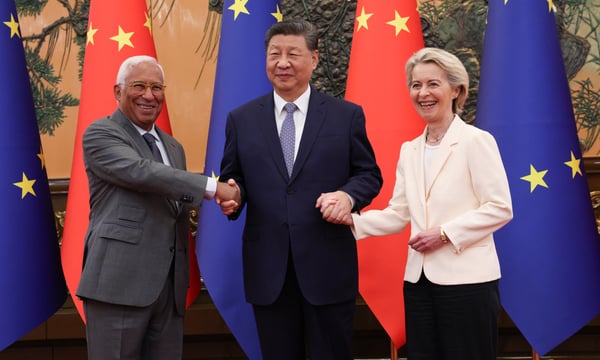
EU-China relations are being defined in two very different ways at the same time.
On June 29, during Chinese Commerce Minister Wang Wentao’s visit to Brussels, the EU and China reached a mutually agreed new definition of their economic relations – “stable and balanced key trading partners.” To give substance to the term, the two sides launched a trade and investment consultation mechanism (TIC), which consists of trade and investment balancing, export controls, intellectual property rights, and WTO reform. This new definition has since appeared multiple times in Chinese outlets and official statements, including People’s Daily, the Ministry of Commerce, and the Chinese readout of Dutch Trade Minister Sjoerd Sjoerdsma’s visit to China.
Yet almost at the same time, a much harder definition was emerging from the European security debate. In the European Council’s latest official “assessment of the EU’s strategic environment,” China is described as “a critical long-term strategic challenge,” and a “crucial enabler for Moscow” in the Ukraine conflict. This paper was endorsed by EU member states’ ambassadors on July 8 and reportedly adopted at the Foreign Affairs Council (FAC) on July 13.
The assessment is an update to the EU’s threat assessment since 2022, in which China was still characterized in line with the European Commission’s 2019 definition: “a partner for cooperation, an economic competitor and a systemic rival.”
These dynamics create a contradictory signal in today’s China-EU relationship. Economically, both sides want to stabilize and rebalance the relationship in order to prevent trade tensions from turning into a broader trade war. Strategically, however, the EU is moving toward a more explicit security framing of China, especially in the context of the Russia-Ukraine war. This situation begs the question of whether two divergent definitions of the same relationship can coexist.
The busy summer of China-EU trade negotiations showed that both sides still want to keep the economic relationship manageable. In a press conference held by the Chinese Ministry of Commerce, the spokesperson announced that the second round of TIC will be held in Beijing this fall, with EU Trade Commissioner Maroš Šefčovič expected to make the trip to China. This is just one of multiple meetings and negotiations scheduled to happen before the October deadline set by the European side for “tangible progress” on trade; vice-minister level meetings will be held in August and September.
Neither side expects a structural transformation of China’s manufacturing-based economic model. Instead, they are creating conditions to harvest lower-hanging fruit. First, China has committed to reducing the deficit by importing EU goods in Chinese government procurement or state trading, Denis Redonnet, the European Commission’s deputy director general for trade and economic security, told the European Parliament’s trade committee. A “joint monitoring mechanism” will be discussed before the end of July to monitor increases in Chinese imports into Europe.
At the member-state level, diplomatic and economic channels have also become more active. During Foreign Minister Wang Yi’s visit to Denmark, Sweden, Finland, and Norway from July 2 to 7, China emphasized partnership, political dialogue, respect for core interests, and practical cooperation. Green transition, innovation, and AI governance were presented as promising areas for future engagement. The Dutch and Chinese governments also committed to creating a favorable environment for enterprises to resolve the Nexperia dispute.
The message is clear: Even amid wider China-EU tensions, both sides are trying to ease economic friction and preserve areas of practical cooperation.
This economic and diplomatic effort, however, is paralleled by a hardening in Europe’s perception of its security environment. The war in Ukraine has deepened the divide between Europe and China, making Beijing’s relationship with Moscow a central impediment to building closer strategic and security cooperation between the two sides. The EU has targeted multiple China-based companies in sanctions related to Russia’s military-industrial complex, while China has consistently denied providing military support to Russia.
The picture is more complicated than a simple bifurcation into China-Russia versus Europe-Ukraine camps. Ukraine has reportedly been allowed to use part of a 6 billion euro EU defense-loan tranche to buy Chinese-made drone components. This exposes a paradox: China is seen as an enabler of Russia’s war economy, while European and Ukrainian defense supply chains may still utilize Chinese components.
In addition, the assessment document’s framing of China goes beyond the Russia-Ukraine context in three ways. First, it presents China as part of a wider systemic competition over global order, technology and influence. Second, it highlights China’s geoeconomic leverage, including its industrial scale, trade position, critical raw materials and selected technological advantages. Third, it links Europe’s security more directly to the Indo-Pacific, arguing that tensions in the South and East China Seas or across the Taiwan Strait could affect European security, stability and prosperity.
Can the two definitions of China-EU relations – as “stable and balanced key trading partners” and “critical long-term strategic” rivals – coexist? Tactically, yes. They can help both sides keep channels open, manage disputes, and avoid an uncontrolled spiral. Strategically, however, they cannot provide a fully coherent basis for the relationship. China wants interdependence to be seen as a source of stability, while the EU increasingly sees some forms of interdependence as sources of vulnerability.
At this stage, it remains unclear whether the Foreign Affairs Council’s description of China as “a critical long-term strategic challenge” will develop into a broader framework for defining China-EU relations, in the same way that the 2019 “partner, competitor and systemic rival” once did. However, the signal sent by the FAC could still complicate the progress recently made by the Directorate-General for Trade and Economic Security of the European Commission and China’s Ministry of Commerce. In this sense, the tension lies not only between the EU and China, but also within Brussels: while one part of the EU machinery is trying to stabilize economic relations with Beijing, another is framing China as one of Europe’s long-term security concerns.
China’s reaction to these diverging narratives will be critical in defining the near-term trajectory of China-EU ties. Beijing may choose to strategically downplay the EU’s new security framing, especially since it has not yet attracted major public attention, to keep trade negotiations on track. However, if Beijing chooses not to downplay the wording, the new definition could become a more serious source of friction and further complicate an already tense China-EU relationship.