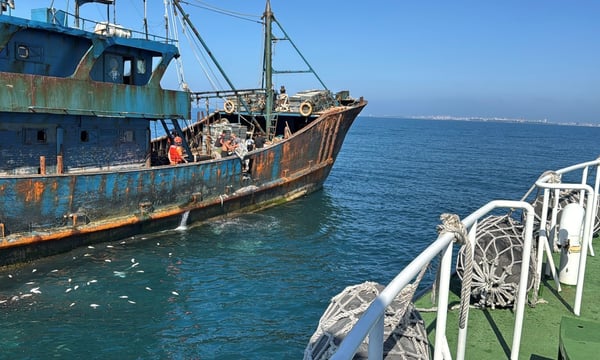
On October 1, a Chinese mainland fishing vessel came into a confrontation with a Taiwan Coast Guard vessel near the Pratas (Dongsha) Islands. After the fishing boat refused to leave the waters, the Taiwan Coast Guard vessel used a water cannon against it, eventually forcing it to leave the area.
Just one day earlier, the Taiwan Coast Guard had detained another Chinese fishing vessel near Penghu and taken control of its seven crew members.
The incident quickly attracted widespread attention on Chinese social media. Videos showing a Taiwan Coast Guard vessel spraying the Chinese fishing boat with a water cannon were widely circulated, prompting widespread criticism of what many described as the Taiwanese vessel’s heavy-handed conduct. Some commentators interpreted the incident as a deliberate provocation by Taipei on the National Day of the People’s Republic of China.
However, much of the criticism was directed not only at Taiwan, but also at the Chinese government itself. Some argued that Beijing’s repeated “concessions” toward Taiwan had encouraged Taipei to become increasingly assertive. Others even questioned whether Beijing is capable of effectively protecting Chinese fishermen. The reaction reflects the existence of a particularly hardline strand of opinion on Taiwan in mainland Chinese society, which frequently criticizes the government for being “too weak” toward Taiwan.
This challenges a narrative in which Beijing is portrayed as the main driver of coercive pressure against Taiwan, while mainland Chinese society simply passively absorbs Chinese Communist Party (CCP) propaganda about national (re)unification. In fact, in recent confrontations between Taiwan’s government vessels and civilian vessels from the mainland, Beijing has often exercised restraint and refrained from using its superior military capabilities in response.
Following the October incident, for example, the Taiwan Affairs Office of the PRC State Council merely called on Taiwan not to “use dangerous methods to treat mainland vessels and crew members in a heavy-handed manner.” Beijing has so far refrained from escalating the situation through its maritime forces.
This resembles Beijing’s handling of the February 2024 fishing boat incident near Kinmen, in which two mainland fishermen died after their vessel capsized during a confrontation with Taiwan’s Coast Guard. At the time, visible anger emerged on mainland Chinese social media. Related Weibo posts received more than 50 million views, accompanied by calls for retaliation against Taiwan. However, Beijing ultimately responded in a relatively restrained manner.
This raises an important question. Beijing has conducted repeated military drills around Taiwan in recent years, and confrontations between Chinese fishermen and the Taiwan Coast Guard might appear to provide convenient opportunities to demonstrate Chinese military power. So why has Beijing refrained from doing so?
Beijing must strike a balance between military deterrence and the image of itself as a guarantor of peace and stability across the Taiwan Strait. A forceful response to Taiwan might satisfy public anger in the short term, but it could also reinforce Taiwanese society’s perception of the mainland as a security threat over the longer term.
Beijing frequently uses military exercises as a signal to Taipei and the international community of its determination to safeguard national unity. However, although Beijing continues to insist that such activities are directed only at the Democratic Progressive Party (DPP) and “Taiwan independence separatist forces,” polling suggests that a substantial share of the Taiwanese public regards these activities as a threat to Taiwan. Against this backdrop, any retaliatory action by the China Coast Guard or the People’s Liberation Army Navy against Taiwan could be presented by Taipei as further evidence of a military threat from the mainland.
Therefore, it is necessary for Beijing to calibrate the use of force carefully, lest coercive measures produce the opposite of their intended effect and undermine the credibility of deterrence. This may help explain why incidents such as fishing boat confrontations are not necessarily regarded in Beijing as occasions warranting a military response.
However, growing public dissatisfaction with Taiwan in mainland China could push cross-strait relations into a more dangerous direction. It could transform tensions between the CCP and the DPP into a broader conflict between two societies across the Taiwan Strait. Although direct interaction between people on the two sides has declined substantially since 2016, the remaining interpersonal, economic, and cultural ties between the two societies continue to play an important role in preserving peace across the strait.
A recent poll found that mainland respondents still held broadly positive attitudes toward Taiwan. Their average feeling toward Taiwan rose from 57 points in 2025 to 61 points in 2026, on a 100-point scale. At the same time, 38 percent agreed that force should never be used to achieve (re)unification under any circumstances, while 47 percent disagreed. When asked what measures could be taken if Taiwan formally declared independence, 81 percent supported “limited military operations on offshore islands,” but only 32 percent supported “a full-scale military attack.”
When asked why (re)unification between the mainland and Taiwan was important, 71 percent pointed to the two sides’ shared cultural heritage. These findings reveal an important ambivalence in mainland Chinese attitudes toward Taiwan: Opposition to the independence of Taiwan coexists with a sense of cultural affinity toward Taiwanese society.
Maritime confrontations, however, could cause this attitude to deteriorate, and the Chinese government itself could become an early target of public anger. For years, alongside military deterrence, Beijing has sought to improve Taiwanese attitudes toward the mainland through economic incentives and other forms of preferential treatment. However, these policies are often interpreted within mainland Chinese society as evidence of the failure of Beijing’s Taiwan strategy. These sweeteners have not persuaded Taiwanese society to move toward support for (re)unification. When PRC citizens see Taiwan’s Coast Guard forcibly enforcing its regulations against mainland fishing vessels, Beijing’s preferential policies toward Taiwan may instead be interpreted as a betrayal of the interests of the Chinese people. Beijing is therefore caught in a difficult position: Its restraint toward Taiwan can frustrate nationalist sentiment at home, while a more forceful response could undermine its longer-term efforts to influence Taiwanese society.
If such public sentiments continue to intensify, they could place pressure on Beijing to adopt a harder line toward Taiwan. A historical example can be found in the 2012 China-Japan dispute over the Senkaku (Diaoyu) Islands. Although Beijing initially sought to balance a demonstration of resolve toward Japan with the need to preserve Sino-Japanese relations, growing domestic demands for a tougher response contributed to pressure for escalation. After Japan proceeded with the nationalization of the islands, Beijing significantly intensified its response.
Managing the expansion of radical voices within society will therefore be important to keeping cross-strait tensions under control. However, this is not solely Beijing’s responsibility. Taiwan’s firm maritime enforcement may appear to reinforce the DPP’s longstanding hardline position toward Beijing, but its immediate effect may be felt not only by the Chinese government but also by Chinese society. Therefore, Taiwan will also need to calibrate its actions carefully to avoid turning maritime confrontations into triggers for a much broader conflict.