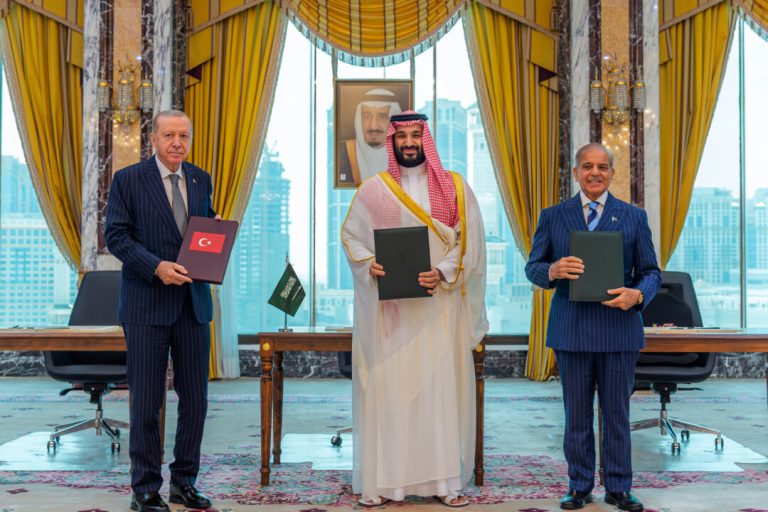
Saudi Arabia, Turkey, and Pakistan signed a defense agreement on Aug. 7, Pakistan’s Foreign Ministry said, deepening ties between three of the world’s largest Islamic powers.
The agreement was signed in Mecca, Saudi Arabia, the holiest city in Islam, during a meeting between Saudi Crown Prince Mohammed bin Salman, Turkish President Recep Tayyip Erdogan, and Pakistani Prime Minister Shehbaz Sharif.
It has been titled the Makkah (Mecca) Joint Defence Agreement and reflects “the three States’ shared commitment to further strengthening their collective security and to promoting peace, security, and stability in the region and beyond, in pursuit of a secure and prosperous future,” the Pakistani Foreign Ministry said in a statement posted on X.
“The agreement is intended to strengthen collective deterrence against any act of aggression, and stipulates that any armed attack against any one of the three states shall be regarded as an attack against them all,” the statement said, adding that it “further provides for the enhancement of all aspects of defense cooperation among the three States.”
All three nations are noted for their strong militaries, with Saudi Arabia having the largest military in the Arabian Gulf, Turkey possessing the second-largest army in NATO after the United States, and Pakistan being the only nuclear-armed Muslim nation.
The agreement’s clause stating that an attack on one of the three states shall be regarded as an attack against them all closely mirrors the language of NATO’s Article 5, which likewise obliges all signatories to come to the aid of the party that has been attacked.
It also builds on a September agreement between Riyadh and Islamabad, which also defined any attack on either country as an attack on both.
Elaborating on the agreement’s meaning, Saudi Deputy Minister for Public Diplomacy Rayed Krimly said it represents the culmination of years of negotiations, but stressed that it is purely defensive in nature.
“The Makkah Joint Defense Agreement enables the three signatory countries to develop joint defense capabilities, strengthen strategic deterrence, enhance readiness, and further develop and integrate their respective defense capabilities to jointly address any threats to their safety and security,” he said in an Aug 7 post on X.
However, Krimly added that the agreement “does not represent an effort to establish a military axis or a sectarian bloc. Nor is it linked to any nuclear ambitions or arms race, rather it is focused on building sustainable capabilities.”
He further added that it does “not come at the expense of the Kingdom’s strong and strategic relations with its Gulf, Arab, and international partners,” and “does not constitute a threat to the security of any country in the region, nor does it represent an escalation of tensions between any two states.”
This view was echoed in a similar post on X the same day by Erdogan’s head of communications, Burhanettin Duran.
Sharif arrived on Aug. 6 for a three-day visit accompanied by a high-level delegation including members of the Pakistani military.
“Although taking place against the backdrop of heightened tensions in the Gulf, the visit carries significance beyond the immediate crises and short-term considerations,” the Pakistani Foreign Ministry said in a statement announcing the start of the visit.
“It will further strengthen bilateral relations, deepen strategic cooperation, enhance coordination on regional and international issues of mutual interest, and reinforce multilateral cooperation,” the ministry added.
Middle East Turmoil
Saudi Arabia has been repeatedly struck by Iran, as well as by Tehran’s Houthi allies in Yemen and Shiite militia in Iraq, since the U.S.–Iran war began on Feb 28.
The day before the agreement was signed, a Houthi attack on southern Saudi Arabia injured 11 civilians.
Riyadh’s more than decade-long conflict with the Houthis has become increasingly entangled with the wider Iran War, particularly after the terrorist group declared a blockade of Saudi shipping through the Red Sea, further disrupting global oil supplies, which have already been strained by the Iranian blockade of the Strait of Hormuz.
Rival Reactions
The agreement between the trio of powers was criticized by Tehran, with Ebrahim Rezaei, a member of the Iranian Parliament’s National Security and Foreign Policy Commission, saying it would not bring security to Saudi Arabia in an Aug. 7 post on X.
“The Saudis should know that a paper agreement with Turkey and Pakistan will not bring them security, just as years of one-sided ‘milking’ by the Americans did not bring them security. Change your policies so that you do not have to #BegForSecurity from others,” he wrote.
Pakistan’s regional rival and fellow nuclear power, India, said it was “closely following” the development, according to the Indian news outlet Hindustan Times.
Israel, which is experiencing increasingly strained relations with Turkey over issues related to Gaza and other regional conflicts, has not yet commented on the deal.