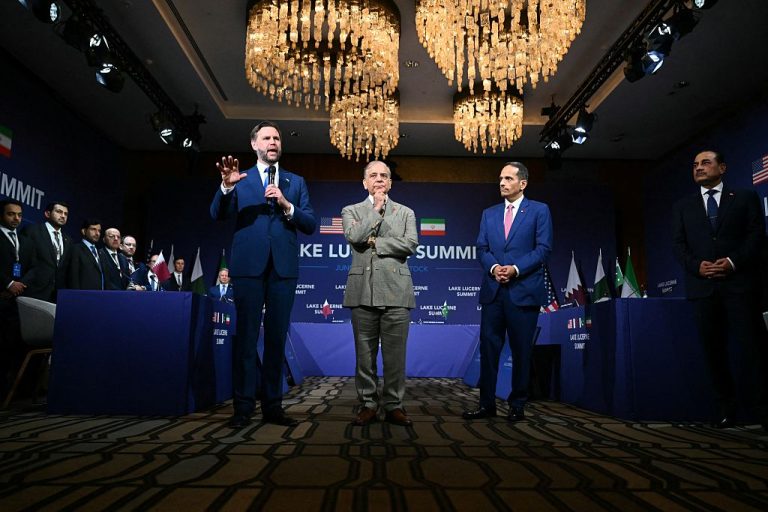

(L–R) U.S. Vice President JD Vance speaks next to Pakistani Prime Minister Shehbaz Sharif, Qatari Prime Minister Sheikh Mohammed bin Abdulrahman bin Jassim al-Thani, and Pakistani Chief of Army Staff Field Marshal Asim Munir during a quadrilateral meeting between the United States, Iran, Pakistan, and Qatar at Lake Lucerne, Switzerland, on June 21, 2026. Fabrice Coffrini / POOL / AFP via Getty Images
Pakistan’s Army Chief Field Marshal Asim Munir will travel to Iran on Monday leading an official delegation, Iran’s official news agency Islamic Republic News Agency (IRNA) reported.
Iranian Foreign Ministry spokesperson Esmail Baghaei said Munir’s visit involved Pakistan’s effort to “contribute to the reinforcement of peace and stability to the region,” according to IRNA. Munir is expected to meet and have talks with senior Iranian officials during his visit.
Pakistan has served as a mediator between the United States and Iran during the conflict. In April, Prime Minister Shehbaz Sharif and Munir urged President Donald Trump to halt planned attacks on Iran. Trump subsequently announced a two-week ceasefire, while Iran credited Pakistani officials for helping broker the agreement.
The United States and Iran signed the Islamabad Memorandum of Understanding on June 17, with Pakistan acting as a mediator and witness. The interim agreement called for a halt to military operations and set a 60-day period for negotiations toward a final agreement. It also addressed commercial passage through the Strait of Hormuz and the U.S. naval blockade of Iranian ports.
The agreement later unraveled. Trump declared the deal “over” in July amid disagreements over the Strait of Hormuz and other provisions, and Iran subsequently suspended its participation. The two countries resumed military strikes in July, and negotiations toward a permanent agreement have stalled.
Munir’s visit occurs as tensions between Washington and Tehran are again heightened. Trump said on Aug. 18 that no talks with Iran were planned, while Iran has maintained restrictions on shipping through the Strait of Hormuz.
U.S. Treasury Secretary Scott Bessent has also said the Trump administration is preparing the “toughest sanctions in history” against Iran.
Iranian officials have warned that additional U.S. economic pressure would fail and have threatened retaliation.
Trump said on Aug. 19 that the United States might resume negotiations with Iran “at some point,” a day after saying no talks were underway or scheduled.
The United States and Iran remain far apart in their dispute over the Strait of Hormuz, with neither side showing signs of making concessions.
The U.S. Navy continues to escort commercial vessels through the Omani side of the Strait of Hormuz, although the volume of traffic remains uncertain because many ships are traveling with their transponders turned off.
Maritime tracker Kpler estimates that about 300 ships have made more than 1,510 of these “dark transits” since the Navy began its escort operation in early March. Many are Very Large Crude Carriers, which are capable of transporting up to 2 million barrels of oil. The pace of the transits has increased since mid-July, with ships operating under the protection of a 20-ship U.S. Navy battle group.