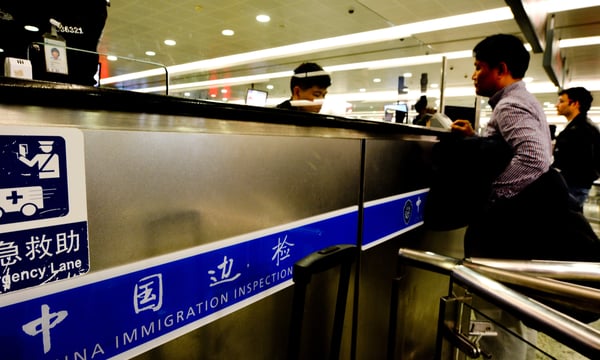
More than two months have passed since China’s new regulations on the so-called “K visa” formally took effect on October 1. Yet the frontier has been strikingly quiet. The visa category remains absent from the Chinese Visa Application Service Center’s official list, and despite official assurances that detailed implementation measures would be released through embassy and consulate websites, there has so far been no mention of the K visa on any of them.
What was billed as a significant step in China’s effort to attract global talent remains, for now, largely theoretical. For many young STEM professionals closely tracking developments around the new visa, the silence has been puzzling. Why has implementation moved so slowly?
The contrast is striking when set against China’s recent unilateral visa free policies for short-term visits such as tourism and business in parts of Europe and elsewhere since late 2023. In those cases, announcements were often made just a week in advance, with policies taking effect almost immediately.
The difference is that the K visa is much more complex. Unlike short-term visa waivers, it carries far broader implications. It touches on employment, residency, social security, and the long-term governance of foreign professionals, areas that require coordination across multiple bureaucracies. A closer parallel can be found in China’s R visa, designed for foreigners with high-level talent or specialist skills. Although announced in 2013, the R visa did not receive detailed, workable implementation rules until 2017.
China has long been cautious when it comes to immigration policy. Even the R visa, aimed largely at recruiting already established scientists, many of whom were Chinese nationals working abroad, took four years to move from policy declaration to practical application. By comparison, the K visa is more broadly defined and far more ambiguously framed. If history is any guide, it too is likely to face a long and uneven path from ambition to reality.
Many commentators have called the K visa China’s version of the H-1B in the U.S., but the comparison is misleading. The only real similarity is that both aim to attract foreign talent, and that the K visa can be seen, in part, as China’s strategic response to the United States’ tightening of H-1B rules. But the parallel ends there.
The H-1B is, at its core, a work visa that grants foreign professionals the legal right to be employed in the United States. The K visa does not. It does not confer formal work authorization in China, even for highly skilled foreign professionals. While K visa holders may engage in “relevant entrepreneurial and business activities,” longer-term employment and residence still require a transition to a standard work permit and the Z visa. In other words, the K visa functions as a preliminary status rather than an employment visa in its own right.
Seen in this light, the K visa more closely resembles post-study or job-seeking visas found elsewhere. These include the United States’ F-1 Optional Practical Training, the United Kingdom’s Post Study Work visa, and Japan’s J-FIND visa, all of which provide temporary residence for highly skilled graduates and researchers to seek employment, even without a job offer. The difference is that, in those systems, the rules are clear and the pathways well defined. For China’s K visa, that clarity has yet to emerge.
The biggest hurdle for the K visa lies in its transition to a formal work visa. If the policy aims only to facilitate exchanges rather than truly integrate foreign talent into China’s workforce, its ambition falls flat. But the challenge is not just administrative, but domestic. Since the announcement, many unemployed young people in China, already navigating an intensely competitive job market, have voiced anxiety about a potential influx of foreign tech talent, particularly from India.
The task ahead for the Chinese government, therefore, is not merely technical. It is political and social. Drawing clear boundaries around who qualifies for the K visa, under what conditions it can lead to employment – and how it complements rather than threatens domestic labor – will be essential. So, too, will be persuading the public that attracting foreign talent and protecting domestic employment are not mutually exclusive goals.
The first step is clarity. Who exactly qualifies for the K visa in terms of age and education, and how those credentials translate into real job opportunities? Equally important is making life in China navigable for young foreign talent. A system that helps foreigners overcome language barriers and adapt culturally will be crucial to the policy’s long-term success.
History offers a cautionary tale. It took four years for the R visa to move from announcement to implementation. In fast-changing fields like technology and AI, however, the K visa cannot afford such delays. While the launching of the K visa symbolizes China’s increasing openness and embrace for global talent, without efficient implementation and careful management of domestic concerns, it will remain more optics than reality.