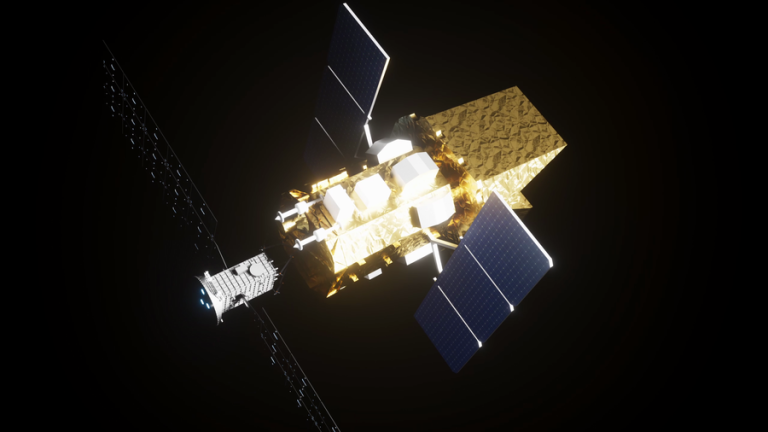

Concept art of the LINK spacecraft (L) coming in to rendezvous with NASA’s Swift observatory. Courtesy of NASA
NASA announced on Aug. 16 that it would forgo an attempt to rescue one of its observatories from falling out of orbit.
After more than 20 years of service studying gamma-ray bursts and other cosmic events, the Neil Gehrels Swift Observatory began experiencing a rapidly decaying orbit due to what NASA called “increased solar activity.”
Enter, LINK: a spacecraft built by Katalyst Space in less than a year, after being awarded a NASA contract in September 2025 to mount a robotic servicing mission and help advance U.S. spacecraft servicing technology overall.
It was launched on a Northrop Grumman Pegasus XL rocket from Kwajalein Atoll in the South Pacific Ocean on July 3. Its ambitious objectives included capturing the satellite and boosting it into a higher altitude above the Earth and further extend its usefulness.
Ground teams were able to establish communication with LINK and conducted in-orbit checkouts. However, a few weeks later, the spacecraft experienced orientation control issues that teams seemingly have been unable to overcome.
The decision was made to restrict interactions between the two spacecraft to rendezvous and proximity operations. In other words, fly LINK close to Swift and perform some maneuvers, but never actually capture its target.
Swift is expected to burn up upon reentry into Earth’s atmosphere later this year.
“We knew this was a high-risk, high-reward mission—a first-of-its kind attempt, developed on an unprecedented timeline driven by the sun’s activity,” said Shawn Domagal-Goldman, director of NASA’s Astrophysics Division. “We were all hoping for more science from Swift. But we knew the takeaways from this mission would be worthwhile either way, and we have gained so much through the series of accomplishments up to this point.”
Space agency leadership still touts sub-successes of the mission, such as being able to rally the commercial space industry to answer the call to service a satellite at such a fast pace, and provide some amount of progress toward satisfying the need for on-orbit satellite servicing that NASA has not had since the days of the Space Shuttle.
“NASA should be willing to move quickly and take smart risks when the potential return is worth it, and that is exactly what we did with this mission,” said NASA Administrator Jared Isaacman. “This is not the outcome we were working toward, but it does not change why this mission was worth attempting.
“The team moved with extraordinary speed to give Swift a chance to carry out more science while advancing capabilities America will need for satellite servicing in the future. We are going to learn everything we can from LINK’s rendezvous attempt and put those lessons to work on the missions that follow.”
NASA and its commercial partners plan to gather as much data as possible from the rendezvous to inform on future servicing missions, and continue to plan for the Swift observatory’s end of life. Other ongoing orbital missions will be utilized to fill the gaps in cosmic observations that Swift leaves behind.