CAPE CANAVERAL, Fla.— NASA officials revealed plans on Oct. 23 to return American astronauts to the lunar surface before the end of 2028 and shared more details about the Artemis Moon program’s next two missions.
NASA Administrator Jared Isaacman, NASA associate administrator Amit Kshatriya, and Artemis program manager Jeremy Parsons shared details of the proverbial path toward a lunar landing from low lunar orbit at a press conference, capped by NASA’s Artemis III and Artemis IV missions.
It will require, among other things, some of the world’s most powerful rockets in operation and coordinated efforts across multiple flight control teams for what Parsons called “likely the most complicated launch campaign ever undertaken.”
Never-done-before on-orbit refueling will also be a necessity, as well as on-orbit tests of landing craft in general, and new spacesuits for moonwalks in what will be the most challenging terrain NASA’s ever selected for a crewed landing.
After all that, Artemis IV’s entire approach to the moon will ultimately be determined by which lander is chosen for the mission.
“We are here for the mission and to deliver the outcomes the world expects of the most accomplished space agency in history,” Isaacman said during the press conference.
He channeled the spirit of NASA’s Apollo program, which launched Apollo 7—the first manned Apollo flight—and Apollo 11 in just nine months and with far less understanding of flying to the moon than is known today, and he emphasized his agency’s dedication to rebuilding a workforce daring and disciplined enough to meet the challenges.
“They should not represent the upper limits of what NASA is capable of, but the standard that we should continuously aspire to exceed,” he said of Apollo.
“Great nations do not remain great by being caretakers of history, but by continuously making history,” he said.
Here’s a look at what is to come:
Artemis III Mission Plan

NASA released a graphic outlining the three-launch mission plan of 2027’s Artemis III mission on Oct. 23, 2026. NASA
Artemis III is scheduled for the summer of 2027. It will feature three of the world’s most powerful rockets launching in succession, all from Florida’s Space Coast.
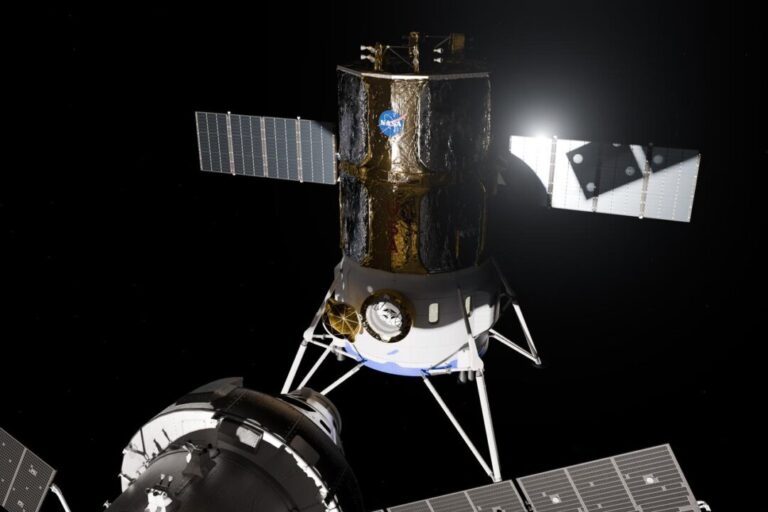
Launch 1: Blue Origin’s Blue Moon MK-2 Test Lander
First, Blue Origin’s New Glenn semi-reusable rocket will launch the test version of its MK-2 crew-capable lunar lander into low Earth orbit from Launch Complex 36 at Cape Canaveral Space Force Station.
When it goes, NASA’s Space Launch System rocket will already be on its launch pad several miles north—Launch Complex 39B at Kennedy Space Center—and NASA leaders expect it will have completed its launch-day wet dress rehearsal.
The goal is to launch Artemis III’s crew as soon as possible after Blue Origin. But Parsons said Blue Origin’s lander could stay in orbit for up to 30 days if needed.
Launch 2: NASA’s Space Launch System Moon Rocket
Once they are given the go-ahead, NASA astronauts Randy Bresnik, Frank Rubio, and Andre Douglas, and European Space Agency astronaut Luca Parmitano will become the second-ever human crew to ride the Space Launch System into space and fly the Orion spacecraft.
Parsons said NASA’s moon rocket is so powerful that the 20-story-tall core stage and its two solid rocket boosters can place the foursome into an elliptical orbit that extends as far as 1,122 miles from Earth. A special empty adapter is being built to hold the Orion spacecraft in place of a second stage.
Crew Flight Day 1–2: The crew will perform a series of maneuvers to lower the crew capsule from that elongated orbit to a circular low Earth orbit and dock with Blue Origin’s lander at about 273 miles above Earth. First, they will establish a circular orbit at about 345 miles, perform a series of spacecraft checkouts, and then drop lower.
Parsons explained that this slower transition is because the moonship will experience more intense thermal conditions in lower Earth orbit than in deep space.
Crew Flight Day 3–5: Artemis III will rendezvous and dock with Blue Origin’s lunar lander. The crew will enter the lander and, over the next two days, run a suite of checkouts and tests, from life support to flight controls.
“This one’s going to be a big one,” Parsons said. “This is where we learn how both Orion and Blue systems operate together: their guidance systems, laser navigation control, communications, all together in real-world conditions.”
“We’re going to put our mission control teams through the paces,” he added.
Launch 3: SpaceX Starship
A SpaceX Starship will then launch from Kennedy Space Center’s Launch Complex 39A into an orbit about 237 miles high. However, it will not carry the crew space or almost any other features specific to its Human Landing System variant. It will only be equipped with the docking port fitted in the nose cone.
Crew Flight Day 6: Artemis III will interact with Starship for only about two hours, with rendezvous and docking being the main objectives.
Crew Flight Day 7-12: The crew will conduct various scientific objectives and further test the spacecraft. Those objectives include completing remaining checkouts on the orange crew survival suit, conducting experiments for NASA’s Human Research Program that continue the work started by Artemis II, and observing Earth and the Sun.
“The full 14 days are packed the entire time with science, with objectives that are really each buying us down risk,” Parsons said.
Crew Flight 13–14: Artemis III begins its return home via re-entry and splashdown in the Pacific Ocean off the coast of Southern California. Mission planners are building in flexibility to let the mission last up to 17 days if needed.
Artemis IV: How to Get to the Moon
Despite the landers’ different levels of completion for Artemis III, Isaacman, Kshatriya, and Parsons said no decision has been made on which will carry Artemis IV astronauts to the lunar surface. But they each offer a different way to get there.
Blue Origin’s Path to the Moon

NASA shares a graphic outlining its plan to get Artemis IV to the lunar surface using Blue Origin’s Blue Moon MK-2 lander on Oct. 23, 2026. Screenshot/NASA
If NASA selects Blue Origin’s Blue Moon lander for Artemis IV, the crew will have to find and rendezvous with it in an elliptical polar orbit around the moon.
A chain of three transfer vehicles built off the lander’s technology will carry it from Earth orbit to that elliptical waiting point around the moon. Once Artemis IV arrives, the third transfer vehicle will use its remaining fuel to move both ships into low lunar orbit before taking the MK-2 down to the surface.
The Artemis IV crew, meanwhile, will launch atop the Space Launch System moon rocket and use a larger version of United Launch Alliance’s Centaur upper stage rocket to go from Earth to the moon. NASA leaders also told reporters that they were considering adding a “kick stage” to help Orion reach low lunar orbit on its own.
Parsons said that many of these systems will be demonstrated and tested during unmanned MK-1 lander missions starting in 2027. Those missions will also provide a better understanding of landing conditions the Artemis IV crew were likely to experience.
SpaceX’s Path to the Moon

NASA shares a graphic outlining its plan to get Artemis IV to the moon using SpaceX’s Starship on Oct. 23, 2026. Screenshot/NASA
If NASA chooses SpaceX’s Starship variant, the crew will rendezvous with it in high Earth orbit. But after launch, the lander variant must first dock with a Starship “depot” for refueling before going on to the moon. NASA officials estimate six to eight additional Starship launches will be needed to place enough fuel into orbit.
SpaceX plans to demonstrate what it calls “ship-to-ship propellant transfer” sometime in 2027.
Artemis IV will then use Starship to leave Earth Orbit and arrive in low lunar orbit, and the three NASA leaders told reporters that NASA is modifying Artemis IV’s Orion spacecraft to enable Starship’s trans-lunar push.
The Epoch Times asked Parsons how NASA and SpaceX planned to remain in contention for Artemis IV while apparently opting out of the same scale of on-orbit checkouts during the mission as Blue Origin.
He said that it was a matter of tests NASA felt SpaceX needed to conduct to sufficiently reduce outstanding risk.
The company already had years of experience with crewed spaceflight using the Dragon crew capsules, and it was integrating much of that knowledge into Starship. So its risk-reduction path would focus on a series of uncrewed test flights, including the ship-to-ship refueling demonstration and its own uncrewed lunar landing demonstration, also set for 2027.
Either way, Artemis IV is targeting a crewed landing near the moon’s south pole in 2028. Astronauts will perform at least two moonwalks in Axiom Space-built sortie suits, each lasting at least two hours.