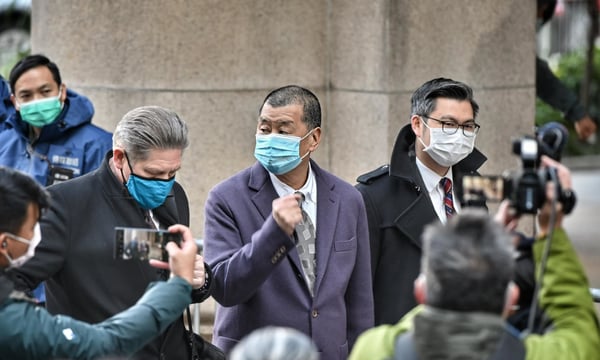
On December 15, a Hong Kong court found media tycoon Jimmy Lai guilty on all three charges in his landmark national security trial: two counts of “conspiracy to collude with foreign forces” and one count of “conspiracy to publish seditious publications.” The 78-year-old founder of the now-defunct Apple Daily newspaper, who has been detained for over 1,800 days across multiple criminal cases, faces the prospect of spending his remaining years behind bars.
The 855-page verdict caps a trial that spanned more than 150 court days across two years. Lai, whose health has reportedly deteriorated in solitary confinement, was labeled by the court as the “mastermind” behind conspiracies to undermine national security. The verdict drew extensively on Lai’s conduct before the National Security Law (NSL) took effect – even though the law supposedly does not apply retroactively. The court has blurred the distinction between non-retrospective principles and the actual consideration of facts, further eroding the reputation of Hong Kong’s courts and the rule of law.
Both Hong Kong and the Chinese authorities have long warned against “fake news” circulating about Lai’s trial and developments in the territory. Yet the Lai verdict reveals something more troubling: local courts are endorsing authorities engaged in information manipulation about Lai and Hong Kong’s pro-democracy movement. The ruling represents more than just another conviction in a city where dissent is no longer tolerated. It is a capstone in the ongoing effort to rewrite the history of Hong Kong and its pro-democracy movement – using the once-respected courts as the final word in this narrative revision.
The Toolkit of Cognitive Warfare
For years, China’s cognitive warfare against Hong Kong has operated on several fronts. First, it promotes the narrative that Hong Kong’s pro-democracy movement was merely foreign interference. This is the “mastermind” theory, portraying activists as foreign proxies rather than citizens exercising collective political agency. Second, it advances political relativism, suggesting that Chinese authoritarian governance deserves equal respect as Western liberal democracies and that authoritarian regimes deserve leadership. Third, it insists that human rights must yield to nationalistic conceptions of regime security and that the international system does not necessarily promote the established human rights norms and practices set by the United Nations.
The purpose of this warfare is clear: by influencing and manipulating the information environment and information supply China aims to eventually affect attitudes and behaviors of Hong Kongers and the Chinese people. The goal is to reshape their understanding and erode their commitment to the city’s pro-democracy movement and outstanding figures like Jimmy Lai, as well as the embedded values of universal human rights, freedom, democratic accountability, and the rule of law.
To advance this agenda, Hong Kong’s judiciary has become indispensable. Hong Kong’s courts earned a strong international reputation for decades. Instrumentalizing the judiciary to legitimize political control is a well-documented strategy in authoritarian regimes – courts leverage their credibility to endorse state-led narratives through issuing verdicts and judicial decisions, making it difficult for those who previously supported the court’s legitimacy to reject its rulings.
Since 2020, Hong Kong’s courts have served this autocratic agenda. The Court of Appeal’s injunction against “Glory to Hong Kong,” the protest anthem, compelled corporations to comply with national security imperatives – demonstrating how judicial authority can be weaponized. The subversion verdict that convicted 45 pro-democracy activists in May 2024 also showed how the courts endorse the state-led theory that lawmakers exercising their constitutional mandate to pressure the executive government for political bargaining amounts to a security crime.
Demonizing One Man, Rewriting a Movement’s History
The Lai verdict represents not merely a continuation of this judicial function but a new low. The Court of First Instance departed from political impartiality by adopting politicized language against Lai – and by extension, Hong Kong’s entire pro-democracy movement.
The verdict claims Lai’s trial is not a “trial for his political views and he is free to hold whatever views he likes on politics.” Yet its substance overwhelmingly associates his guilt with political speeches and actions. The opening paragraphs stigmatize Lai’s character with loaded language: his “rabid hatred of the CCP” (Chinese Communist Party), his “deep resentment,” his “obsession to change CCP’s values to those of the Western worlds and counterbalance China’s influence.” The court describes him as “poisoning the minds of his readers” through “venomous assertions” in the Apple Daily. The verdict traces Lai’s origins in Hong Kong – a story of displacement from mainland China shared by many Hong Kongers – to paint a picture of a man motivated by hatred rather than principle.
The 2019 pro-democracy movement – which at its height saw 2 million people take to the streets – is reduced to violence and chaos in the court verdict. The court portrays Lai as both the “mastermind” of the movement and a foreign proxy, reinforcing Beijing’s preferred narrative. Notably, none of Lai’s actions as described in the verdict was violent. The verdict even acknowledges occasions where Lai advocated for nonviolence.
Most troubling is the verdict’s treatment of post-National Security Law conduct. The court acknowledges that after the law took effect, Lai made no explicit public requests for sanctions. Yet it concludes his “implicitly disguised and subtle approach” to communications still constituted collusion. This reasoning – finding criminality in the unspoken – approaches the Chinese concept of “誅心” (punishing thoughts), criminalizing intentions rather than acts that can be proven beyond a reasonable doubt. This veers into thought crimes incompatible with freedom of conscience.
The verdict’s credibility assessments are equally troubling. Prosecution witnesses – accomplices with obvious incentives to cooperate after extended pre-trial detention and detention in the mainland – are accepted wholesale as credible. At the same time, Lai’s testimony is categorically rejected as “contradictory, inconsistent, evasive and unreliable.”
Replacing Human Rights Discourse With “Anti-West” Notions
Notably absent from the verdict is engagement with human rights jurisprudence. The decision makes no attempt to reconcile its findings with the International Covenant on Civil and Political Rights, nominally applicable in Hong Kong. Under international standards, restrictions on speech and publications must be necessary, proportionate, and prescribed by law. The vague definitions of “collusion” and “sedition” fail these tests.
What’s in the verdict instead refers to the courts’ endorsement of an anti-Western notion that the Chinese government always appreciates. In describing Lai’s intention, the court suggests that Lai “had an obsession to change CCP’s values to those of the Western worlds,” “desired to assimilate China into the Western world’s values system,” and “wanted the countries in the world to gang up and confront China against the ‘CCP Culture.” Such polarized descriptions highlighting the contrast between the CCP and the West are less helpful to address universal values of human rights protections, but rather sponsor the conventional narrative of the CCP that Western values are threats to China’s national security
The verdict’s release triggered an immediate government response. Within hours, official statements from various official agencies in Hong Kong and China cited the court’s findings to justify their usual narratives depicting Lai as a foreign agent, anti-China troublemaker, and a media mogul spreading misinformation. Calls for heavy punishment by government agencies were widely publicized – even before Lai could present his argument for mitigation.
Most of these accusations stemmed from facts that predate the promulgation of the NSL, and the verdict says they serve only as “a background.” Nevertheless, these pre-NSL facts in the verdict now endorse state-led political narratives and discourse. This rapid adoption of propaganda, followed by counterattacks against foreign media, reveals how judicial decisions now serve as ammunition in a broader information war.
How the Global Community Should Respond
The international community must approach this verdict with clear eyes. Court rulings are not sacred texts – particularly when issued under structural constraints that compromise independence. Hong Kong’s designated judge system, which allows the chief executive to select judges for national security cases, creates conditions in which impartiality cannot be achieved.
The verdict contains manipulated facts and political judgments dressed in legal language. The definitions of “collusion with foreign forces” and “hostile activities” remain vague; the court’s presentation of facts and law, rather than reasoning from legal principles, criminalizes conduct protected in any jurisdiction that embraces universal human rights values; and institutional structures ensure outcomes aligned with Beijing’s preferences.
Jimmy Lai’s conviction is not merely a personal tragedy for a man who may die in prison. It declares that in today’s Hong Kong, voices of political dissent will be criminalized, international engagement seeking accountability for the domestic government will be punished, and courts will be deployed to endorse manipulated information and legitimize repression.
Beijing and its proxies have long portrayed Lai as a criminal; now they have a judicial stamp to cite. The global community must recognize this verdict for what it is: not a milestone of justice or common law jurisprudence, but cognitive warfare by judicial means.