As rescue efforts have continued on both sides of the border following the devastating floods in Nepal and Tibet, a fight over how the disaster is being reported has been growing in intensity on social media. The dispute centers on the claims and counterclaims following a story by the BBC’s China correspondent, Laura Bicker, about how China is censoring videos of the floods.
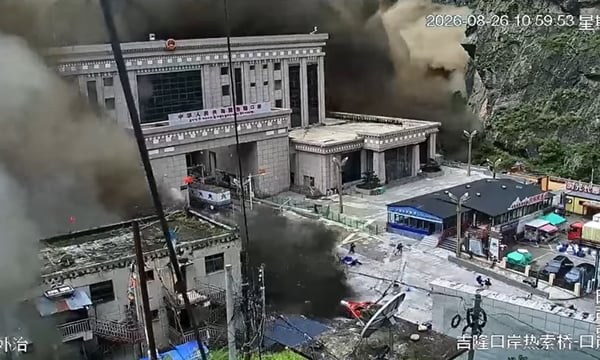
Bicker said videos of the landslide and flood surge sweeping through Gyirong Port on the border was scrubbed from the internet, in part, because Beijing fears instability in the politically sensitive region of Tibet.
Some social media users, however, have posted screenshots of the footage used by the BBC, pointing out it had actually been shown in the Chinese media. One Chinese journalist put it bluntly: “Never seen the BBC spread rumors so blatantly.” Another X user said the “middle ground often gets lost” in heated debates like this over Chinese censorship.
The Chinese government has long complained about what it sees as Western media “bias” in reporting on Tibet. Its supporters seem to have doubled down on this narrative this week on social media, zeroing in on the BBC.
But Chinese social media users, both inside and outside China, have long dealt with the authorities exercising control over information. This has certainly been the case in the aftermath of the floods, too.
As Bicker noted in her report, the most concrete example is the deletion of videos showing the massive wave of mud and water swallowing Gyirong Port. The footage was initially circulated on the platforms Weixin and RedNote, but users later could not access it.
Another form of control has been the restricted access for independent and foreign journalists. Allyson Horn of the Australian Broadcasting Corporation said she had made repeated requests to travel to Tibet, but was denied. Other foreign journalists have similarly been blocked. This makes it difficult, if not impossible, for foreign media to independently verify the Chinese government’s account of what happened there.
The absence of independent reporting, combined with the removal of footage from social media, has allowed the Chinese state media to dominate the narrative. This reflects a longstanding tendency in Chinese media to avoid material that could cause social instability or public panic.
Coverage of the Tibet floods by the state-controlled media has focused heavily on the People’s Liberation Army rescue operations, President Xi Jinping’s leadership during the crisis, and Premier Li Qiang’s visit to the disaster zone. There has also been some coverage of efforts to reopen roads and the delivery of disaster-relief supplies to affected residents.
But as the Guardian has noted, there has been much less reporting about how the disaster has affected local villagers, their homes, and communities. On the Nepali side of the border, meanwhile, foreign journalists have been able to interview survivors without restrictions.
Critics also say the Chinese government is hiding the true number of casualties. The problem with these contested claims is that no outsiders – whether they be critics or not – have been able to verify the death toll due to the restricted access to the disaster site.
China’s media environment has, at times, been less controlled than it is today.
On May 12, 2008, an earthquake measuring 8.0 on the Richter scale struck Sichuan province, killing more than 70,000 people and leaving millions homeless. Chinese state media provided extensive live coverage almost as soon as the quake struck. This continued for weeks, with China Central Television regularly updating the death toll and reporting extensively on rescue efforts.
Foreign media did raise questions about whether lives had been unnecessarily lost due to the collapse of poorly constructed school buildings. Foreign journalists also questioned whether justice would be served for the families of the victims. Chinese media reported on some of these controversies, including questioning whether the local government had done the proper quality control checks on school construction.
At the beginning, the coverage represented a major breakthrough in Chinese media reporting of emergencies and natural disasters. Its “unprecedented openness” was widely observed by Western media. But within weeks, the government had begun to clamp down on information about the schools for fear the issue could drive anti-government sentiment.
As a general practice, China’s state media outlets are instructed to emphasize “positive reporting” during times of crisis, while censors remove criticisms of government responses or culpability online.
The media coverage of a fatal train accident in the city of Wenzhou in 2011 was a good example.
Research shows that, unlike the Sichuan earthquake, the government kept a tight control on what was permissible in the media. The authorities ordered media outlets not to send reporters to the scene, limited the frequency of their reporting, and instructed them not to link the story to high-speed rail development. Journalists were also told not to investigate the accident’s causes or impact, or circulate personal microblogs on the incident.
Instead, they were urged to seek “moving” stories of bravery and sacrifice, such as local blood donations. The aim was to evoke love and compassion in the wake of the disaster.
When Xi came to power in 2012, the government’s concerns over potential challenges to its rule led to even more tightening on Chinese media and social media. The media’s handling of the Tibet floods is now following this pattern of restricted coverage and emphasizing positive news.
The disaster has also occurred at a time of growing distrust between China and the West. This seems to be adding to the perceptions of biased coverage. None of this is helped by the logistical difficulties in accessing both the disaster site and first-hand sources of information.
Chinese restrictions are making it harder for Western journalists to independently verify what is happening. The resulting information gap is raising suspicions in the West and criticism of censorship and biased coverage in Chinese media.
And that criticism, in turn, may reinforce Beijing’s belief that Western reporting on Tibet is inherently biased, giving it another reason to restrict information.
This article was originally published on The Conversation. Read the original article.