Germany’s Foreign Minister Johann Wadephul made his first visit to China on December 8 and 9 in an attempt to mend ties with Beijing. Wadephul had planned to make the trip to China in October but was forced to postpone his trip, allegedly over a cold response from China’s side.
A spokesperson for Germany’s Foreign Ministry said back in October “The trip cannot take place at this time and will be postponed to a later date.” The spokesperson further clarified that Wadephul had not secured enough meetings to make the trip worthwhile: the only confirmed agenda item had been a discussion with his Chinese counterpart, Wang Yi.
Politico called the October postponement a “diplomatic bombshell.” The trip by Germany’s foreign minister would have prepared the way for German Chancellor Friedrich Merz to make his own visit to China. The lackluster response from Beijing at the time was plausibly due to Wadephul’s repeated public remarks over China’s “increasingly aggressive behavior” in the East and South China Seas, along with the Taiwan Strait.
Most notably, Wadephul has repeatedly criticized China’s attempts to unilaterally change the status quo in the Taiwan Strait, to the displeasure of Beijing. Earlier this year, Wadephul said that Germany’s “One China policy continues unchanged – and we decide on its design. This also includes that there must be no violent change of the status quo.” That did not sit well in Beijing. A spokesperson for China’s Foreign Ministry countered that the “One China Policy has no room for any self-definition,” adding, “There is only one China in the world and Taiwan is a part of China.”
Despite this episode, Wadephul eventually made his long-awaited visit to China earlier this week, which came after German Finance Minister Lars Klingbeil’s visit to China and Merz’s meeting with Chinese Premier Li Qiang on the sidelines of the G-20 summit in South Africa last month.
According to the German Foreign Office, Wadephul’s visit was “indispensable” given the need for direct communication on a range of issues. “Particularly on issues that affect Europe’s security, such as the situation in the Indo-Pacific and especially the Russian war of aggression against Ukraine, the two countries have differing positions,” the Foreign Office said. “This is what makes it so important to talk to China face to face.”
Wadephul added, “We want and need in-depth discussion with China in order to advance on all of these issues. When it comes to the major challenges facing humanity, such as climate change, too, we can only make progress together. We want to cooperate with China – but we also expect to see understanding for Europe’s key concerns and interests.”
The Foreign Office readout emphasized that China is “Germany’s most important trading partner – and has become a major player on the international stage.”
During his two-day visit, Wadephul held meetings with his Chinese Foreign Minister Wang Yi, Chinese Vice President Han Zheng, and Commerce Minister Wang Wentao. His agenda during this visit focused on access to critical rare earth minerals, trade ties, and Taiwan.
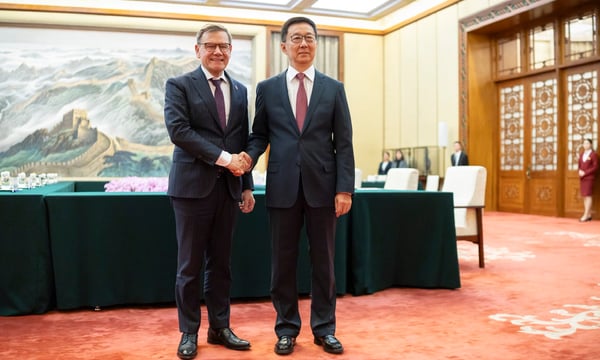
Wadephul met with Han on December 8. The Chinese vice president said that “China is willing to work with Germany to deliver on the important common understandings between the leaders of the two countries, enhance communication and dialogue, and work to bring the China-Germany all-round strategic partnership to a new level.” He further said that Beijing expected Berlin to play an active role, as a core member of the European Union, in promoting the healthy development of the relations between China and the EU. Han added, “China and Germany are important economic and trading partners that can achieve win-win results through mutually beneficial cooperation.”
Over the issue of Taiwan, Han reiterated that “the Taiwan question is at the center of China’s core interests, and China hopes that the German side will abide by the one-China principle.”
Wadephul said he greatly appreciated the “opportunity to speak at length with Vice President Han Zheng” in a post on X. The German minister emphasized that “we attach great importance to Germany-China relations,” but stressed that “[w]e are interested in a fair exchange on economic and security matters.”
The issue of Taiwan featured prominently in the meeting between Wadephul and Wang, which, according to China’s Ministry of Foreign Affairs, “set forth the historical facts and legal bases of the Taiwan question.” Responding not only to Wadephul’s own remarks but to a more recent controversy involving Japan’s prime minister, Wang took an extended around to time laying out Beijing’s position that “Taiwan has been part of China’s territory since ancient times” and that all the World War II-era declarations “prove as a matter of policy and law that Taiwan is part of China.” Wang concluded by saying that the status of Taiwan has been “sealed with seven locks.”
Moreover, Wang cautioned against supporting “Taiwan independence,” saying “such attempts violate both China’s Constitution and international law.” However, according to the MOFA readout he spent most of the time railing against Japan, rather than addressing the German foreign minister’s own comments.
Chinese state news agency, Xinhua, reported that Wadephul told Wang, “Germany remains firmly committed to the one-China policy, and this position is unwavering.” However, Wadephul did not mention that in his post on X. Instead, he thanked his Chinese counterpart for the “warm welcome and good conversation,” which he described as a “very constructive exchange.” Wadephul added, “My Chinese colleague Wang Yi and I agree: only together can we tackle many global challenges.”
Besides the issue of Taiwan, trade and rare earth minerals were the important issues on Wadephul’s agenda. Germany and the larger European Union have been alarmed by China’s successive restrictions on the export of rare earths and processed products made with rare earths, which are crucial inputs in green energy and cutting-edge technologies.
In his meeting with Chinese Commerce Minister Wang Wentao, both sides exchanged views not only on China-Germany economic and trade relations but also that between China and the EU. Wang Wentao noted that “both sides should implement the important consensus reached by the leaders of the two countries, firmly support free trade, uphold the multilateral trading system with the WTO at its core, and offset uncertainties in the external environment through the certainty of working together.”
Most certainly alluding to Trump’s tariff war, Wang added that “the growing trend of politicizing economic and trade issues and overstretching security concepts has severely disrupted the security and stability of global industrial and supply chains.” Meanwhile, he also stressed that Beijing attaches great significance to Berlin’s concerns vis-à-vis rare earth export controls, and that is why China has been granting general licenses in areas that include rare earth minerals.
In a post on X, Wadephul said that he had a very constructive discussion with Wang Wentao. The German foreign minister noted that “we want balanced economic relations and have common interests such as WTO reforms.” Wadephul said that Germany is “in favor of free world trade” and “in favor of removing trade barriers.” He highlighted that China was Germany’s most important trade partner and said Germany intended to expand its trade partnership with China.
However, Wadephul also pointed to existing “imbalances” and “differences,” such as “those concerning market access and trade restrictions.” He said one goal for his China trip was to identify “where we can strengthen our economic relations, but also determine where obstacles exist.”
In an interview from Beijing with German broadcaster ZDF, Wadephul raised concerns about China’s restrictions on exports of rare earths, which are critical for Germany’s (as well as for the EU’s) tech, auto, and defense manufacturers. He further highlighted that China was still not actually ready to grant general licenses for the export of rare earths to Germany. “We have received signals, but there is still quite a lot of work to be done,” he added.
As a result, German industries that are dependent on China’s supply of rare earths are still stuck in limbo. It’s widely assumed that China did not intend to target Germany directly; rather, China does not want its rare earths to reach the United States. Still, the restrictions have undeniably been affecting German industries as well.
Despite no concrete response from China’s side regarding rare earth supplies, Wadephul’s China visit sent positive signals that the diplomatic ties between the two are mending. The German foreign minister’s trip laid the groundwork for Chancellor Merz to visit China, possibly early next year. Merz has been a harsh critic of Beijing and was expected to be tough on China before being elected as Germany’s chancellor earlier this year. However, the reality is far more complex, and the Merz government has been compelled to adopt a more balanced approach in its relations with China.