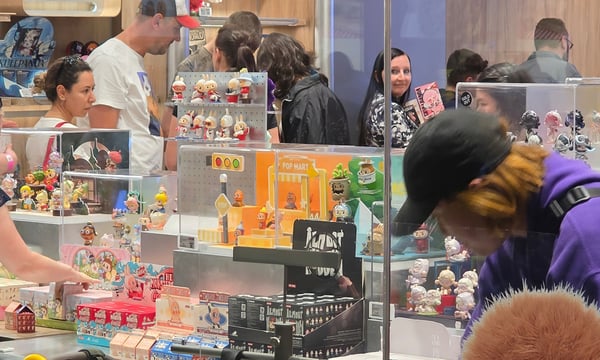
BYD, DeepSeek, and Pop Mart are among the Chinese companies making headlines for their global successes and controversies alike. What is often omitted, however, is that these firms illustrate China’s accelerating shift from a global factory producing low-cost, low-quality, low-value goods to a global innovator competing with Western companies in high-quality products on an increasingly equal footing, as seen most prominently in the EV sector.
This shift has coincided with major developments in China’s intellectual property (IP) protection regime. After decades of accusations over counterfeiting foreign brands, Chinese companies are now assuming dual roles: as not only IP violators, but also IP proprietors. The collectible toy market – especially Pop Mart’s toothy monster dolls known as Labubus – exemplifies this evolution.
A Brief History of IP Protection in China
Intellectual property first became a topic of national interest during China’s reform era. In 1980, China joined the World Intellectual Property Organization (WIPO), and in the years that followed, adopted relatively comprehensive patent, copyright, and trademark laws. Yet IP protection remained largely on paper; enforcement was weak and counterfeiting widespread.
It was not until China’s accession to the World Trade Organization (WTO) in 2001 that its IP system began gradually aligning with global standards. Even then, legislation proved insufficient, as enforcement lagged due to limited incentives for provincial authorities, resistance from parts of the manufacturing base, and other structural factors. Despite acceding to the Trade-Related Aspects of Intellectual Property Rights (TRIPS) agreement, China long remained a global hub for counterfeiting and a chronic violator of foreign IP.
A more qualitative shift began in the 2010s, when the government started to view IP as a strategic asset. This new emphasis was embedded in the “Made in China 2025” strategy, which treated the strengthening of IP protections as a prerequisite for cultivating an innovative ecosystem. Institutionalization accelerated with the creation of specialized IP courts in three major cities. In 2021, Beijing unveiled its plan for “Building a Powerful Intellectual Property Nation,” declaring that by 2035 China’s competitiveness in intellectual property should rank “among the top in the world.”
As China became a global leader in patent filings, IP protection rose even higher on the Chinese Communist Party’s agenda. In 2023 alone, China submitted 47.2 percent of global patent applications, surpassing the United States and Japan, with 16.8 and 8.4 percent, respectively. That same year, China’s National Intellectual Property Administration (CNIPA) received over 1.6 million patent applications.
Most importantly, however, a major driver behind China’s strengthening of IP governance has been the issue of technology transfer – i.e., the imperative of protecting technology crucial to its self-reliance efforts in high-tech sectors. Concurrently, then, China’s concept of IP has expanded beyond patents and trademarks to include data and digital assets.
For Beijing, the importance of IP protection to China’s technology ambitions is the central factor – not concerns about “Lafufus,” “Lagogos,” “Lababies” and other knockoffs of Pop Mart’s Monster series.
The Lafufu Paradox: From Imitation, Through Innovation, to Crackdown
Within the collectible toy market, the “blind box” business model built around scarcity helped Pop Mart’s profits soar by 400 percent this year, boosted by an even more lucrative secondary market where resale prices have effectively pushed Labubus into the luxury goods category. Pop Mart is now valued higher than major global toy manufacturers, including Mattel, Hasbro, and Sanrio combined.
But the success of Labubu has also produced a predictable side effect, one that has long been a hallmark of China’s treatment of foreign IP: counterfeiting. Fake dolls known as Lafufus are now sold globally, including in major retail chains such as 7-Eleven in the United States, which has led Pop Mart to file several lawsuits. At the same time, the problem extends beyond IP infringement. Numerous reports warn that Lafufus may pose health hazards to children as small parts of the toys can detach and the dolls may contain higher levels of lead or other harmful chemicals.
The paradox is that Lafufu dolls are also made in China. Government actions have thus been swift. Nearly 2 million Lafufus were seized this year through factory raids, market inspections, and customs checks. Pop Mart often identifies counterfeits first and reports them to police, resulting in coordinated crackdowns.
The Lafufu case demonstrates that Chinese authorities are increasingly willing to act against IP violations – at least, when domestically originated IP is at stake. This aligns China’s actions with the CCP’s rhetoric about a rules-based innovation system, where original IP is an asset, not a liability. This can be seen in a Xinhua article criticizing the Lafufu phenomenon, which argued that “entrepreneurs and producers should clearly understand that to win in the market, they must first respect the rules of innovation.”
Toy Story: Labubu or Wakuku?
While the Chinese government cannot claim credit for Pop Mart’s global popularity, it nevertheless uses the company and its own crackdowns on Lafufus as a proof that China can produce and protect a “super IP brand,” likening Pop Mart to an “Eastern Disney” in the making. Indeed, Pop Mart’s Executive Director Si De has openly acknowledged that the company is learning from Disney’s playbook when it comes to building long-term IP value, especially given the short-term nature and risks inherent in the blind box model. Pop Mart has plans for expanded merchandise lines, theme parks, and even film adaptations already underway.
In the same way that Pop Mart has learned from Disney or even Sanrio – considering the many comparisons between Labubu and Hello Kitty – other Chinese companies have increasingly learned from Pop Mart. Miniso, a retailer with a far larger global footprint (7,900 stores worldwide, compared to Pop Mart’s 443 stores and 2,437 vending machines) has long relied on licensing third-party IPs, including Disney, Sanrio, and Marvel. But it is now investing more into original IP design and development, as demonstrated by the release of its hit toy Wakuku. Still, despite Miniso’s scale, many agree that it may struggle to rival Labubu’s rise as a major Chinese cultural export, given Labubu’s celebrity endorsements and a significant resale market.
Is Chinese IP Ready for Global Success?
Questions persist about the long-term profitability and rise of Pop Mart’s collectible series – with the Monster series being just one of many – and about the broader rise of Chinese IP-based cultural products. Pop Mart remains something of an outlier among Chinese cultural exports. Unlike many Chinese products that compete primarily on the value-for-money factor, the Monster series relies heavily on emotional appeal, which has driven much of the company’s success.
Labubu is not the only Chinese cultural product to gain international attention recently. The video game “Black Myth: Wukong,” the animated films “Ne Zha” and “Ne Zha 2,” and the sci-fi novel “The Three-Body Problem,” which has been adapted into a Netflix series, have all made waves. Yet a closer look reveals limitations. Around 70 percent of “Wukong” sales were domestic, with most reviews on Steam, a popular game distribution platform, written in Chinese. “Ne Zha 2” earned less than 3 percent of its box office revenue from outside China, and the Netflix adaptation of “The Three-Body Problem” received polarized reviews.
So far, Labubu seems to be the only Chinese-made cultural product to develop a truly global fandom, though notably, the doll is not even explicitly marketed as Chinese, thereby limiting the toy’s relevance for China’s soft power strategies. Designed by a Hong Kong-born artist and inspired by Nordic mythology, Labubu demonstrates the centrality of localization and collaboration with foreign artists to Pop Mart’s global strategy. Indeed, Miniso has long utilized Japanese aesthetics to reap profits from high-quality and other positive perceptions associated with Japanese brands.
At the same time, when looking beyond cultural exports, China’s growing portfolio of high-tech exports – particularly in green technologies – is already proving that “made in China” no longer stands for just low-cost manufacturing but also innovation, creativity, and a maturing IP ecosystem.