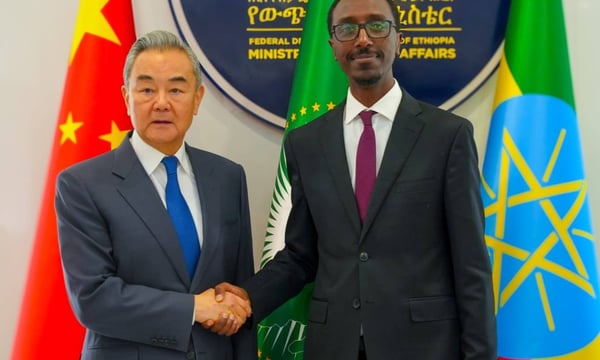
It has long been routine for China’s foreign minister to make his first overseas visit to between four and five African countries. The Chinese government has confirmed that this year’s trip, from January 7 to 12, will mark the 36th consecutive year of this diplomatic tradition. Thanks to this long-standing commitment, our data on high-level diplomatic visits between China and Africa since 2009 record an impressive total of almost 200 visits to 48 African countries involving Chinese heads of state, premiers, and foreign ministers.
For Ethiopia, Tanzania, Somalia, and Lesotho – Foreign Minister Wang Yi’s four destinations for 2026 – the visit is not welcomed simply because of the symbolism, ceremony, or tradition. It is welcomed because each government has specific economic and diplomatic objectives to pursue with China.
Since 2009, Ethiopia – now a BRICS member and the African country with the highest level of diplomatic relations with China – has hosted nine visits from Chinese leadership, while Tanzania has received eight, reflecting both countries’ centrality to China’s Africa diplomacy. Somalia and Lesotho, however, have each only seen two visits in the dataset period so far. Notably, Somalia and China celebrate their 66th anniversary of diplomatic relations this year – an auspicious number.
Engagement has also been reciprocal. Tanzanian leaders have made 11 official visits to China, the highest among the four, while Ethiopia’s leadership has undertaken seven missions to Beijing since 2009, reinforcing sustained economic and policy diplomacy.
Importantly, all four countries are classified as least developed countries (LDCs) in the context of China’s tariff policies and therefore have enjoyed zero-tariff access on all products for many years under China’s preferential market access regime for LDCs. That status shapes their trade policy strategies and export incentives with China and beyond.
Indeed, four somewhat interlinked themes help explain why the four countries see significant value in this visit.
Infrastructure, Logistics, and Energy: From Headline Projects to Growth Systems
Infrastructure financing remains a central pillar of China’s engagement, but its relevance increasingly lies in system viability rather than headline projects.
In Ethiopia, infrastructure is inseparable from macroeconomic stabilization. Legacy investments – industrial parks, railways, and power generation – are now constrained less by construction gaps than by foreign exchange shortages and debt overhang under the G-20 Common Framework.
Addis Ababa is navigating a complex restructuring with China playing a pivotal role. Yet debt relief alone is insufficient. Projects such as the planned new international airport, critical to sustaining Ethiopian Airlines’ role as a continental hub, are framed as growth enablers that restore investor confidence and generate foreign exchange.
Somalia, by contrast, having reached the HIPC Completion Point by the end of 2024 and reduced its debt-to-GDP ratio significantly, is entering infrastructure discussions from an entirely new position. Its strategic location along the Gulf of Aden and Red Sea links development priorities to maritime trade and security corridors. Ports, logistics routes, fisheries infrastructure, and cold-chain facilities are central to job creation and revenue generation.
For Tanzania, the emphasis is long-term competitiveness rather than crisis response. Energy underpins this strategy: electricity demand is expected to more than double by the early 2030s, driven by industrialization and urban growth. With substantial natural gas reserves and expanding renewable ambitions, Tanzania is seeking investment across generation, transmission, and regional power trade. Tanzania’s prospective membership in the Asian Infrastructure Investment Bank (AIIB) and the very recent appointment of Tanzania’s former ambassador to China as finance minister will strengthen its capacity to deliver in this regard.
Manufacturing and Value Addition: Reducing Vulnerability and Upgrading Value Chains
Across the four countries, manufacturing and value addition are central – not as abstract policy ambitions, but as responses to concrete economic vulnerabilities.
For Ethiopia and Lesotho, exposure to U.S. trade tariffs has emerged as a strategic vulnerability. Textiles are a critical export sector for both countries, and more than 70 percent of their apparel and textile exports have been destined for the U.S. under the favorable conditions specified by the U.S. African Growth and Opportunity Act (AGOA), enacted in 2000. However, recent tariff hikes and uncertainty over AGOA’s future (it expired in September 2025) have underscored the limits of export models built on preferential market access rather than resilient domestic value chains.
Neither Ethiopia nor Lesotho expects China to replace the U.S. as a destination for finished garments. Instead, policymakers are looking to Chinese investment to address structural weaknesses – low domestic value capture, shallow supplier networks, and limited backward integration. Ethiopia is seeking to move beyond low-margin assembly into higher value-added segments such as pharmaceuticals, renewable energy equipment, and industrial intermediates. Lesotho, meanwhile, prioritizes building upstream capacity in spinning, weaving, dyeing, and other textile inputs to reduce reliance on imported materials. Expanded production in these upstream light-industry segments could also better align with Chinese market demand, given that China’s imports from Lesotho are concentrated in inputs such as wool and mohair rather than finished apparel.
For Tanzania, value addition is inseparable from logistics. The commercial viability of TAZARA, the China-built railway linking Tanzania’s east coast to Zambia, depends on raising the value of goods transported – copper and mineral processing in Zambia, and downstream manufacturing and logistics anchored in Tanzania’s ports.
For Somalia, manufacturing ambitions are strategically significant. Investment in construction materials, agro-processing, plastics, and fisheries supports employment creation, import substitution, and fiscal recovery, which are core components of state-building and political legitimacy. For Chinese firms, Somalia represents a frontier market where first-mover advantages are paired with higher risk but strong political backing for development-led stabilization.
Sovereignty, Stability, and Regional Alignment
Wang Yi’s visit also offers a platform for African governments to articulate regional and domestic political perspectives that are often filtered through external narratives.
Ethiopia and Somalia both seek China’s firm diplomatic support for territorial integrity – an issue resonant with Beijing’s own principles. Several African states are facing secessionist pressures, particularly Somalia after the partial recognition of Somaliland by Israel. Importantly, China’s support is not framed as military backing, but as diplomatic alignment reinforced through development cooperation and institutional strengthening.
For Tanzania, the emphasis is continuity and stability. Dar es Salaam is keen to reassure partners while resisting the politicization of domestic governance processes. China’s longstanding practice of non-interference, combined with sustained economic engagement, positions it as a preferred interlocutor at a time when relationships with OECD countries are perceived to be highly conditional or increasingly distant due to aid budget cuts.
Development-Centered Multilateralism in a Fragmented Global Order
Finally, the visit provides space at a time of fragmentation for broader exchanges on development and multilateralism, an area where all four countries bring distinct historical experiences.
China’s emphasis that “African problems should be resolved by Africans in African ways” continues to translate into a development-first approach to stability. This does not sideline security concerns but embeds them within economic recovery, employment creation, and institutional capacity-building. For Somalia, this logic supports state reconstruction; for Ethiopia, post-conflict recovery and national reconciliation; and for Tanzania and Lesotho, autonomy in development planning amid intensifying great-power competition.
Taken together, these dynamics explain why China’s foreign minister is warmly received across four very different national contexts. The appeal lies not in uniform solutions but in an engagement perceived as predictable, adaptable, and anchored in long-term development trajectories rather than short-term political cycles. Countries advancing relatively smoothly in their development trajectories look to expand cooperation, while those facing post-conflict recovery and heightened exposure to external shocks see value in deepening engagement with China at this juncture.