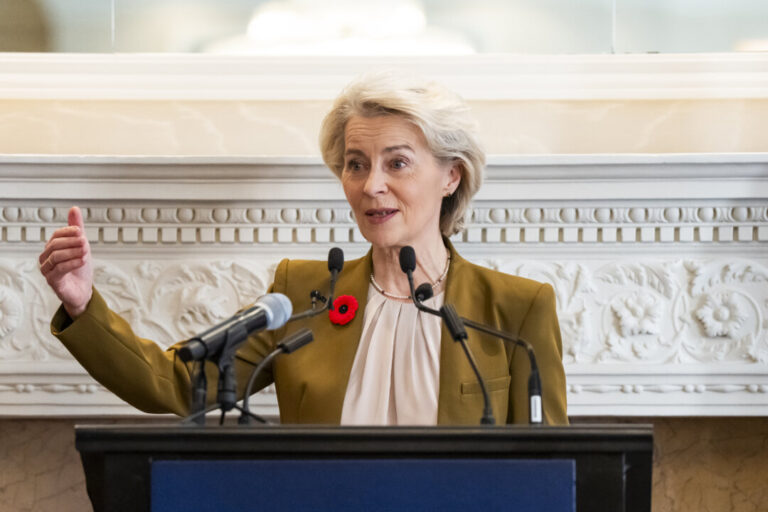

President of the European Commission, Ursula von der Leyen, gives remarks ahead of the EU-Canada summit, in Montreal, on Oct. 29, 2026. The Canadian Press/Christopher Katsarov
European Commission President Ursula von der Leyen says today’s Canada-EU Summit in Montreal will launch talks about Canada becoming the European Union’s first “associate member.”
Von der Leyen told a crowd gathered at an event hosted by the C.D. Howe Institute in Montreal that the partnership makes sense because Canada and the European Union are “two complementary systems.”
“Of course, Canada cannot become a full-fledged member of the European Union because of geography,” she said during her Oct. 29 speech ahead of the two-day Canada-EU Summit. “But we both want to bring our relationship to the highest level possible, and this is why we are discussing the idea of Canada becoming the first associate member of the European Union.”
Von der Leyen first proposed associate member status for Canada during a speech to the European Parliament on Sept. 16. Prime Minister Mark Carney welcomed the offer in his own speech to the Parliament the following day, saying Ottawa was prepared to deepen cooperation in areas such as critical minerals, defence industrial capacity, artificial intelligence (AI), and energy security.
Some European officials have since sought to distinguish the broader goal of closer cooperation from the specific “associate member” label.
Several EU member nations like Germany, France, Italy, and Greece specifically objected to the “associate member” terminology this week when the proposed language was suggested in documents ahead of the summit.
Some European news agencies had reported this week that the term was subsequently dropped from the draft joint declaration, with the two sides instead pursuing closer association and further discussions on the future relationship.
Von der Leyen nevertheless continued to promote the concept in Montreal, outlining her vision of how a closer relationship could bring Canada and the EU nearer to the kind of cooperation associated with membership.
“Our idea is simple… an association without accession,” she said during her 30-minute speech. “But we can replace accession with a common ambition and vision. We can build a partnership that comes closer to membership than anything we’ve done before.”
She outlined three areas for closer alignment: policies, governance, and programs.
Policy alignment would cover areas ranging from artificial intelligence and climate measures to energy solutions and national security, she said. Governance would involve closer cooperation between the European Commission and the Canadian government, while the two sides would also seek to deepen their institutional ties.
She said closer alignment on programs would allow Canadian students and researchers to work and study alongside their European counterparts. Potential avenues she cited include Horizon Europe, the EU’s flagship research and innovation funding program, and Erasmus+, the EU’s education and student-mobility program.
“So that’s in a nutshell, and much, much more, what associate membership is all about, open only to our closest partners outside of Europe, who are ready to open a new frontier together and to chart the course together,” von der Leyen said.
“To think beyond the terms of our partnership today towards the most ambitious version of what we can build, and I must say, I can think of no better partner than Canada to embark exactly on this journey with us.”
Von der Leyen also outlined her views on the potential benefits of the partnership.
She said closer cooperation could reduce supply-chain risks through joint investments, pair Canada’s mining expertise with European demand for critical minerals, and advance AI safety and standards.
She also proposed working together to counter Russian competition in the Arctic by monitoring oceans, connecting remote communities, and protecting critical raw materials.
Von der Leyen argued countries must think beyond traditional approaches to international cooperation because of what she described as a “deeper decay in international order.”
She said that change comes with risks but that the EU can “no longer let ourselves be shackled by the limits of the old world order” and must seek partnerships that are “built on trust and driven by common interests and beliefs.”
Partnership Titles
Von der Leyen’s speech comes as Carney welcomes EU leaders to Montreal for a two-day summit on the next steps in Canada’s relationship with the bloc.
Some EU member states have expressed reservations about von der Leyen’s “associate member” proposal, including the terminology and the process behind it. Carney, meanwhile, has said the substance of closer cooperation matters more than the name attached to it.
“The good news is it doesn’t matter about specific names or nomenclature,” he told reporters earlier this week.
The prime minister has previously suggested the relationship could be described as an “alliance for the future.” His office described the summit in a statement this week as an opportunity to advance “an ambitious new partnership” with the European Union.
The EU offers market power, research, and manufacturing capabilities, while Canada offers energy, critical minerals, expertise in space technology, AI and quantum computing, and a strong banking system, the PMO said.
The Canadian Press contributed to this report.