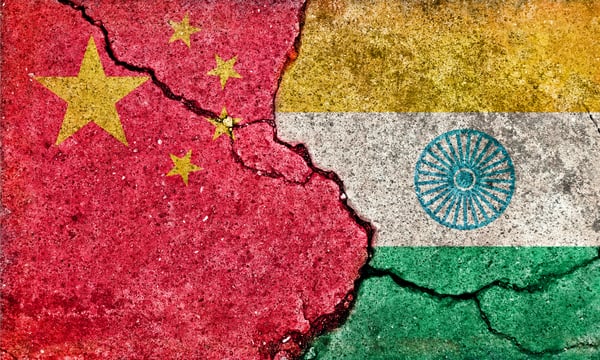
After nearly five years of tension, China-India relations have improved, with increased interactions between the two sides in 2025. As a gesture of goodwill, the Chinese government lifted visa restrictions on Indian citizens in March and eased visa rules, which have facilitated Indian citizens’ visits to China.
However, this has sparked a huge uproar on Chinese social media. Videos depicting Indian tourists in a negative light – such as eating with their hands on the subway and bathing in tourist attractions in China – were posted on social media and triggered a barrage of criticism and even racist remarks targeting Indians. Some comments even advocated that China should refuse entry to all Indian travelers and expel all Indians living in China.
This anti-Indian sentiment quickly became extreme, making it difficult to find calm and neutral comments among the thousands of posts under the videos.
This sentiment can be attributed to widespread stereotypes about Indians. On social media platforms like Douyin (the Chinese version of TikTok), Indians are often portrayed as unhygienic and morally deficient. Furthermore, reports of a surge in Indian immigrants “occupying” countries like Canada and Australia – despite being untrue – have led Chinese netizens to believe that China is a potential target for Indian emigration.
According to the Ministry of External Affairs of India, there are just 8,460 overseas Indians residing in mainland China, significantly fewer than neighboring Hong Kong (44,140), Japan (47,810), and South Korea (17,001). Moreover, there is no evidence that a large number of Indians are illegally residing in China after overstaying their tourist visas, as is sometimes alleged on social media. In fact, China is not a major destination for international migrants and maintains strict restrictions on immigration.
However, due to the limited China-India exchanges following the 2020 border conflict and the closed nature of Chinese social media, diverse information struggles to penetrate the Chinese internet and dismantle these stereotypes and misinformation.
A deeper reason lies in Chinese society’s tolerance of anti-Indian rhetoric. Amid tense China-India relations, Indians were seen as objects of ridicule and even discrimination. In this context, nationalists maintain their sense of security by attacking India, which is perceived as inferior to China in the international system. Despite a self-perception of China as a victim of Western racism, extreme nationalists are similarly portraying India as a worthless, failed state and justifying racism against its citizens. Furthermore, the absence of anti-racist discourse in the mainstream discourse system in Chinese society allows racist rhetoric to spread unchecked online and widely influence public opinion.
The Chinese government likely does not approve of the recent anti-India sentiment on social media, despite its past attempts to garner public support through nationalist rhetoric during periods of tension with India. After lifting pandemic-related lockdown measures, the Chinese government has been focusing on reviving its fragile economy. To this end, it implemented a series of measures, including easing visa requirements for foreigners. In this context, China had already issued 265,000 visas to Indian citizens by September 22. The series of diplomatic efforts suggest that India remains a key neighbor of China, particularly given its role as an important buyer of Chinese products.
Therefore, there is no reason to believe that China is deliberately provoking anti-India sentiment at this time. On the contrary, this sentiment has even evolved beyond racist stereotypes of Indians into questioning the Chinese government’s foreign policy.
Despite its efforts to revive its economy, China has struggled to escape the post-pandemic slump. Meanwhile, persistently high unemployment has fueled public distrust of the government. Against this backdrop, the non-existent “mass migration of Indians” has been interpreted as competition for limited job opportunities, with the Chinese government, which is issuing the visas, being portrayed as the mastermind. In this discourse, the Chinese government is accused of attempting to compensate for a labor shortage caused by the low birth rate by bringing in Indian immigrants.
The K visa program for young foreign scientific and technological talent, which the Chinese government announced in August, has been interpreted as a systemic loophole which will lead to an influx of Indian immigrants into China. There has even been mention of a conspiracy theory that the Chinese ambassador to India and Chinese immigration officials are Indian spies.
These unfounded accusations reflect a collective social anxiety. Because methods to alleviate this sentiment are lacking, public opinion has become overly sensitive and constructed “unwelcome groups” as potential threats. It is in this context that Indians have become victims of popular nationalism. This bears some resemblance to the anti-Japanese sentiment that led to several serious crimes in 2024.
Undoubtedly, the influence of nationalist discourse is profound and enduring. It can be a tool for a government to consolidate power, but when government actions fail to satisfy increasingly radical sentiments, nationalism is likely to backfire. In any case, Beijing should recognize that if it cannot effectively control this sentiment before it spirals out of control, nationalism is likely to become a negative asset rather than a tool for consolidating its regime.