As Chinese electric buses have made inroads into European cities, potential security issues have been raised by the media. Recently, both the Danish and Norwegian public broadcasters reported on the risks of operating buses that can be “switched off remotely” from China. Such concerns feed into a broader debate about China’s growing dominance in the green tech sector – a debate that recently prompted EU Commission President Ursula von der Leyen to stress that “we should learn our lesson.”
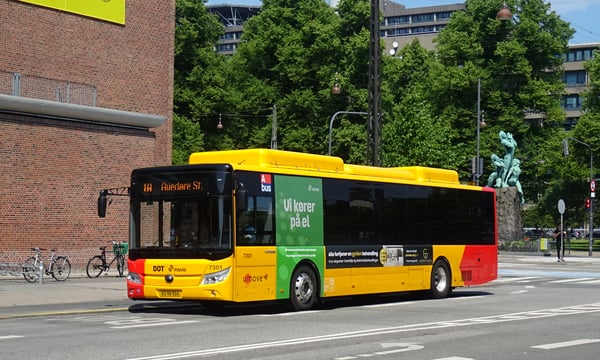
Yet these security and dependency concerns have so far done little to deter European transport companies from operating Chinese buses. In Denmark, where Prime Minister Mette Frederiksen has repeatedly warned against excessive reliance on Chinese suppliers, no less than 68 percent of Copenhagen’s city buses are currently “made by China,” a figure set to rise to 80 percent by 2027.
Another set of concerns could prove more disruptive. In 2023, a report by the human rights NGO Globalworks Lund AB found evidence of forced labor practices in the production of Chinese electric buses, including major companies such as BYD, CATL, and Yutong. Puzzlingly, however, only local authorities in Sweden have so far halted purchases of Chinese-made buses over human rights concerns.
It turns out that Chinese companies have devised a protective shield against such human rights allegations. By virtue of their participation in the U.N. Global Compact – a set of principles for corporate responsibility regarding human rights, labor rights, the environment, and anti-corruption – Chinese companies acquire a veneer of legitimacy that can easily be manipulated to deflect scrutiny.
Denmark offers a particularly instructive example of this practice.
In 2019, Copenhagen’s municipality government embarked on an ambitious plan to convert its entire bus fleet to electric vehicles. When local politicians and media this summer questioned the growing number of Chinese buses on the streets of Copenhagen, the city government requested Movia, the largest Danish public transportation company, to consider alternatives to Chinese bus providers.
In response, Movia argued that Chinese-made buses are cheaper, have lower operating expenses, match their European competitors on quality, and are – unlike the latter – delivered on time. Nevertheless, new questions have emerged since then, raising both security-related and human-rights concerns.
In October, against a backdrop of longstanding accusations of forced labor practices in China, Copenhagen’s municipal government specifically asked Movia to clarify to what extent its suppliers respect workers’ right to free association. Conveniently, Movia pointed out that all its suppliers have pledged to adhere to the core principles of the U.N. Global Compact, including those on labor rights. Indeed, Movia expressed its confidence that all of its Chinese suppliers can document their commitment to the principles in the Compact, which, according to Movia, is a “legitimate and widely recognized” standard for evaluating corporate responsibility.
This is where the wheels start to come off. Chinese companies such as CATL and Yutong – Movia’s key suppliers – are officially listed as participants in the U.N. Global Compact and will accordingly submit annual reports on their progress in complying with its core principles. However, the Compact explicitly states that it has no “mandate to be a compliance or monitoring body” for its Chinese participants.
Even more worryingly, a private consultancy firm is credited for preparing the Global Compact’s “China strategy” – a document that reads like something gleaned from the website of China’s State Council Information Office.
Amid growing demand for green-tech solutions to facilitate Europe’s transition to climate-neutral economies by 2050, Chinese companies are avidly positioning themselves as indispensable partners. To smooth the path for these partnerships, the U.N. Global Compact provides a useful legitimacy stamp that allows Chinese companies to market their products under the banner of responsible labor and human rights practices. Of the 11,049 companies currently registered as participants in the U.N. Global Compact, 666 are Chinese.
With Washington poised to bar nearly all Chinese vehicles from the U.S. market by 2027, and Brussels set to ban carbon dioxide-emitting buses by 2035, firms like BYD, CATL, and Yutong are doubling down on Europe to relieve domestic production overcapacity in China. Today, roughly one-third of Europe’s fleet of electric buses is already of Chinese origin, and that share is likely to rise, unless Brussels and local governments introduce tighter regulation and more rigorous oversight.
Whether the goal is protecting European manufacturers, addressing security risks, reducing technological dependence, or upholding the key principles in the U.N. Global Compact, Europe should no longer look the other way.
The author would like to thank Andreas Wittschieben for his research assistance in preparing this article.