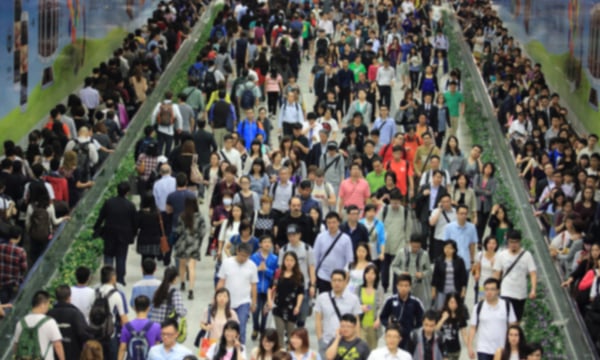
They call themselves “rat people,” Chinese slang for young graduates who have given up on conventional success. They join the “lying-flat generation,” who reject the “996” grind (9 a.m. to 9 p.m., six days a week), refuse to date or marry, and scrape by on minimal consumption. It’s a dark, sobering self-portrait of a generation that was supposed to be China’s future.
The economic numbers explain much of the despair. China’s unemployment rate sits at 5.1 percent overall, but 16.5 percent for those aged 16 to 24. Youth unemployment peaked at 18.9 percent in August 2024 and remains elevated. And roughly 70 percent of unemployed 20-to-24-year-olds hold university degrees, as China’s skyrocketing higher education sector now churns out more degrees than there are jobs. Over 12 million graduates flooded the job market in 2025 alone – and even more will graduate this year.
China built the world’s largest higher education system. Enrollment jumped from 17 percent to 60 percent in two decades, and the number of university graduates rose from 7.5 million in 2018 to an expected 12.7 million in 2026. But the economy can’t absorb what the universities produce.
The mismatch runs deep. Graduates want white-collar jobs in tech and finance. Companies need logistics workers, retail staff, and skilled machinists. The one-child policy, which ended in 2016, made this worse: parents who sacrificed to give their only child a degree don’t want to watch them work on a factory floor. So graduates hold out for jobs that don’t exist while employers can’t fill the ones that do.
The result is a generation opting out. Some take temporary work while searching for something better. Others flee into graduate school to delay the reckoning. But a growing number have simply quit trying.
Survey evidence in the World Values Survey and China Family Panel Studies confirms the generational rupture. Chinese born after 1990 are far less likely to view work as “a duty to society” than their parents’ generation. The number of Chinese who believe that “hard work is rewarded” has collapsed among those born in the 1980s and 1990s.
Beijing’s response has been to try to rein in the pessimism. In September 2025, the Cyberspace Administration launched a two-month campaign against posts that “excessively exaggerate negative and pessimistic sentiments.” The targets were believed to have included “studying is useless” and “hard work is useless” messages from lying-flat and rat-people communities.
The government has also rolled out policy measures to address structural mismatches: restructuring university majors toward STEM and applied fields, expanding firm-based training, and linking vocational credentials and academic degrees. These align with the 15th Five-Year Plan, which prioritizes artificial intelligence, new energy, advanced materials, and aerospace.
The annual number of engineering bachelor’s graduates in China has reached about 1.3 million, while the total number of STEM graduates in recent years has risen to around 5 million.
The growing share of youth “lying flat” is especially alarming given how few young people China has. The demographics are working against Beijing. China’s fertility rate fell from above seven births per woman in the early 1960s to about 1.0 in 2024 – well below the replacement level. Births dropped to 7.9 million in 2025, the lowest since 1949. The total population fell by 3.4 million to 1.4 billion. The number of women aged 20 to 34, who account for about 85 percent of births, is predicted to shrink from 105 million in 2025 to just 58 million by 2050.
Beijing’s attempted fixes verge on parody. A 13 percent value-added tax on condoms and birth control, ending a three-decade exemption, took effect in January 2026. A $12.7 billion child-care subsidy offers families a lump-sum payment of about $500 per child under three. Neither policy addresses why young people aren’t having children: they can’t afford homes, can’t find decent jobs, and don’t see a future worth bringing children into.
The government’s pro-natalist policies also collide with changing gender norms. Years of feminist discourse have heightened awareness of the unequal burdens of marriage and childrearing, making cash incentives insufficient to offset women’s expectations of career interruption and uncompensated care work.
Companies such as DJI, Midea, and Haier have introduced mandatory leave-on-time policies aimed at reducing burnout and improving work-life balance. Yet these initiatives remain confined to high-profile firms in major cities, with limited spillover to broader workplace norms.
The “rat people” label isn’t just internet nihilism. It’s a verdict on a social contract that promised education would deliver prosperity. That contract is broken.
China has considerable strengths in advanced manufacturing, along with growing capabilities in technology and innovation. Yet the challenge it faces is no longer simply one of output or scale, but of alignment. China’s economic model emphasizes state direction and strategic control, and that’s increasingly out of step with a younger generation whose values around work, family, and personal fulfillment are rapidly changing. China can censor pessimism but it can’t manufacture hope.
Years of higher-education expansion, urbanization, changing family structures, and the diffusion of feminist ideas have reshaped expectations faster than institutions and labor markets can adapt. The question is whether a state-led model can deliver the flexibility young workers need – or whether a generation of “rat people” represents the new normal.