China Power | Security | East Asia
The purges carry real implications for China’s domestic politics and short-term military readiness, but their relevance to Beijing’s Taiwan policy is limited.
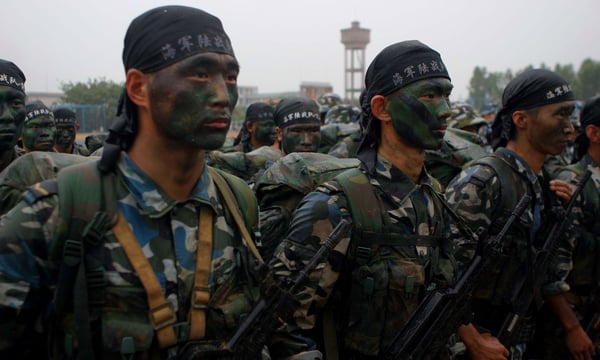
Marines of the People’s Liberation Army Navy (PLAN) stand at attention in Zhanjiang, China, Nov. 16, 2006.
Credit: U.S. Navy photo
Last month, Beijing placed Central Military Commission (CMC) Vice Chairman Zhang Youxia and CMC member Liu Zhenli under investigation for alleged disciplinary violations. Predictably, the news set off a wave of speculation about what the purges mean for Taiwan. These narratives largely miss the point. The purges carry real implications for China’s domestic politics and short-term military readiness, but their relevance to Beijing’s Taiwan policy is limited.
Commentary linking military purges to Taiwan contingencies tends to fall into three camps. Some argue that the likelihood of war has increased because there are fewer senior officers able or willing to restrain paramount leader Xi Jinping. Others contend that the widespread nature of the disciplinary action – and the corruption it exposes – makes Beijing less prepared for a prolonged conflict, reducing the likelihood of aggression in the near term. Still others insist that the purges reflect Xi’s impatience to resolve the Taiwan issue and, while delaying conflict in the short run, are aimed at clearing obstacles and accelerating the People’s Liberation Army’s (PLA) readiness for a Taiwan operation.
All three explanations overstate Taiwan’s relevance to this issue. A more plausible reading is that the purges reflect a mix of genuine disciplinary concerns and political maneuvering independent of Taiwan. State-run media reports about the actions taken against Zhang and Liu have emphasized rooting out corruption, enforcing ideological discipline, and safeguarding the Communist Party’s “absolute control” over the military. References to building a stronger force appear mostly in abstract terms and largely in the context of preserving Xi’s and the party’s authority. This is unsurprising. The PLA’s core mission has always been regime security; everything else – including unification with Taiwan – is secondary.
The popular narratives tying PLA purges to Taiwan rest on a shaky assumption that Beijing’s decision to use force against the island will hinge on the PLA’s operational readiness. But historical evidence doesn’t support this assumption. Studies of previous Chinese military action show that Beijing’s decisions to employ force tend to be driven by perceptions of political necessity, not military readiness.
To be sure, any country would have a hard time launching a complex joint military operation with a disrupted command structure. But Beijing’s interest in Taiwan is fundamentally political. Furthermore, any decision to use military force would be made by Xi, who is driven primarily by his domestic political interests. How much influence his generals have over his decision-making is a matter of speculation, but judging from his governance style in other policy areas, Xi likely dictates more than he listens.
While no one can know Xi’s thinking, both the nature of China’s political system and Xi’s track record indicate that his overriding priority is political survival. The sensitivity of Taiwan in China’s political discourse makes it inseparable from this concern. No Chinese leader can afford to be seen forfeiting Beijing’s claim over the island. If Xi concludes that military force is necessary to preserve that claim, he is likely to act regardless of the PLA’s readiness or the advice of his generals. Even a high risk of failure is unlikely to deter him if he believes his legitimacy is under threat.
Fortunately, Xi has strong incentives not to use force unless he judges that taking military action poses less risk to his political standing than not taking such action. Such a judgment would most likely be made in response to a formal declaration of Taiwan independence, which is nearly impossible under the island’s political and constitutional system.
The surest way for Xi to jeopardize China’s claim over Taiwan would be to seek to force unification before he is confident the PLA would prevail against not only Taiwan but also the United States, Japan, and other regional powers, which for planning purposes he must assume would intervene. Even a successful campaign would likely be long and costly, inflicting economic and social damage that would set China back decades and derail Xi’s vision of national rejuvenation. Nothing in Xi’s 14-year tenure suggests he is inclined toward such reckless risk-taking. These dynamics long predate Xi’s anticorruption drive in the military and will persist after the CMC is reconstituted.
Sure, the removal of senior officers imposes a handicap on the PLA. But the idea that this will meaningfully shape Beijing’s Taiwan decision-making misunderstands how these decisions are made. Xi’s political interests – not the PLA’s readiness – will largely determine whether China uses force.