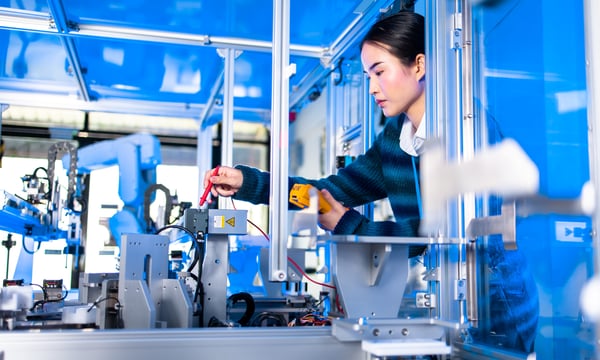
As China celebrated its dominance at the Asian Games that concluded days ago in Nagoya, Japan, its achievement at another global sporting festival in Shanghai has been largely overlooked. In the 2026 edition of WorldSkills, what the organizers call an Olympics for vocational skills, the Chinese team topped the medal table with 41 gold, 11 silver, and 4 bronze medals. In fact, the Chinese team has topped the medal table five straight times in the biennial competition, a phenomenon that has been attributed to the country’s unparalleled investments in providing systematic coaching and training for athletes in the same way it does for the regular Olympics.
Beyond simply winning medals, the Chinese authorities felt the need to drum up public interest in the competition. Local and national media, and even governments, covered WorldSkills extensively while it largely went unnoticed in other countries. Given that whatever prestige that China earns from WorldSkills is largely geared toward a domestic audience rather than an international one, it begs the question of why China would even bother with prompting something that leads to little gain in global stature.
The answer to the question may be found in a February 2026 announcement from the Chinese Ministry of Education (MoE) suggesting vocational school reforms. The document criticized the current system’s lack of connection between education and employers, producing few skilled industrial workers essential for driving China’s next generation of high-tech manufacturing.
China’s 2026-2030 Five-Year Plan emphasized that manufacturing remains central in ensuring the technological self-sufficiency underlying long-term economic growth and safeguarding national security. The MoE implied that the country’s vocational schools, without reforms, would be incapable of producing the human resources needed to achieve that goal.
But for vocational schools to urgently produce talent for high-tech manufacturing, they need more than just an appropriate curriculum. They also need the best raw talent that China has to offer. Here is where vocational schools fall short.
China’s university enrollment increased from 1 million in 1999 to 9.6 million in 2020. The country’s brightest increasingly aspire to join the ranks of what used to be a tiny segment of the intellectual elite signaled by a university diploma. The expanding path toward college education has cemented a social hierarchy in which a bachelor’s degree followed by white-collar work is seen as more desirable than a vocational one followed by a career in manual labor, no matter how technically sophisticated.
That norm of high-education aspirations is most clearly seen in study abroad. My primary job as a college admissions consultant leads me to interact with hundreds of Chinese families who are first and foremost attracted to higher-ranked institutions with well-recognized names. In choosing between the likes of the American Ivy Leagues and the British Oxbridge, they care less about what practical skills they can acquire, but whether the degrees indicate a highly competitive environment, and by proxy, the intelligence of successful applicants. Despite much cheaper costs and clear paths for employment, very few indicate interest in English-language higher-education programs in Germany and other European countries anchored by technical apprenticeships.
It is this cultural norm that the MoE must fight against as it seeks to overhaul the vocational school system in China. The proposed collaboration with major manufacturers will help. In a slowing economy, many applicants may be interested in blue-collar work with the likes of Huawei and Xiaomi, rather than a bachelor’s degree that comes with unemployment afterwards. But without changing the cultural norms of seeing technical education as “lower” than the university one, vocational schools in China, no matter how reformed, can still only attract those who are not afraid to be seen as desperate and obtuse enough to work on the factory floor.
Hence the glowing coverage of WorldSkills. The prestige of China’s medalists is about bringing pride not just to the country, but to their professions. And to further bestow status, China is turning hundreds of vocational schools into diploma-granting colleges, slapping bachelor’s degrees on vocational training. If better prospects for jobs do not bring brighter talent into technical education, the hope is that erasing the difference in visual appearance between universities and vocational schools can break down the hierarchical thinking.
It remains to be seen whether China’s dwindling ranks of youngsters will be sufficiently lured by the more attractive job prospects offered by manufacturing. As Chinese firms wow domestic and foreign audiences with fully automated dark factories, the image of grittiness associated with manufacturing is being chipped away. But will that overcome an ingrained educational culture that sees the work of the brain as higher in social status as that of the hand, even if the hand is increasingly replaced by robotics? It will depend on whether the Chinese mentality will evolve as fast as the country’s approach to industrial policies and technologies.