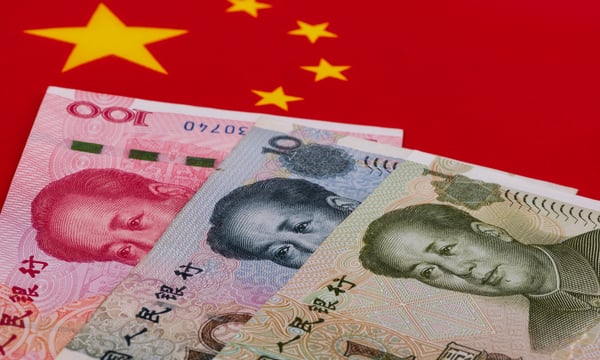
Moody’s, one of the world’s Big 3 credit ratings agencies, this week confirmed China’s sovereign credit rating of A1, Upper-Medium Investment Grade, and revised its outlook from “Negative” to “Stable.”
For nearly two-and-a-half years, since December 2023, China has had to manage a fiscal environment in which its global outlook was designated by Moody’s as “Negative.” Among other impacts, such designation has called into question China’s credibility as a safe destination for Foreign Direct Investment (FDI), and was perceived by the Chinese as an affront to its self-image as a reliable partner and economic powerhouse.
Now, along with Fitch’s and S&P, the other two Big 3 ratings agencies, China has swept the board of recognition and validation by the world’s most trusted credit ratings organizations.
However, while China’s economic forecast looks rosier than many people might have expected in the wake of tariffs and the oil and gas supply crunch, there are those who express caution when taking official Chinese statistics into account – the same figures that agencies like Moody’s use to give coveted ratings that help build companies and countries alike.
James Lewis, a distinguished fellow with the Tech Policy Program at the Center for European Policy Analysis (CEPA), discussed the issue in his aptly-titled article, “The Funhouse Mirror of Chinese Statistics.” Lewis wrote: “Many comparisons of the U.S. and China that are derived from Chinese statistics are open to question… China is engaged in a long-running influence campaign to persuade the world of its success. China’s surprisingly successful campaign (a tribute to persistence) means that China will tilt any statistics in its favor.”
Those who are familiar with Chinese working environments, whether they be in government or in business, know that the pressure to alter numbers to make them more palatable to Chinese Communist Party leadership may be difficult to resist. Everyday bureaucrats in government, and their counterparts in business, may themselves have little taste for “cooking the books,” but may face disciplinary measures, lack of promotion, or even loss of employment if they don’t comply with expectations from above. Compliance doesn’t always mean willing participation, though, and coercive tactics are common.
The pressure comes from superiors, who themselves have to justify the targets that executive leadership has ordained will occur. Indeed, it is uncanny how often China’s government predictions come true. “China’s government regards more data as ‘state secrets’ than other countries do,” Lewis noted. “…China’s national economic statistics cannot be taken at face value. There is a constant desire to inflate metrics like GDP and to disguise metrics, such as debt levels, that contradict the story that success is inevitable.”
China’s official key economic indicators, despite their often-supposed internal adjustments, are a worthy place to begin understanding the basic shape of the Chinese economy, as long as one keeps in mind that there are significant caveats.
Key economic data shows a GDP growth rate in the first quarter of 2026 of 5 percent (year-on-year). Growth over the last quarter, Q4 2025, was 1.3 percent.
The Nominal GDP for all of 2026 is estimated to be $20.85 trillion. The government is targeting growth between 4.5 percent and 5 percent for the year. Growth is being driven “by strong industrial output, increased infrastructure investment, and robust export performance,” according to Trading Economics.
China’s annual inflation eased to 1.0 percent in March 2026 from February’s 1.3 percent – which represented a three-year high – falling short of market expectations of 1.2 percent.
There was a more worrying signal from unemployment data – widely considered one of China’s most sensitive economic statistics. Trading Economics reported that “China’s urban youth unemployment rate for those aged 16–24, excluding students, rose to 16.9 percent in March 2026 from 16.1 percent in the previous month, according to the National Bureau of Statistics. The increase marked the highest level since November 2025, reversing a downward trend seen since September.” In addition, unemployment “among those aged 25-29, also excluding students, climbed to 7.7 percent from 7.2 percent in February.”
As an Asia Society report detailed in September 2025, youth unemployment in China has left millions of graduates with little chance of finding employment, especially in jobs that suit their degrees.
For the Chinese Communist Party, the situation presents a dilemma. The country cannot afford societal destabilization; at the same time, it has by and large taken its thumb off of the operation of the job market. Gone are the days when graduates were assigned jobs, as their parents and grandparents were.
On the other hand, the Chinese graduate today is not benefiting from the spirit of entrepreneurism that hit China in the 1990s as economic reforms took hold and millions of Chinese started up their own businesses. Many chose that route rather than the presumed security of a state-owned enterprise job (many of which were disappearing, as well). Taking this leap was called xia hai – jumping into the sea. But that generation in China had few material comforts to begin with, and were thus more willing to take risks. Today’s Chinese student generation has largely grown up with more security, and aren’t willing to lose it.
The real engine of the Chinese economy, as reported by state sources themselves, is the private sector. This single fact bedevils Communist Party leadership, particularly the man at the top, to no end.
As I wrote previously, the private sector is responsible for “over 60 percent of China’s Gross Domestic Product… China receives 56.9 percent of its tax revenue from the private sector. Over 80 percent of urban employment is provided by private enterprises.”
The strength of privately owned and operated commercial enterprise in China is such that it cannot be ignored, yet it cannot, for ideological reasons, be overly acknowledged or appreciated.
And then there’s China’s unofficial, underground “shadow economy.” At an estimated $3.6 trillion, it is considered to be the largest in the world in absolute terms. In terms of its size relative to China’s GDP, some sources say that this informal economy comprises just over 20 percent of the overall economy, a level shared by Brazil and Indonesia.
With an estimated pool of 200 million people working “off the books” – usually in semi-skilled occupations such as domestic staff, drivers, and construction – it is difficult to quantify their economic contribution, as well as their cost in terms of unpaid taxes. Society generally turns a blind eye to their presence, as they provide valuable services often not found from the traditional, more visible, labor pool.
What happens in Chinese cities when this off-the-books population is hollowed out? Tens of millions of Chinese who went to urban areas to make more money have been forced to leave those cities for lack of a household registration (hukou) card that would give them the right to stay. There is little public data available on either their whereabouts or their welfare, as they didn’t officially exist in their urban landscapes to begin with.
Finally, there’s one more factor to consider: the role of foreign investment and know-how in China’s economic landscape. The Chinese economy has benefited beyond all expectations from the influx of FDI with which China has been inundated over the last 35 years. The investments and the technologies that came with them also brought the foreign practitioners of their industries. Those global engineers, managers, and technicians brought more than just professional skills. They brought the culture of their countries and exposed China to the outside world in profound ways.
Now, however, China is closing back up to foreign influence. Although it is officially still open to incoming investment, foreign businesses have found China a less and less hospitable place to do business. According to data from the World Bank, China’s net FDI inflows peaked at $344 in 2021 – then plummeted over the next three years, bottoming out at just $18.6 billion in 2024. That was the lowest level of net FDI since 1992.
The argument can be made that the more that China builds walls around itself again, the more it loses the ability and insights to successfully interact with the rest of the world – economically or otherwise. In a world ever more interconnected, that’s probably not the best idea.