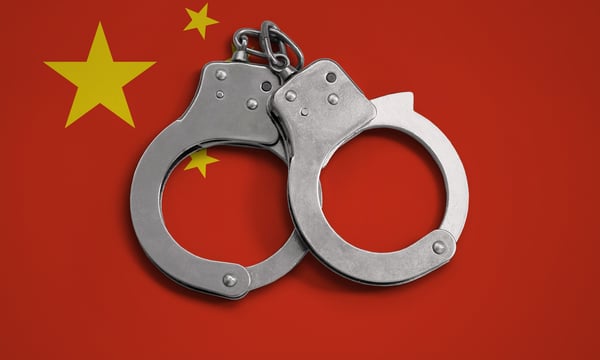
On the eve of the Central Commission for Discipline Inspection’s (CCDI) Fifth Plenum on January 12, CCTV ran a nationally-televised documentary on anti-corruption. In the video, China’s former agriculture minister, Tang Renjian, tearfully recounted the transgressions for which he was given a death sentence. The timing of the choreographed spectacle delivered a sharp reminder of the unrelenting “high-pressure” situation of China’s anti-corruption campaign.
By the time the plenum concluded it became clear why the CCDI is one of the most powerful Chinese Communist Party organs.
Anti-corruption – the remit of the CCDI – has been a top political priority for over a decade. The linkage of political security with economic outcomes indicates the primacy of anti-corruption work for the internal balance of power in the CCP. Last year drove home the CCDI’s continued importance, with the promotion of Zhang Shengmin – who is a deputy secretary at the CCDI – to vice chairman of the Central Military Commission, and with a record-breaking number of cadres and officials investigated in 2025.
So far in 2026, it’s been a busy month for officials leading China’s discipline inspection agencies and organization departments. The conclusion of the CCDI Fifth Plenum was followed by plenums organized by provincial discipline inspection agencies, the National Conference of Organization Ministers, the Central Political and Legal Work Conference, and a conference for provincial and ministerial cadres attended by all Politburo Standing Committee members.
Then, on January 25, the Defense Ministry made the bombshell announcement that two of China’s top general – Zhang Youxia and Liu Zhenli – are being investigated for “violations of discipline and the law.” In China’s system, an investigation presupposes guilt and an eventual conviction.
The flurry of activity signals that significant changes are incoming. Reading the tea leaves to decipher new directions of travel in China’s anti-corruption work, may offer insights into how the CCP regulates itself in the crucial period leading into the 21st National Party Congress (NPC) in 2027, amid a period of global geopolitical turbulence and internal economic uncertainty.
Old Habits Die Hard
General Secretary Xi Jinping’s speech at the Fifth Plenum and subsequently-issued Communique by CCDI indicate continuity with 2025, suggesting the coming year is likely to maintain the increasing intensity of anti-corruption work. Keep in mind, 2025 was a year of dizzying new heights for China’s anti-corruption campaign. A record 115 high-ranking “tigers,” like Tang Renjian and others in the military – Li Shangfu, Miao Hua and He Weidong – were investigated and punished by the CCDI for the vague, but familiar, charge of “seriously violated the Party’s political discipline.”
While the tigers dominated headlines, lower-ranking officials – “flies” – also kept pace with the record-breaking streak of their superiors. Take violations of the Central Eight-Point Regulation, the cornerstone of the anti-corruption campaign, which is mainly violated by cadres below the provincial level. The CCDI investigated 251,516 cases from January to November of 2025, an increase of 30.87 percent compared to the same period in 2024. Grassroots officials (township level and below) were specifically targeted, with investigations growing by 31.28 percent and disciplinary sanctions growing by 19.80 percent compared to 2024.
With these numbers serving as past experience, Xi’s speech guaranteed that 2026 will continue along the established high-pressure pattern. Far from declaring victory, Xi asserted that the fight against corruption remains “severe and complex” and the task of eliminating conditions facilitating corruption remains “arduous and heavy.” Even the title of the Fifth Plenum’s Work Report – “Advance Full and Rigorous Party Self-Governance with Higher Standards and More Concrete Measures, Providing a Strong Guarantee for Achieving the Objectives and Tasks of the 15th Five-Year Plan Period” – indicates greater intensification and institutionalization of measures to investigate misconduct and corruption in 2026.
Emerging Emphasis
While the campaign has been ongoing since Xi took office in late 2012, new priorities are emerging within anti-corruption work. The Fifth Plenum’s explicit emphasis on the 15th Five Year Plan (FYP) reflects the integration of anti-corruption work with policy planning to secure economic performance. Even while speaking at the CCDI’s Plenum, Xi showed a strong focus on economic goals. He stated that the CCP must focus more closely on implementing a new development philosophy, which includes building high-quality development, a modern industrial system, new productive forces, a unified national market, and common prosperity – all while tackling hidden debt.
As a result, anti-corruption work plans at the Fifth Plenum focused on implementation by cadres and officials, to provide a guarantee for policy execution during the 15th Five-Year Plan period (2026-2030). Some priorities were outlined in the Fifth Plenum. For instance, the county-level has been identified as the main “battlefield,” where the CCDI has promised to continue deepening its supervision and rectification work. As one local CCDI official noted in the People’s Daily, “The grassroots level is the ‘last mile’ of policy implementation.”
The emphasis on implementing decisions also reinforces the structure of decision-making within the CCP. It reinforces the top-down structure of policymaking by scrutinizing local officials for implementation. While local officials come under the microscope of the CCDI, Xi Jinping’s centrality to determining the future trajectory of China is assured by the Plenum’s focus on the “two establishes” and “two safeguards.” The China Media Project summarized the meaning of those catchphrases as follows:
1) that he [Xi Jinping] must be the single, unquestionable leader of a unified CCP and that 2) his ideas… are by necessity the bedrock of the Party, its policymaking and its legitimacy for the 21st century.
According to Chen Li, deputy director of the Research Center for Party Constitution and Regulations of the Central Party School, reinforcing this policy ideation-implementation structure is necessary for addressing the “complex international situation” and “arduous domestic tasks of reform, development and stability.”
Replication Across Power Structures
The focus on implementing CCP decisions and preserving the authority of decision-making is repeated diligently across power structures in the party. Plenums at the provincial level and provincial party secretaries have echoed the emphasis on policy implementation. The party secretary of Beijing, Yin Li, in his speech at the Fifth Plenary Session of the 13th Beijing Municipal Commission for Discipline Inspection, promised to “relentlessly strengthen political oversight to ensure the effective implementation of the Party Central Committee’s major decisions and plans” as the first task of strengthening Party discipline. Similarly, the Resolution adopted at the Fifth Plenary Session of the 12th Shanghai Municipal Commission for Discipline Inspection, identifies “ensuring the effective implementation of the major decisions and deployments of the Party Central Committee” as its first task of 2026.
Meanwhile, other structures within the CCP have signalled the importance of securing Xi Jinping’s position as part of anti-corruption efforts. Lü Pin, deputy director of the Research Center for Party Constitution and Regulations of the Central Party School, pointed out that the Three-Year Action Plan for Education and Guidance of Young Cadres in Central and State Organs (2025-2027) educates young cadres on the “two safeguards.”
In fact, the emphasis on implementing the party’s decisions is a call back to the Central Eight-Point Regulation, the fountainhead of Xi Jinping’s anti-corruption campaign. Designed to handle work ethic problems, the Regulations have been emphasized at the Fifth Plenum. Even the release of details relating to Tang Renjian’s case reinforced the perniciousness of hedonism and extravagance, and formalism and bureaucracy (four work ethic problems). Tang’s confession that all his problems started with eating and drinking indicates that the Regulations are tied to the anti-corruption campaign’s focus on ensuring economic outcomes in the 15th Five-Year Plan period.
Institutionalization and Construction
True to the shifting searchlight of anti-corruption work to unearth violations across the party-state, new targets have been identified at the Fifth Plenum. Corruption in finance, state-owned enterprises (SOEs), energy, fire protection, tobacco, pharmaceuticals, universities, sports, development zones, public welfare and charity, work safety, engineering construction, and bidding has been prioritized for 2026. Investigations will also target rural collective assets, medical insurance, elderly care services and farmland construction.
In the political domain, they will target “capital’s infiltration into the political sphere” (资本向政治领域渗透) and the “revolving door” (旋转门) between business and government. Additionally, the “Year of Standardization, Legalization, and Regularization of Discipline Inspection and Supervision Work,” will be extended for two years to further institutionalize anti-corruption work.
Other efforts to institutionalize anti-corruption work have also been proposed, including revisions to the “Regulations on Intra-Party Supervision of the Communist Party of China” and “Rules for Supervision and Discipline Enforcement Work of the Discipline Inspection Organs of the Communist Party of China.” To actualize the Fifth Plenum’s plans, new regulations have been proposed and others have already been released. The CCDI plans to formulate an anti-cross-border corruption law with the National People’s Congress, and on January 20 the National Supervisory Commission (NSC) released new information disclosure regulations to strengthen the supervision of supervisory organs.
Building a “culture of integrity in the new era” has also been championed, leveraging concepts from traditional Chinese culture, revolutionary culture, and socialist culture to augment the ideological and moral foundations of anti-corruption work. Ren Jianming, professor at the School of Public Administration of Beihang University, argued that the “culture of integrity in the new era” departs from the previous theme of clean governance with its expansion of influence from party and government organs to mass culture.
Looking Ahead
The CCDI Fifth Plenum’s efforts to condition China’s political environment and the behavior of self-interested actors in the party can greatly influence how internal and external pressures are managed. Institutions like the CCDI are increasingly vital in determining the execution and outcomes of policy plans, like the 15th Five-Year Plan. Overall, the linkage of anti-corruption work with broader policy outcomes reinforces the idea that political security is a precondition for economic outcomes. An expression of the same idea is that governing the party is a necessary prerequisite for governing China.
Outcomes of the Fifth Plenum encourage the scrutiny of officials at the county and township level, while crystallizing the top-down policymaking structure that reinforces the authority of Xi Jinping. With pressing policy problems on the horizon, as the latest economic data suggests, limitations on the motivation of officials to innovate and experiment with policy directives could be damaging. However, with the 21st Party Congress looming on the horizon, consolidating political security and mitigating risks to centralized authority are likely to take precedence over other considerations.