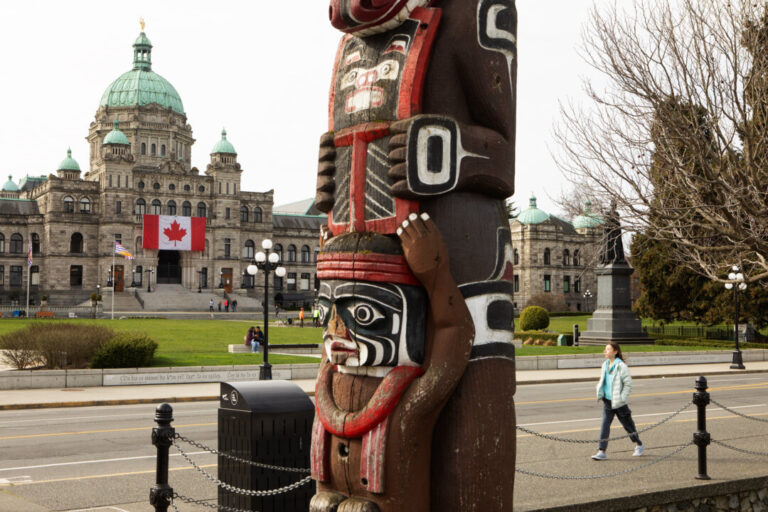

A view of the B.C. legislature in Victoria on March 7, 2025. The Canadian Press/Chad Hipolito
The B.C. government says it has dropped plans to tie its bill suspending parts of the Declaration on the Rights of Indigenous Peoples Act (DRIPA) to a confidence vote, reducing the likelihood of an early election.
B.C. Premier David Eby said last week that the survival of his NDP government would depend on passage of the bill. However NDP House Leader Mike Farnworth said on April 13 that the planned legislation won’t be tabled this week in the legislature, adding that it will not be tied to a confidence vote when it is introduced in the future. In a confidence vote, the defeat of a bill would trigger an election.
DRIPA, passed in 2019 under former Premier John Horgan’s NDP government, commits the province to aligning its laws with the United Nations Declaration on the Rights of Indigenous Peoples (UNDRIP). UNDRIP is a non-binding 2007 U.N. declaration that sets out global goals for self-determination, land rights, cultural preservation, self-governance, and consultation for indigenous peoples on any decisions affecting their communities.
“We recognize that this is an important issue,” Farnworth told reporters on April 13, adding that NDP MLA Joan Phillip, who is indigenous, has “significant concerns” about the bill and has said she will not support its passage.
The proposed bill has drawn backlash from First Nations leaders in B.C., including Phillip’s husband, Grand Chief Stewart Phillip, who serves as president of the Union of B.C. Indian Chiefs.
The NDP holds a one-seat majority in the B.C. legislature, and Farnworth said the government is seeking a “path forward” for the proposed legislation. Farnsworth dismissed the suggestion that Eby has lost the confidence of the legislature, calling it “nonsense.”
Eby has said aspects of DRIPA pose legal uncertainty after a B.C. Court of Appeal decision on Dec. 5 of last year in favour of the Gitxaala Nation. The appeal court held that DRIPA was legally enforceable in backing Gitxaala’s challenge to the province’s mineral tenure system, which the First Nation said allowed mineral claims to be staked on its territory without adequate consultation or consent.
The ruling stated that B.C. must ensure DRIPA is “properly interpreted” and incorporate UNDRIP into B.C. law “with immediate legal effect.”
Eby said the Gitxaala ruling now means every provincial law can be challenged to determine consistency with UNDRIP.
“The court has told us that their interpretation of the law is that the entirety of the declaration act has become B.C. law overnight. That was never the plan,” he told reporters April 10 in Vancouver.
Farnworth said the bill temporarily pausing certain sections of DRIPA will be tabled during this spring legislative session and said consultation and engagement with First Nations will continue. He said that, once the bill is introduced, he expects Joan Phillip as well as B.C. Conservatives, Independents, and Green Party members will support it.
The BC Conservative Party has said it will take every possible opportunity to defeat the NDP government and pledged to repeal DRIPA entirely if in power.
“20 court cases pending. Property rights at risk. But the Premier folded because he doesn’t have the confidence of his own caucus,” Interim BC Conservative Party Leader Trevor Halford said on social media. “BC needs certainty, and that means repealing DRIPA.”
The Canadian Press contributed to this report.