In early March, China made an unusual offer to Taiwan – promising energy security in return for acquiescing to Chinese rule.
It surprised few, then, that the offer was quickly turned down by the Lai administration. With the Democratic Progressive Party (DPP) in power, China would not expect Taiwan to agree. The offer was only for optics, so that Beijing could frame the Lai administration as unwilling to engage in dialogue with China, even if this puts Taiwan’s energy security into crisis.
China is, of course, playing on global anxieties after the outbreak of hostilities in Iran. Shipments through the Strait of Hormuz, a key chokepoint for energy supply chains, have stalled, and the global impact is enormous, with oil and gas shortages in other countries in the region. Natural gas constituted around half of Taiwan’s energy generation in 2025, with one-third of liquified natural gas (LNG) shipments coming through the Strait of Hormuz from Qatar.
Although Taiwan has not yet seen such shortages, the Taiex, the Taiwan Stock Exchange’s benchmark index, tumbled 594.43 points, or 1.80 percent, earlier this week due to rising crude oil prices. Taiwan’s major tech companies, such as TSMC and Hon Hai, were among the hardest hit.
Still, Beijing’s offer was unusual. In the past, China has not made many specific offers to Taiwan about what it would gain in return for ceding sovereignty, aside from vague promises that Taiwan would benefit from China’s economic growth. It is also of note that through this offer, China is attempting to position itself as a security guarantor for Taiwan – a role traditionally played by the United States, in terms of defending Taiwan from Chinese military threats. It is to be seen if the Chinese Communist Party (CCP) continues to lean into this narrative of framing itself as an alternative security guarantor for Taiwan, in light of continued global instability.
Taiwan’s dependence on energy imports has come into focus as of late, with tensions in the Middle East only one factor that concerns policymakers and analysts alike. In the event of a Chinese invasion, Taiwan would be cut off from shipments of LNG needed to keep society running. Likewise, Taiwan’s economy is currently buoyed by the semiconductor industry and AI boom, which also requires stable energy.
Taiwan largely takes the view that its present dominance in semiconductors keeps the world invested in Taiwan’s defense – and dissuades China from a military assault, since it is also dependent on Taiwanese semiconductors. This view is often referred to as the “Silicon Shield.” As such, energy security is considered vital for Taiwan’s geopolitical security.
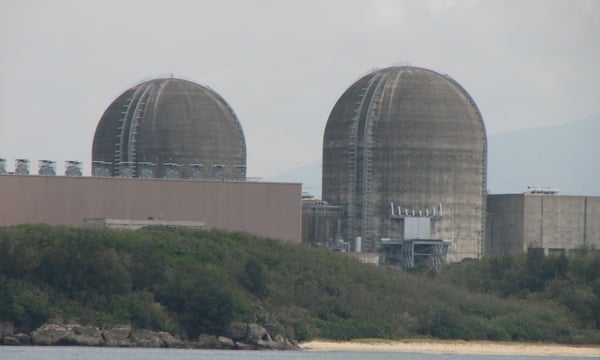
It is in this context that the Lai administration reversed course on nuclear energy, which the DPP has historically been opposed to. On March 22, Lai stated that Taiwan’s state-run energy utility, Taipower, would submit plans to restart the Guosheng No. 2 nuclear plant in Wanli, New Taipei, and the Maanshan No. 3 nuclear plant in Hengchun, Pingtung before the end of the month.
Lai had previously hinted at an openness to nuclear energy, stating that nuclear energy could be used to fuel the AI boom. In 2024, Lai had expressed interest in small-scale modular reactors (SMRs). In this framing, SMRs are framed as free from the safety concerns that the DPP has long had about nuclear energy, due to being a newer and more advanced technology.
Yet considering the use of SMRs proved very different from restarting nuclear reactors that had previously been decommissioned. The Lai administration, following in the footsteps of the previous Tsai Ing-wen administration, allowed the licenses of existing nuclear reactors to expire, rather than extending them – something the Kuomintang (KMT) had pushed for.
In May 2025, the last of Taiwan’s nuclear power plants – the Ma-anshan plant – ceased operations.
When questioned by the opposition KMT, the Lai administration denied that its shift on nuclear energy is due to the Strait of Hormuz crisis. The administration asserted that it has been able to negotiate natural gas shipments, stating in early March that 20 of 22 planned shipments had been secured. Taiwan’s government says that the LNG supply would be stable through April.
The Lai administration has emphasized that the nuclear restarts will follow normal recommissioning procedures, rather than taking place as emergency restarts. Taipower, the state-owned company that operated Taiwan’s nuclear power plants, would have to submit a formal request for restarts, followed by inspections by the Nuclear Safety Commission. It is believed that the recommissioning process will take several years, with reactors coming back online in 2028.
By contrast, an emergency order by President Lai Ching-te would allow for a near-immediate restart, though safety checks would also have to take place. An emergency order would only allow plants to operate for two to three months.
The Lai administration has stated that there is no need to restart nuclear power plants on the basis of an emergency. Taiwan has more than 11 days of LNG supply, as required by law, and its oil reserves are sufficient for more than 100 days. Rather than restart nuclear power plants, the Lai administration has stated that coal-fired plants could be brought back online in an emergency if the crisis in the Middle East continues.
Since Lai’s announcement, the KMT has gone on the attack, hitting out at the DPP for obstructionism against nuclear energy then later reversing course. The KMT has frequently pushed for nuclear power, support no less than three public referendums on nuclear energy since 2018.
The DPP has historically been opposed to nuclear energy, due to concerns about nuclear waste storage on Taiwan’s limited land mass and the possibility of Taiwan’s frequent seismic activity causing a nuclear disaster along the lines of the 2011 Fukushima disaster.
Indeed, on March 11, Minister of Economic Affairs Kung Ming-hsin announced plans to restart the No. 3 Ma-anshan Reactor. Given that Taiwan’s anti-nuclear movement saw its peak in past decades in the wake of the Fukushima disaster, it was rather brazen for Kung to make the announcement on March 11, the 15th anniversary of the Fukushima disaster.
Traditional supporters of the DPP may be angered by the party shifting on a core position. The government, however, may be aiming not only at energy security but sending a message to the international community about Taiwan’s willingness to make hard choices to ensure its security.
Nuclear energy only constituted 6 percent of Taiwan’s energy supply in 2023, but international discourse sometimes speaks of nuclear energy as a silver bullet solution to Taiwan’s industrial energy needs – particularly in hypothetical scenarios where energy supply is cut off by an invasion or blockade.
In this sense, Lai may be seeking to maintain international support for Taiwan by changing the DPP’s posture on nuclear power. Notably, the reversal takes place at a time when the KMT’s continued blocking of defense spending in the legislature has raised questions for Western countries over Taiwan’s will to defend itself. U.S. lawmakers and Washington’s de facto diplomatic representatives in Taiwan have weighed in numerous times on the matter.
Even so, reliance on nuclear energy may still prove a short-term solution, given Taiwan’s lack of fuel rod storage capacity and the unwillingness of local governments to upset voters through the construction of new nuclear waste disposal facilities. Domestic discussion of Taiwan’s energy security during an invasion or blockade has sometimes questioned the utility of nuclear reactors when they may be targeted by China as a single point of failure that could disrupt the energy grid.
Instead, some experts in Taiwan argue that decentralized grid of renewables – currently at 12.7 percent of Taiwan’s energy mix – would be more resilient against an invasion, dovetailing environmental and defense concerns. The Lai administration has also stated that nuclear energy will be used alongside renewables, but Taiwan’s energy debate is far from settled.