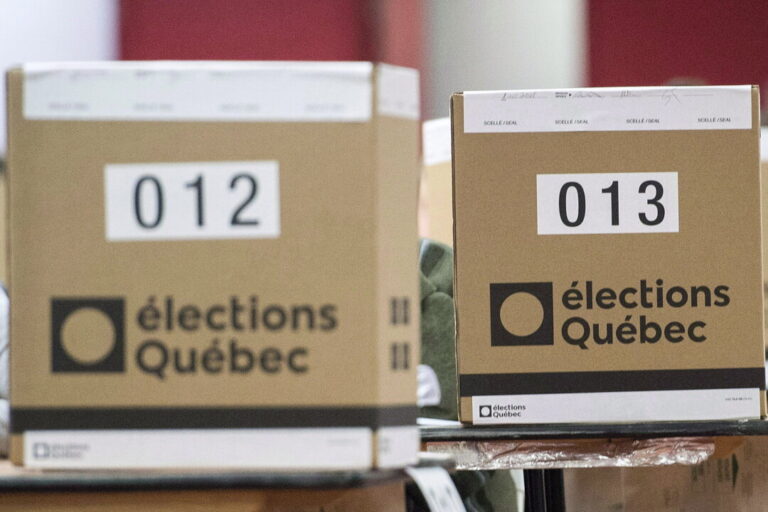

Ballot boxes are shown at a polling station in Montreal on Oct. 1, 2018, on election day in Quebec. The Canadian Press/Graham Hughes
Quebec residents headed to advance polling stations on Sept. 27 as five major parties vie for seats in the Oct. 5 general election.
The latest provincial poll on voter intention, conducted by Léger online from Sept. 18 to 21 among 1,001 eligible Quebec respondents and published Sept. 22, shows Parti Québécois leading at 29 percent. The Quebec Liberal Party follows at 23 percent, the governing Coalition avenir Québec (CAQ) at 20 percent, the Conservative Party of Quebec at 17 percent, and Québec solidaire at 10 percent.
The parties have been focused on issues related to cost-of-living, immigration, while the CAQ, like other incumbents in recent elections in Canada, have campaigned on the response to U.S. President Donald Trump.
CAQ’s platform is focused on addressing the cost of living, improving public services, and infrastructure expenditure through the $180 billion Plan québécois des infrastructures, while aiming for a balanced budget by fiscal year 2029–30.
PQ has focused on issues such as public spending, the housing crisis, cost of living, the protection of the French language, and homelessness. The separatist party has said that it wouldn’t hold a separation referendum if it wins the election while Trump is U.S. president.
Quebec Liberals have also focused on housing affordability and construction, economic support for small and medium-sized businesses, health-care access, education, and youth supports.
The Conservatives advocate for greater private-sector involvement in health care, natural resource development, regional autonomy, and increased autonomy for Quebec within Canada, along with specific measures on immigration, housing, education, families, and seniors.
Québec solidaire proposes a tax on high-net-worth households (over $25 million) to fund public services; measures to drive the ecological transition, by investing heavily in public transit in particular; and ultimately Quebec independence.
On the election campaign, CAQ Leader Christine Fréchette charged that Americans might try to support the separatist PQ to cause instability. The comment drew criticism from opposition parties, and Fréchette later appeared to backtrack, saying there is no indication of interference in the current campaign.
This year, a rule governing the use of languages other than French at Quebec polling stations fully took effect, requiring election staff to communicate with voters in French unless a recognized exception applies. The rule does not restrict what language voters may speak. Staff may use another language to determine whether a voter qualifies for an exception, such as being indigenous or eligible for English-language education.
The rule stems from Bill 96, enacted in 2022, which tightened Quebec’s language laws and established limited exceptions. After transition periods for government bodies expired, Élections Québec’s directive fully took effect for the current election cycle.
The Canadian Press contributed to this report.