Last week, Nie Pengli’s two-and-a-half–year ordeal finally came to an end. Ahead of his scheduled retrial on charges of illegally selling firearms, he was informed that prosecutors had withdrawn the case. Nie had faced the prospect of years in prison.
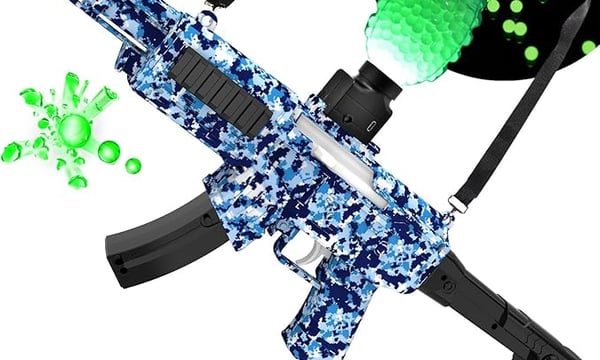
His alleged crime? Selling toy-like “gel blasters” that fire soft, water-filled polymer beads.
Nie’s case is only the latest example of how China’s exceptionally strict definition of a firearm continues to pull ordinary people into the criminal system over items that, in many countries, would be regulated as toys. Over the past 15 years, this threshold has repeatedly produced cases that appear disproportionate or even absurd.
According to reporting by ThePaper.cn, Nie – formerly a security guard and later a food-delivery worker – opened an online toy shop in 2020 after losing his job during the pandemic. Gel blasters quickly became his bestselling product. These are gas- or spring-powered replicas designed for recreation, firing soft beads that typically shatter on impact. Nie promoted them on Douyin and sold them through WeChat. With similar products widely available across Chinese e-commerce platforms, he had little reason to suspect any legal jeopardy.
But when one customer tried to return items for repair, the delivery company reported the parcel to police in Wuwei, Gansu province. That lead to a raid on Nie’s warehouse in Henan and, in early 2023, criminal charges for possession and sale of illegal firearms. At his first trial, prosecutors sought up to six years in prison, and the court ultimately handed down a three-year sentence, suspended for four years. Nie appealed, and in April 2024 a higher court ordered a retrial, questioning the evidentiary basis of the original verdict. Prosecutors finally dropped the case.
Throughout the proceedings, Nie’s lawyer argued that gel blasters do not meet the Criminal Law’s definition of a gun – namely, an object capable of causing bodily injury, death, or loss of consciousness. Instead, the prosecution relied on a technical standard used by police: whether the device can fire a projectile with an impact energy exceeding 1.8 joules per square centimeter.
This threshold does not come from statute. It’s an administrative standard adopted by the Ministry of Public Security around the time of the 2008 Beijing Olympics. According to one media report, this figure was chosen as this is the threshold for injuring the human eye. Like other security measures adopted around that time, like body scanners at the capital’s subway stations, the threshold has proven long-lasting.
The standard is also unusual. It measures impact energy over an area, not muzzle velocity or overall projectile energy, making cross-jurisdiction comparisons difficult. State media have cited unnamed experts who claim that Hong Kong’s regulations work out to just over 7 J/sq cm and Taiwan’s to around 20 J/sq cm, with roughly 16 J/sq cm required to pierce human skin. Nie’s gel blasters were recorded at 2.2 J/sq cm.
After the adoption of this standard, the number of firearms offenses cases recorded by police surged dramatically, with tens of thousands of arrests recorded in the following years, according to official media.
Although Nie spent months in detention, his eventual outcome was lenient compared to several high-profile predecessors. In 2015, Fujian resident Li Dehua received a life sentence for “arms smuggling” after buying air guns from Taiwan. At trial, Li reportedly told the court, “Shoot me with my guns. I will plead guilty if they are capable of killing me!” Following sympathetic state media reporting and public criticism, his term was later reduced to seven years.
In 2017, Zhao Chunhua – a middle-aged woman who ran a fairground shooting gallery – was sentenced to three and a half years for firearms possession. Her sentence was also ultimately suspended after an outcry.
Observers often ascribe such cases to a longstanding suspicion of an armed populace, pointing as far back as the Qin dynasty’s ban on private weapon ownership. But the persistence of today’s low threshold has less to do with ancient precedents than with institutional inertia. The 1.8 J/sq cm standard has now shaped police practice for around 15 years. Despite producing recurring controversies – most recently Nie’s case – and calls for change, it has proven remarkably resistant to revision.