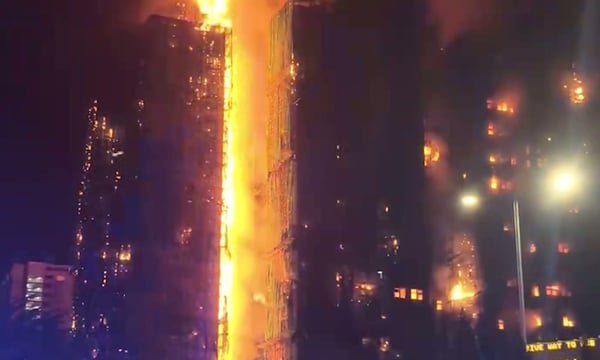
The fire that tore through the Wang Fuk Court apartment complex in Tai Po on November 26 was the deadliest fire Hong Kong has experienced in decades. Over 150 people have died, and the death toll continues to climb.
This tragedy is a manmade disaster through and through. I say this with great love for Tai Po as a resident for all my life before coming to Boston for graduate school. To see the tragic fire unfold from afar, especially during the festive Thanksgiving weekend in the United States, has been particularly difficult to me. The seven 31-storey buildings at Wang Fuk Court that were engulfed by fire – a tragedy documented in real-time in videos and social media – are just a 10 minute drive from my home. Many Tai Po residents pass by them every time they travel downtown.
I watched in great shock, sadness and anger, as the death toll climbed to at least 151 and as more information surfaced about the safety concerns that residents had raised a year ago.
International media across the board were quick to follow the Hong Kong government’s narrative in blaming the cause on the bamboo scaffolding. In doing so, reporters were overlooking the fact that homeowners in these buildings had long protested about the tendering process for the HK$330 million (US$42.4 million) exterior maintenance contract, about workers smoking on-site once the project started, about the flame-retardant safety standards of the mesh used to cover the scaffolding, and about the fire alarm system being turned off for the “convenience” of the work.
The result was that when the first building with its exterior mesh caught fire, the fire alarm did not go off for its 4,600 residents. It took only 10 minutes before the fire reached the top of the first building and spread sparks to the next six, burning everything for 30 hours. Ironically, much of the maligned bamboo scaffolding remains standing after the fire was finally put out.
These are undeniable facts based on the countless media interviews with survivors and government documents that have come to light.
How could fire alarms be disabled for a housing estate of over 4,600 residents? If the government enforced safety standards as necessary, could this have been prevented in the first place? How is the government not more concerned with the underlying series of oversights that have led to this tragedy?
Indeed the Labor Department inspected Wang Fuk Court 16 times since July and during its last inspection on November 20, a week before the blaze, the contractor was issued a reminder of fire safety standards following complaints of workers smoking on-site. This begs the question of how and why government inspections were insufficient in preventing the disaster. Foam panels used to conceal residential units’ windows from the outside in the Tai Po fire were even certified as flammable by the secretary of security – how were they not spotted in the inspections?
Hong Kong has suffered similar fires in the past. Most recently on October 29, at a Kai Tak construction site, the mesh covering the scaffolding was allegedly ignited by a cigarette butt. On October 18, a No. 3 alarm fire was declared for a commercial building in Central, following which the Building Department indicated investigation into fire safety compliance of the mesh used.
While no one died in these two fires, they should have served as a wake-up call before tragedy struck. How could there not be a sufficient response, such as a city-wide inspection campaign, to ensure the safety of the millions of Hong Kong citizens living around construction and maintenance sites?
Any accountable government would have anticipated a parliamentary inquiry into a disaster of this scale, through powers vested in the legislature to conduct its own investigations. Hong Kong’s Legislative Council, under Article 73(10) of the Basic Law, has the power “[t]o summon, as required when exercising the above-mentioned powers and functions, persons concerned to testify or give evidence,” powers further set out by the Legislative Council (Powers and Privileges) Ordinance (Cap. 382).
An attempt in this direction to request a special meeting of the Council pursuant to Session 15 of the LegCo Rules of Procedure was made by legislator Tik Chi-yuen of the Social Welfare Constituency. This request was refused by LegCo President Andrew Leung on the ground that only the chief executive could request emergency LegCo meetings. Does this mean Chief Executive John Lee opposes parliamentary inquiry?
That same evening, Leung was seen attending a banquet organized by the Former Senior Civil Servants Association, and smiling when addressing the room in front of a screen showing the name of the heroic firefighter who died saving the lives of Hong Kong citizens. This is not an optics problem, but an exacerbation of the ongoing crisis of societal faith in public institutions and good governance following one of Hong Kong’s worst disasters in decades.
The Commissions of Inquiry Ordinance was exactly designed to deal with such doubts in matters of public importance. With a High Court Judge as chair, it was used in the past to investigate corruption in infrastructure projects and heavy metal contamination in drinking water. And yet, the formation of the Inter-departmental Fire Investigation Task Force falls far short of the impartiality that an independent Commission of Inquiry could warrant.
Hong Kong is now at a crossroad again. Will the city government prioritize fairness and justice through impartial investigations into the complaints from residents previously cast aside, or will it focus on deflecting scrutiny, steering the city toward a dangerous governance crisis?