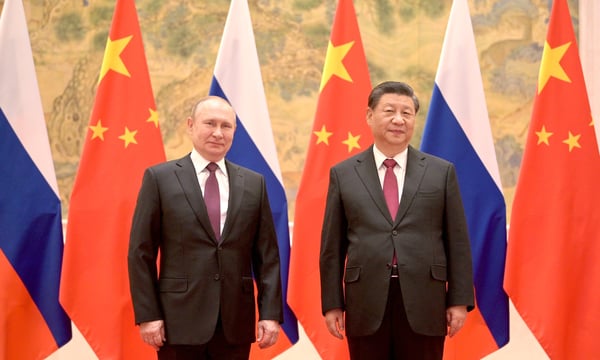
On February 4, 2022 – four years ago, today – China and Russia proclaimed a “no-limits” friendship. It was set out in the Joint Statement of the Russian Federation and the People’s Republic of China, issued by Presidents Vladimir Putin and Xi Jinping on the sidelines of the Beijing Winter Olympics. Released just 20 days before Russia’s full-scale invasion of Ukraine, the declaration has since become one of the most frequently cited tropes in discussions of China-Russia relations.
While analysts often and correctly point to the practical constraints of the partnership, debates frequently overstate the meaning of the phrase itself, because observers rarely consider its origins. The slogan emerged in the context of the 2021 renewal of the Sino-Russian Treaty of Good-Neighborliness and Friendly Cooperation and the logistical anxieties of a world under pandemic lockdown.
Fixation on the “no-limits” formula obscures a more consequential development embedded in the joint statement: China expressed understanding for, and endorsement of, Russia’s demand that NATO withdraw soldiers and weapons systems from post-1997 member states such as Poland and the Baltic countries. While references to a “no-limits” friendship have entirely faded after 2023, Beijing has progressively reinforced and hardened its stance against NATO.
China-Russia “No Limits” in Pandemic Context
The “no limits” phrase was most likely not born in a military war room but in the Chinese Foreign Ministry’s attempts to manage the physical isolation of the COVID-19 pandemic. Foreign Minister Wang Yi first used the formula, albeit without stating friendship, in January 2021 during a New Year interview, noting that China-Russia strategic cooperation “has no limits (没有止境), no taboos (没有禁区), and no upper limit (没有上限).” Around the same time, Foreign Ministry spokesperson Hua Chunying echoed similar language. In this setting, the formulation rather sounded like a commitment that, despite border closures, strategic cooperation and trade would continue uninterrupted.
While Wang Yi introduced the language of “no-limits” cooperation, Vice Foreign Minister Le Yucheng updated it in December 2021. He emphasised that there were “no limits to China-Russia friendship, no taboos in cooperation, and no upper limit on mutual trust.” Unlike Wang’s earlier emphasis on cooperation, Le explicitly elevated the concept to the level of friendship.
Crucially, he still linked this formulation directly to the pandemic, stating that China would strengthen coordination with Russia to “prevent the cross-border spread of COVID-19 and ensure the safe and orderly movement of personnel.” In 2021, the term thus remained tethered to the functional realities of pandemic governance.
The Politics of Friendship
Whereas the “no-limits” phrasing was shaped by pandemic conditions, the concept of “friendship” has deeper ideological roots. As David Bandurski argues, the PRC’s understanding of friendship draws on the Soviet tradition of friendship of the peoples, in which friendship functions as a code for expected political alignment rather than emotional affinity.
This relationship is formalized in the 2001 Treaty of Good-Neighborliness and Friendly Cooperation, which was duly renewed in 2021 in accordance with its provisions. Both sides described the treaty as a “programmatic and foundational document” for their strategic partnership and emphasized that it settled border issues (rooted in the 19th-century treaties of Aigun 1858 and Beijing 1860). The treaty invokes the legacy of the 1950 Treaty of Friendship between the Soviet Union and the PRC while symbolically closing the Sino-Soviet split. It does not constitute a military alliance but consists of mutual assurances of political support without specific combat commitments.
The renewal in June 2021 was accompanied by intensified symbolic rhetoric. At a joint event organised by the Russian International Affairs Council (RIAC) and the Chinese Academy of Social Sciences (CASS), Wang Yi referred to Russia as a “reliable comrade” (tovarishch) and spoke of moving together toward the “revival of two great nations.” For China, this language resonates with ambitions toward Taiwan and for Russia, it is difficult to associate it with anything else than to reevoke authority over former Soviet or Tsarist territories. In this setting, “friendship” operated as a coded signal of shared revisionist intent.
From Pandemic Formula to Geopolitical Signal
The transition from a pandemic-associated slogan to an overt geopolitical signal occurred on February 4, 2022. The joint statement issued that day challenged the post-Cold War security order by expressing China’s “sympathy for” and “support” of Russia’s proposals for legally binding security guarantees in Europe. This implicitly endorsed Moscow’s demand that NATO should withdraw troops from the territory of post-1997 member states, such as Poland and the Baltics. While the pandemic was mentioned only in passing, security concerns dominated the text.
According to the statement, “friendship between the two States has no limits, there are no ‘forbidden’ areas of cooperation, [and] strengthening of bilateral strategic cooperation is neither aimed against third countries nor affected by changes in the international environment” – a formulation that appeared to anticipate backlash from the liberal world. At the same time, the February 2022 text quietly abandoned the reference to having no “upper limit” (上限) that had featured in earlier pandemic-era formulations. While friendship was still described as boundless, the omission of this qualifier marked a subtle narrowing of language.
The Reframing Exercise
As the Ukraine war unfolded, Beijing recalibrated its rhetoric. Xi Jinping likely did not anticipate a conflict of this scale and duration. One month after the invasion, then-Ambassador to the United States Qin Gang argued that while cooperation has no limits, it has a “bottom line” in the principles of the United Nations Charter. Around the same time, Foreign Ministry spokesperson Wang Wenbin reformulated the slogan, stating that China-Russia cooperation has “no upper limit” (上限) in “striving for peace, safeguarding security, and opposing hegemony.”
In April 2023, China’s then-Ambassador to the EU Fu Cong dismissed the “no-limits” phrase as “nothing but rhetoric,” later blurring its meaning further by suggesting that cooperation between China and Russia was no more “limitless” than cooperation between China and Europe. Notably, this reframing replaced the language of friendship with that of cooperation and shifted emphasis toward “upper limits,” while references to more general limits (止境) or taboos (禁区) largely disappeared.
Russian officials, by contrast, have generally avoided the “no-limits” formulation. Both before the invasion and in the years since, the phrase has been hardly used by Russian elites. Explicit rhetorical alignment risked further alienating Western actors, while Russia continued to benefit materially from Chinese support. Moscow also has an interest in sustaining the illusion that a “reverse Kissinger” dynamic could still be pursued by Washington. This refers to the idea that Russia might improve relations with the United States in order to loosen or complicate the Sino-Russian partnership. In this sense, rhetorical restraint could be useful to Moscow as well.
One exception was Igor Morgulov, who has served as Russia’s ambassador to China since September 2022. In an interview with RIA Novosti, he endorsed the phrase, stating that it “accurately reflects the state of our relations” and that the prospects for cooperation were “truly limitless.” This endorsement reflected both his diplomatic role and his earlier involvement as Le Yucheng’s counterpart. At the same time, the invocation of future “prospects” (perspektivy) itself suggests a gap between rhetorical ambition and present reality.
The 2026 Milestone
Understanding the “no-limits” slogan as a recycled pandemic-era formula allows for a clearer assessment of the partnership. While international backlash discouraged continued use of the phrase, the underlying dynamics of the relationship have not changed. As 2026 approaches and the next treaty renewal comes into view, a renewed emphasis on “friendship” is already emerging. Morgulov stated in late 2025 that “there is no doubt” the treaty will complete its second renewal and embark on another five-year cycle.
While treaty-based friendship rhetoric is set to return, a revival of the “no-limits” formula itself remains unlikely. The more consequential development lies elsewhere. Since 2022, Beijing has supported Russia’s pretext for war and progressively hardened its stance against NATO, moving toward explicit challenges to the alliance’s legitimacy.
As Wang Yi told EU High Representative Kaja Kallas, China does not want to see a Russian defeat because it fears the United States would then shift its whole focus to Beijing. This position was reiterated during the interparliamentary meeting between the European Parliament and the Chinese National People’s Congress in October 2025, when the Chinese side questioned NATO’s right to exist, arguing that the alliance lost its raison d’être with the end of the Soviet Union.
Thus, the lasting significance of the four-year old joint statement lies not in the vanished “no-limits” slogan but in China’s explicit endorsement of Russia’s position and an anti-NATO stance, which has only intensified over time.