Earlier this month, officials abruptly closed the 758-meter Hongqi Bridge in Sichuan after cracks appeared in the surrounding terrain. Within a day, landslides tore through the mountainside, dramatically collapsing the bridge into the river below.
The Hongqi Bridge collapse is just the latest symptom of a wider problem: incentives for hurriedly completed projects and an insufficiently enforced regulatory regime together lead to construction that can’t withstand real stress.
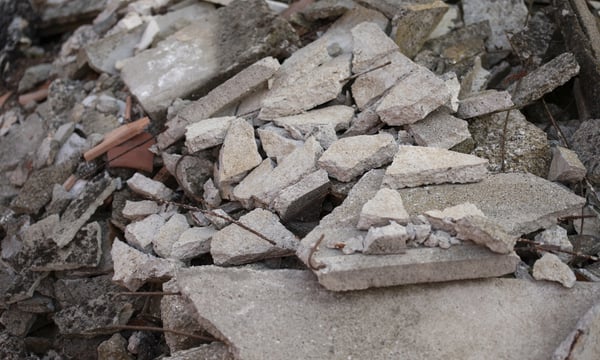
China even has a phrase for these poor-quality works: doufuzha gongcheng, or “tofu-dreg projects,” a term popularized by Premier Zhu Rongji in 1998 after he publicly criticized shoddy construction in flood-control works. It has since become shorthand for construction that passes paper inspections but fails in practice.
Much of the problem lies in China’s target-based responsibility system, which ties promotions to quantifiable achievements. A project that opens on schedule strengthens a cadre’s career prospects; a delay threatens it, even when necessary to ensure quality work. When something goes wrong, officials’ instincts are to manage the narrative, not the root cause.
The consequences have played out for decades. After the 7.9-magnitude Sichuan earthquake in 2008, parents noticed that many government buildings remained standing while school buildings pancaked, killing over 700 children in just one instance. Despite parents’ protests for investigations into the “tofu-dreg schools,” authorities detained activists for “inciting subversion of state power,” such as Tan Zuoren, who co-authored an independent report on the tragedy. Officials curbed domestic reporting, prevented mourning in public spaces, and failed to release a comprehensive audit.
Four years later, the Yangmingtan Bridge in Harbin partially collapsed just nine months after opening, killing three people and injuring five. Reports later found the bridge was completed in less than half the planned time, under intense pressure to showcase local achievement. Quality checks under China’s national standards were also either rushed or bypassed. A report in the state-owned China Daily blamed overloaded vehicles for the collapse.
In 2020, a quarantine hotel in Quanzhou collapsed, killing 29; a warehouse in Heilongjiang collapsed weeks later, killing nine; and a restaurant in Shanxi collapsed after “illegal extensions,” killing 29 more. In 2021, the Four Seasons Kaiyuan Hotel collapse killed 17. In 2024, a bridge collapse in Shangluo, Shaanxi killed 11 and a highway collapse in Sichuan killed two.
This pattern is not confined within China’s borders. This past March, a 32-story building in Bangkok constructed jointly by Italian-Thai Development PCL and China Railway No. 10 Engineering Group, a subsidiary of a Chinese state-owned enterprise, collapsed following a magnitude 7.7 earthquake. While Chinese media coverage focused on the earthquake severity and rescue efforts, engineering experts pointed to poor structural design and cost-cutting as likely causes. Thai authorities stated that some of the building’s core structural elements were improperly designed to absorb shear forces.
This pattern of poor-quality construction is especially striking because China has a detailed regulatory framework that should prevent these failures. The Construction Law requires contractors to hold proper qualifications and prohibits illegal subcontracting of primary structures. The Tendering and Bidding Law requires that bidding information be published. National standards such as GB 50300 outline detailed requirements for material sampling, welding inspections, reinforcement testing, and staged acceptance checks.
On paper, this regulatory system is comprehensive. In practice, enforcement is compromised because quality supervision engineers are hired and paid by the same contractors they are supposed to monitor, which creates an obvious conflict of interest.
Recent government actions suggest Beijing at least partially recognizes these vulnerabilities. In 2024, it introduced a new Fair Competition Review system intended to limit local protectionism in procurement. The Ministry of Housing and Urban-Rural Development issued new testing and supervision rules that identified problems in construction quality management and followed up with a new system for identifying major safety hazards.
Pointing this out does not mean that all Chinese infrastructure is unsafe. China is capable of extraordinary engineering feats, and there is plenty of evidence of that. A 2018 World Bank study of Belt and Road transport corridors found that Chinese firms can meet or exceed international standards when oversight is strong. In other words, China knows how to build well.
That is why the real issue is governance, not engineering. The Hongqi Bridge collapse is only the most recent example of how political incentives undermine even the most well-designed projects. Tying officials’ promotions to long-term safety records would begin to shift incentives toward quality, not speed. Official transparency, including full technical reports after accidents, would help engineers and policymakers identify recurring flaws. Opening procurement data to the public would make it harder for politically connected firms to win bids through opaque processes. And allowing independent auditing of large state-owned contractors, both at home and abroad, would signal credibility to Belt and Road partners.
Citizens want to believe that the roads and buildings rising around them are as strong as the slogans that accompany them. The same holds true for China’s international partners. Countries that welcome Chinese investment do not want to inherit “tofu-dreg projects “hat collapse before the loans are repaid. China’s leadership speaks of creating a “community of shared future for mankind,” which is impossible without committing to safe infrastructure. The real measure of progress is not how fast a skyline can change, but how long it can stand.