Quick question: What anniversary is celebrated on October 25? If you know the answer, congratulations; not many do. It is in fact the end of Japan’s 50-year rule over Taiwan in 1945. At the time, the Republic of China (ROC) was under the impression that Taiwan would be returned to China in accordance with the Cairo Declaration. However, the Cairo Declaration was not a legally binding treaty requiring the transfer of sovereignty, so the ceremony on October 25, the Surrender Ceremony, was hosted by the ROC as representative of the four Allied Powers of the United States, the United Kingdom, the Soviet Union, and the ROC. The ROC troops that landed in Taiwan likewise arrived on board American warships.
Two months, earlier, on August 15, the date seen as the anniversary of Japan’s defeat in the war, Taiwanese President Lai Ching-te said that “August 15 was the 80th anniversary of the end of World War II.” It is unusual for a Taiwanese president to use the expression “anniversary of the end of World War II.” It had previously been customary to frame it as the “ROC’s victory in the War of Resistance Against Japan,”
In contrast to Lai, the (then) Chairman Eric Chu of the Kuomintang (KMT), the largest opposition party, remarked, “Today, 80 years ago, after all the Chinese sons and daughters went through a long and arduous struggle, we finally won the victory of the War of Resistance Against Japan in 1945. Only with this victory could Taiwan be restored, and only then could we have the democracy and freedom we have today.” This discourse was a form of protest against Lai, with the KMT and the Taiwan People’s Party (TPP), which is the third opposition party, subsequently working together to pass a bill in parliament to designate October 25 as a national holiday called the “Commemoration Day of Taiwan’s Restoration.” There is clearly considerable divisions in how Taiwanese view their history.
The Chinese Communist Party (CCP) regards Lai’s Democratic Progressive Party as a “pro-Taiwan independence faction” and simply refuses to accept its take on history. On August 27, a spokesman for the Taiwan Work Office of the CCP said that 2025 would mark the “80th anniversary of Taiwan’s Retrocession,” while also voicing strong criticism, for example by stating that “the relevant remarks by the DPP authorities are a distortion of facts, […] Their real purpose is to distort the history of the War of Resistance Against Japan and preach ‘Taiwan independence.’” On October 24, the Standing Committee of China’s 14th National People’s Congress of China announced that October 25 would be the “Commemoration Day of Taiwan’s Restoration.” The committee claims that Taiwan and the Penghu Islands were returned to Chinese sovereignty on October 25, 1945. The CCP’s view of history basically accords with the view of history of the KMT and TPP inside Taiwan when designating October 25 as “Retrocession Day.” Nonetheless, they are not wholly aligned. The CCP holds that “Taiwan’s retrocession is an important achievement resulting from the victory of the Chinese people in the War of Resistance Against Japanese Aggression.” The KMT meanwhile praises the contributions of not only “Chinese sons and daughters” but also of the KMT in the War of Resistance Against Japanese Aggression; for its part, the CCP has not acknowledged the KMT’s contributions in recent times, instead framing the victory as an achievement of the “people,” associating it with the concept of class.
As for Lai, one would be excused for thinking that he would be talking about the anniversary of the end of Japanese colonial rule on October 25. In fact, he focused on history in a different context. Namely, Lai spoke not of October 25, 1945, but of October 25, 1949. That was the day of the Battle of Guningtou on Kinmen Island, when the ROC forces claimed victory over the Chinese Communist forces. This victory was one of the few achieved by the ROC in the entire Chinese Civil War, with Chiang Kai-shek calling the successful defense of Kinmen Island a “sacred” victory. Lai likewise thinks highly of the victory at Guningtou, seeing it as a key factor in the later stability of the Taiwan Strait.
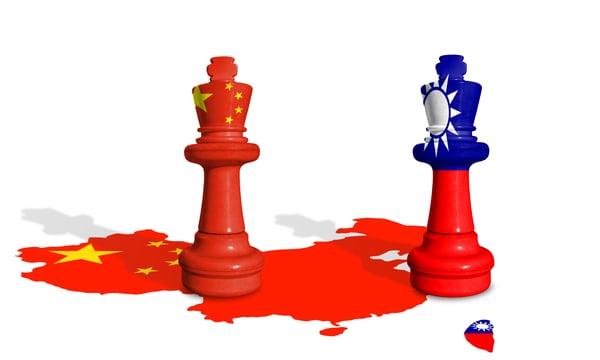
And so continues the endless debate between China and Taiwan, as well as between China and Japan, over various historical discourses. In this ongoing war over history, China seeks to leverage internal disagreements within its neighbors to facilitate its attempts at infiltration, while at the same time trying to maintain a unified position itself.
For Taiwan, China wants to infiltrate the country while collaborating with the KMT and the TPP. As for Japan, China has recently been giving special attention to Okinawa, and is looking to set off a new spat by highlighting the differences in historical perspective between Okinawa and Tokyo.