China’s increasing economic footprint in Brazil, Latin America’s largest economy, is redefining the region’s balance of power. Once primarily a trading partner, China is now entrenching itself in the Brazilian industrial base and consumer economy, turning the South American colossus into a gateway for Chinese influence across the continent. This shift challenges Washington’s traditional sphere of influence while carrying indirect consequences for Taiwan, whose diplomatic survival relies on a shrinking circle of allies in Latin America that have been progressively drawn into Beijing’s orbit.
China has been Brazil’s largest trading partner since 2009, but its economic presence was primarily confined to commodity trade. Now that boundary has disintegrated. Today, China’s economic presence is readily visible in everyday life. BYD’s electric vehicles (EV) dominate Brazilian roads and hold more than 80 percent of sales in the domestic EV market, while Chinese-backed apps such as Didi’s “99” and Meituan’s “Keeta” are competing for dominance in Brazil’s urban mobility and food delivery industries. Chinese companies have expanded from their past role as exporters to now be responsible for job creation and market shaping within Brazil’s economy.
Although China is not yet Brazil’s largest foreign investor – the U.S. still holds that title, accounting for 17.05 percent of the total – Beijing’s foreign direct investment (FDI) is escalating significantly. From 2023 to 2024, Beijing increased FDI to Brazil by 113 percent, while U.S. investment increased by only 0.057 percent. While the Trump 2.0 administration has placed Latin America at the core of its foreign policy, Washington’s economic engagement remains limited, leaving space for Beijing to expand unchallenged.
Alt hough the gap in total investment volume remains wide, the pace of China’s FDI increase should prompt attention from Washington and Brasília. If these trends continue, Brazil will become increasingly reliant on Chinese capital, consequently increasing China’s economic leverage over Brazil and pushing it closer to China’s foreign policy stances.
As China’s investment grows, Brazil’s domestic market has become a platform for regional expansion by Chinese companies like BYD. The automotive company chose Camaçari in Brazil’s Bahia state as the location for BYD’s first and largest complete-vehicle manufacturing base overseas. The factory will serve as a regional strategic hub handling exports to the entire South American market, including distribution to neighboring Argentina and Uruguay. The first vehicles have already rolled off the production line.
In 2024, BYD registered a 327.7 percent increase in sales to Brazil compared with 2023, indicating growing Brazilian consumer interest in its products. Companies like BYD are capturing significant market shares due to their marketing strategies, localized production, affordability, and improvements in quality and reliability. While in the past, Chinese products were considered low-cost and low-quality, strong sales have gradually repositioned them as reliable, competitive, and aspirational in the eyes of Brazilian and Latin American consumers.
China’s rising economic presence in Brazil has also granted it access to trade benefits in the region through Mercosur. According to Mercosur rules, a product manufactured in Brazil can contain up to 45 percent of non-Mercosur inputs and still qualify as a Brazilian-origin good. Through local manufacturing – for example, BYD’s electric vehicle factory in Brazil – Chinese firms are allowed to label their products as “Made in Brazil,” which qualifies them as Mercosur-origin goods.
This trade workaround allows Chinese brands to enter Paraguay, a market that otherwise engages with Taipei, at a lower cost. As Brazil and Paraguay are members of Mercosur, intra-bloc trade privileges, such as simplified customs procedures and tariff exemptions, allow Chinese-made-in-Brazil products to enter not only Paraguay but other regional markets with minimal barriers. As a result, China’s economic expansion in Brazil is indirectly eroding Taiwan’s economic leverage with Paraguay, one of its few remaining diplomacy allies.
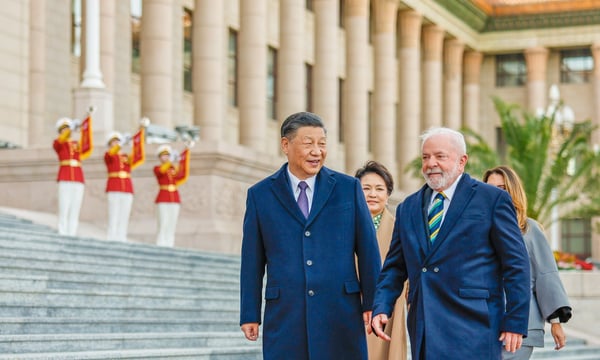
China’s increasing economic presence in the region is not an accident. Brazil has identified Beijing as a reliable and strategic partner to achieve its foreign and domestic policy goals. Under President Luiz Inácio Lula da Silva and the Worker’s Party (PT), Brazil has embraced an “active non-alignment” foreign policy, emphasizing sovereignty, multilateralism, and South-South cooperation. This approach strengthened Brazil’s partnership with China, creating new opportunities in favor of Beijing.
During Lula’s 2023 visit to Beijing, he advocated for settling trade in local currencies instead of the U.S. dollar, demonstrating Brazil’s eagerness to strengthen financial coordination with China and push for de-dollarization. Lula’s administration is expanding ties with China to increase Brazil’s international influence, while China is leveraging Brazil as a diplomatic and logistical gateway into Latin America’s institutions and markets, particularly the Mercosur bloc, which influences regional trade norms.
While economic cooperation promises advantages for both sides, this growing partnership risks subordinating Brazil’s strategic autonomy to Chinese capital and supply chains and may even compromise the sovereignty of neighboring countries such as Paraguay. China’s involvement in Brazil’s energy and industrial sectors poses particularly significant regional implications. According to a study by the Brazil-China Business Council (CEBC), of the $4.8 billion in Chinese investment in Brazil in 2024, 34 percent was directed to the electricity sector, 25 percent to the oil industry, and 14 percent to automobile manufacturing.
Recent technical cooperation and equipment supply between Brazil’s State Grid and China Three Gorges has integrated Chinese technology, capital and supply chains within Brazil’s energy infrastructure. But with Brazil and Paraguay holding joint ownership over the Itaipu Hydroelectric Power Station, which supplies 90 percent of Paraguay’s electric needs, these infrastructural changes have far-reaching consequences. Although China does not own stakes in Itaipu and does not have direct influence over Paraguay’s energy sector, Brazil’s growing partnership with Chinese companies opens it to Chinese influence could indirectly undermine Paraguay’s energy sovereignty.
China’s economic consolidation in Brazil is a long-term plan that could grant it leverage over key industries including energy, rare earth minerals, and agriculture. This economic expansion in Latin America also carries indirect but critical consequences for Taiwan. As Chinese companies scale their footprint in Brazil and gain access to Mercosur, they expand their capacity to influence regional trade and political networks, such as those in Paraguay, Taiwan’s last diplomatic ally in South America. If China strengthens its hold on Brazil’s domestic economy, Taiwan’s position in Latin America could weaken, narrowing its already limited international space.
To counter this trend, Washington and Taipei must cooperate more closely with Latin America. A recently introduced bill, the United States-Taiwan Partnership in the Americas Act, represents a step in that direction, but its implementation should extend beyond Taiwan’s current diplomatic allies. Engaging with major economies like Brazil (albeit informally on Taipei’s part) through technological cooperation, market diversification, and investment would improve regional autonomy and reduce dependency on Chinese capital.
China’s growing presence in Brazil represents a structural shift in hemispheric power. As Beijing leverages Brazil’s industrial and market capacity to expand its clout across Latin America, Washington risks losing influence in its own neighborhood, while Taipei risks losing diplomatic standing in one of its remaining supportive spheres of influence. If Washington and its partners fail to act, Beijing’s involvement in Brazil may evolve into a strong foothold for reshaping economic and political alignments across the Americas.