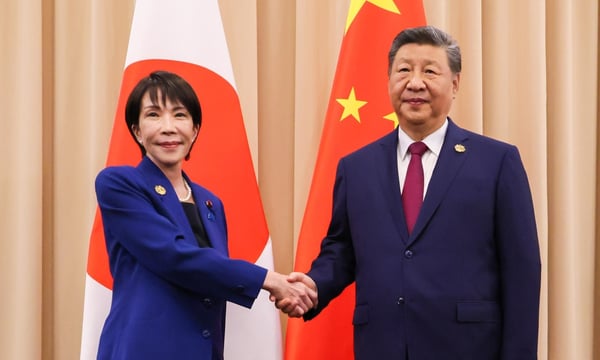
When a senior Chinese diplomat publicly reshared a news article about Prime Minister Takaichi Sanae and added that “the dirty head that sticks itself in must be cut off,” many saw it as an emotional reaction, an understandable moment of spontaneous anger from a patriotic, mid-level official – hey, we’re all human. But in China’s tightly controlled information space, where virtually every statement from a government official is subject to approval or consequence, rhetoric that intense has meaning.
The inflammatory comment from Xue Jian, China’s consul general in Osaka, must be seen not as an uncontrolled outburst, but as a deliberate escalation fitting a familiar pattern whenever Japan challenges China.
The incident began with Takaichi’s remarks to the Japanese Diet. Asked under what conditions a Chinese attack on Taiwan might threaten Japanese security, she responded that the use of force and the presence of warships could constitute a survival-threatening situation under Japan’s security laws.
This was not a radical departure from Tokyo’s regional worldview; Takaichi was echoing Abe-era statements linking Japan’s security to Taiwan. It certainly pales in comparison to repeated assertions by past U.S. presidents that the United States would use force to defend Taiwan. Yet Takaichi’s comment set off a chain reaction in Beijing that appeared entirely out of proportion relative to the message itself.
In short order, China summoned Japan’s ambassador for a dressing down and warned that Tokyo was “playing with fire,” while Xue made his infamous post about decapitating Japan’s prime minister (which China’s Foreign Ministry refused to distance itself from). These official responses – and the ensuing wave of uncensored nationalist outrage online – should be understood as deliberate political posturing rather than a spontaneous outburst that is beyond Beijing’s control.
Past episodes of Sino-Japanese tension have followed a similar pattern. When Japan is perceived as challenging Beijing’s preferred narratives, nationalist fervor reliably surges. But in China, nationalism is not something the government merely reacts to; it is something the government actively must manage, temper or encourage. Online outrage is permitted when it is useful, yet disappears when it is not. The line between domestic and international strategies often appears blurred
The timing of this flare-up is telling. Takaichi hit her stride early with high approval ratings, a successful first round of diplomacy, and a constructive summit with U.S. President Donald Trump. Her early moves – accelerating defense spending, calling for stronger economic security, and speaking plainly about Taiwan – all signaled a willingness for Japan to actively shape its surrounding security environment rather than remain passive behind the United States.
Beijing was watching. Combined with China’s own desire to frame itself as an equal partner to the United States, particularly after the Trump-Xi summit in Busan, Takaichi’s posture presented an inconvenient narrative for Beijing, which prefers to treat Japan as a regional sideliner.
But there’s more at play than China’s unease with Takaichi’s early success. Domestic pressures are growing in China, amid a slowing economy, high youth unemployment, and social dissatisfaction. Under these circumstances, external tensions become politically useful.
The tensions surrounding the China-Japan maritime dispute over the past decade illustrate this dynamic nicely: spikes in Chinese pressure did not necessarily reflect changes in Japan’s behavior but rather shifts in China’s internal political needs.
The same logic applies here. Takaichi’s statements vis-a-vis Taiwan were not precedent breaking to the extent that China’s extreme reaction would imply. What has changed is the political calculus for Beijing. As the promises of performance legitimacy have waned, the Chinese Communist Party is increasingly reliant on nationalism to maintain internal harmony.
When nationalist rhetoric is allowed to escalate, Japan is a low-hanging fruit – not because Tokyo is especially provocative, but because it is a uniquely effective symbol. China’s official statements repeatedly invoke “learning from history,” a familiar refrain that links present policy disputes to grievances stemming from the previous “Century of Humiliation.” This framing serves a dual purpose: it reinforces China’s preferred national narrative while casting Japan as a recurrent enemy.
The fact that such nationalism is being allowed to escalate right now is telling. China has long feared the possibility of unfettered nationalism (particularly against Japan) challenging centralized control. Beijing thus must see some social function in allowing this upsurge of anti-Japan nationalism to erupt.
That societal mobilization is evident in the breadth of China’s response. Beyond diplomacy, Beijing issued a warning urging Chinese citizens to avoid travel to Japan and amplified state-media commentary portraying Tokyo as provocative. These moves are all about narrative positioning. Beijing likes to pretend that it is being forced to respond to external provocation, but China’s own government sets the tone of the initial response – and, through its intensive online censorship, sets the boundaries for subsequent public discussions. The reaction thus reveals more about China’s internal political calculus than about Japanese actions.
The comments by a Chinese consul general about cutting off a foreign leader’s head are disturbing; but they are also instructive. Xue’s post was geared toward a specific audience, and it wasn’t Japan. The whole flare-up of tensions is a case study in how Beijing manages symbolic escalation, where nationalism can be activated to serve immediate political needs.
Takaichi’s remarks did not trigger a crisis; they simply provided an excuse for Beijing, which was looking to “teach Japan a lesson” for reasons of its own. China’s most extreme diplomatic reactions often reflect its internal vulnerabilities more than external threats, and Japan remains a consistent target.
For Japan, this takeaway is that Tokyo must continue to pursue its own political goals while acknowledging it is an actor in China’s political theater. The rest of the region should take note as well.