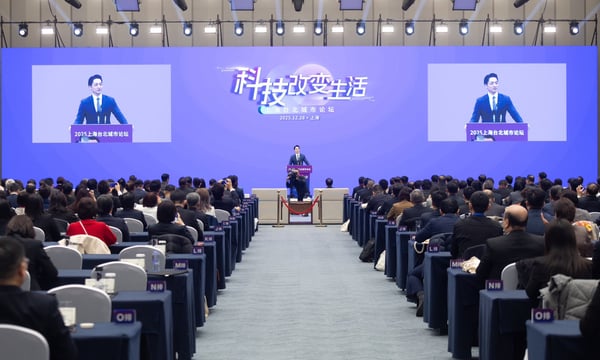
On December 29, the People’s Liberation Army (PLA) of China announced the commencement of a large-scale military exercise around Taiwan. While the specific motives remain unclear, it is widely believed within Taiwan that this may be a response to the diplomatic tensions between China and Japan caused by Japanese Prime Minister Takaichi Sanae’s remarks about Taiwan in November, as well as the recently approved U.S. arms sales to Taiwan. However, the timing of this exercise is still somewhat surprising, especially considering the Shanghai-Taipei City Forum had been held just one day prior.
Because Beijing has consistently refused direct dialogue with the Democratic Progressive Party (DPP), in power since 2016, the city-to-city forum, a political legacy of Ma Ying-jeou’s administration, has become the de facto highest-level regular exchange mechanism between mainland China and Taiwan. Although the forum has been used by the DPP as a pretext to criticize the KMT, Taipei Mayor Chiang Wan-an still visited Shanghai despite the pressure. This sudden military exercise, starting so soon after his trip, undoubtedly represents a heavy blow to the KMT’s image.
Unlike the DPP’s hardline stance toward Beijing, the KMT has consistently used maintaining peace between Taiwan and the mainland as its political banner. In his speech at the forum, Chiang stated his support for friendly exchanges with the mainland. However, the military exercise cast his comments in a deeply ironic light. Why would Beijing choose to sacrifice the KMT’s reputation in Taiwan by staging a military exercise that seems to have no strong motive?
Beijing has long sought to balance the DPP’s influence in Taiwan, particularly since Tsai Ing-wen was elected in 2016. To this end, it repeatedly invited influential KMT politicians to visit mainland China and attempted to cultivate “pro-mainland elements” in Taiwan. Han Kuo-yu, former mayor of Kaohsiung and current president of the Legislative Yuan, was once considered a rising political star and received Beijing’s support. He was invited to the mainland in 2019 to meet with local officials and scholars. However, after his defeat in the 2020 presidential election, he was impeached by the citizens of Kaohsiung, causing Beijing to gradually lose interest in him.
Subsequently, Fu Kun-chi, former Hualien County magistrate and current KMT caucus convener in the Legislative Yuan, appeared to become a key figure supported by Beijing. At Beijing’s invitation, Fu visited the mainland in 2024 and met with Politburo Standing Committee member Wang Huning, considered a key figure in shaping Beijing’s Taiwan policy. Furthermore, following Fu’s visit, Beijing made limited concessions in its Taiwan policy, such as easing restrictions on imports of some Taiwanese agricultural products, to provide the KMT with small rewards and political capital.
Therefore, a two-way selection mechanism appears to exist between the Chinese Communist Party (CCP) and the KMT. On the KMT’s part, some politicians view their ties with Beijing as political capital, although others within the party may view it more negatively. Meanwhile, the CCP tends to favor KMT figures with stable support in their constituencies (such as Fu and Chen Yu-jen in Kinmen County), or politicians with established influence in Taiwan (such as former KMT chairperson Hung Hsiu-chu), who are seen as worthy of support and capable of countering attacks from anti-communist elements in Taiwan.
However, this support has not yielded the results Beijing desired: the KMT lost three presidential elections in a row: in 2016, 2020, and 2024. Although the KMT, through cooperation with the Taiwan People’s Party, has been able to check the DPP in the Legislative Yuan, this advantage is precarious under DPP political offensives, such as the “Great Recall” in 2025.
Furthermore, given the increasingly stable Taiwanese self-identity and the strengthening ties between Taipei and both Tokyo and Washington, Beijing has reason to believe that expecting the KMT to win the 2028 presidential election is too difficult and distant of a prospect.
Despite Beijing’s denial of any plans to achieve national (re)unification by force by 2027, there is no doubt that Beijing considers it necessary to exert pressure on “Taiwan independence separatist forces” through military activities around Taiwan. Since 2022, Beijing has conducted numerous military exercises around Taiwan, often following so-called “significant provocations” made by pro-independence elements.
Therefore, Beijing’s Taiwan policy operates on two tracks: one supporting groups considered pro-mainland, for whom Beijing is willing to provide some backing to maintain its limited influence in Taiwanese politics and to counterbalance the DPP; the other targeting groups represented by the DPP, considered pro-independence, whom Beijing believes it must deter through military displays.
However, under Taiwan’s political system, these two tracks cannot be separated, because any action by Beijing will influence voter attitudes. Although Beijing repeatedly claims that its military deterrence is only directed at the DPP and the CCP is friendly to the Taiwanese people, some polls have shown that the Taiwanese public holds a negative attitude toward the PLA’s military exercises. This is why the two-track strategy might backfire: military deterrence cannot force the DPP to adopt the stance Beijing wants, but it can severely erode voters’ confidence in the KMT’s cross-strait policies.
Beijing is not unaware of this; it simply cannot abandon its hardline stance against the DPP. It is not only an effective tool for maintaining domestic nationalism but is also seen as a diplomatic maneuver. With Washington, Tokyo, and their allies increasingly expressing concern about the Taiwan issue, Beijing has reason to believe that demonstrating its resolve to assert control over Taiwan militarily is necessary to deter “external forces” from playing the “Taiwan card.”
This is why ceasing its military activities against Taiwan is not on Beijing’s list of rewards for the KMT. As Beijing’s envisioned peaceful (re)unification becomes increasingly impossible, its relationship with the KMT must be viewed with greater caution and, more importantly, with less hope.