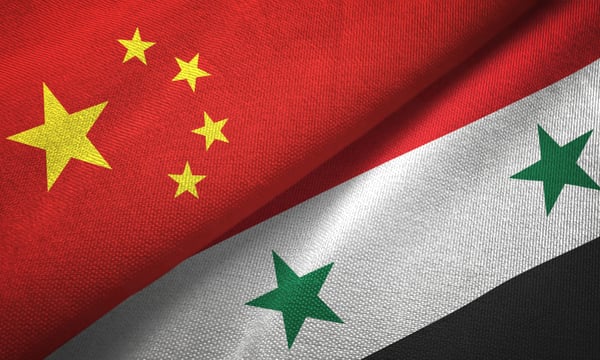
In mid-November 2025, Syrian Foreign Minister Asaad al-Shaibani arrived in Beijing for his first official visit since the fall of Bashar al-Assad. A joint statement after the visit reaffirmed respect for sovereignty, non-interference, and counterterrorism cooperation, while gesturing toward possible collaboration on reconstruction and development. For a country emerging from years of war, sanctions, and diplomatic isolation, the visit appeared to signal a tentative diplomatic reset with a major power that had long shielded Damascus at the United Nations and avoided Western-style political conditionality.
Yet the substance of the visit told a more cautious story. What was concrete in Beijing centered overwhelmingly on security: counterterrorism cooperation, assurances that Syrian territory would not threaten Chinese interests, and reaffirmation of the One China principle. Economic cooperation, by contrast, remained aspirational. References to reconstruction were framed as areas to be “explored,” without timelines, financing mechanisms, or flagship projects. While Damascus sought to project momentum, Beijing avoided commitments that would bind it too closely to Syria’s fragile transition.
This imbalance captures the core of China’s approach to post-Assad Syria. Beijing is engaging, but through a strategy of risk management rather than reconstruction leadership. The objective is to contain potential threats, preserve diplomatic leverage, and retain flexibility, not to underwrite Syria’s recovery or replace Western and Gulf capital. Syria is treated less as an arena for expansion than as a file to be handled carefully, with security concerns setting clear limits on cooperation.
Three priorities shape this posture. First, security: the presence of foreign fighters, particularly Uyghur-linked networks associated with the Turkistan Islamic Party, dominates Beijing’s assessments and its messaging at both bilateral and U.N. levels. Second, diplomacy: China anchors engagement in sovereignty, non-interference, and a “Syrian-led and Syrian-owned” political process, avoiding overt alignment with any bloc. Third, economics: Beijing is keeping options open through limited trade and exploratory agreements, while steering clear of major reconstruction commitments amid sanctions risk, governance uncertainty, and unresolved political tensions.
Security First: Foreign Fighters and China’s Red Lines
For Beijing, Syria’s post-Assad transition is first and foremost a counterterrorism problem. Long before reconstruction or investment enters the conversation, Chinese officials have made clear that the presence of foreign fighters, particularly those linked to Uyghur militant networks, defines the outer boundary of engagement. This emphasis surfaced repeatedly during al-Shaibani’s visit to Beijing, where counterterrorism cooperation dominated both the joint statement and public messaging.
China’s focus is concrete rather than rhetorical. Thousands of Uyghur fighters associated with the Turkistan Islamic Party remain active in Syria, many concentrated in the northwest and increasingly embedded in evolving security structures. Beijing views this presence through a narrow security lens: as a risk that battle-hardened militants could either return to China or target Chinese interests abroad. This threat perception has hardened over time and now outweighs any near-term economic calculation in China’s Syria policy.
That hierarchy was reinforced days later at the U.N. Security Council. China’s ambassador, Fu Cong, praised Syria’s stabilization efforts but returned repeatedly to the issue of foreign terrorist fighters, explicitly naming the Eastern Turkistan Islamic Movement (ETIM) and urging Damascus to take “effective measures” to meet its counterterrorism obligations. While China supported limited adjustments to sanctions to ease humanitarian and economic pressure, it stressed that counterterrorism listings and enforcement mechanisms must remain intact. Security was framed not as a byproduct of recovery, but as its precondition.
This logic helps explain China’s broader diplomatic caution. Beijing has avoided formal recognition of Syria’s new leadership, abstained rather than vetoed on key sanctions decisions, and conditioned deeper engagement on demonstrable progress against foreign fighters. Damascus has offered assurances by pledging that Syrian territory will not threaten Chinese security and reaffirming adherence to the One China principle. Still, Beijing remains unconvinced that these commitments will translate into effective control on the ground. Until that gap narrows, China’s engagement is likely to stay anchored in counterterrorism dialogue rather than economic ambition.
Diplomacy Without Alignment: Sovereignty, Non-Interference, and Leverage
If counterterrorism defines China’s red lines in Syria, diplomacy defines its guardrails. Beijing’s engagement with the post-Assad government has been framed through familiar principles: sovereignty, non-interference, and a “Syrian-led and Syrian-owned” political process. These formulations featured prominently in the joint statement issued during al-Shaibani’s visit to Beijing and were reiterated days later at the U.N. Security Council.
At one level, this reflects continuity. China has long opposed external intervention in Syria and resisted Western-backed pressure during the war. What has changed since Assad’s fall is not the rhetoric, but how Beijing uses it. Rather than shielding a specific regime, sovereignty has become a tool for managing distance. By emphasizing process over personalities, China avoids endorsing Syria’s new leadership outright while keeping diplomatic channels open.
This calibrated posture was visible in China’s handling of sanctions. When the U.N. Security Council moved to lift sanctions on Syria’s transitional president and interior minister, Beijing neither blocked the decision nor fully endorsed it, instead abstaining while highlighting unresolved counterterrorism concerns. The signal was deliberate: China would not obstruct Syria’s re-entry into international diplomacy, but it would not surrender leverage without concrete assurances on security and stability.
That restraint also reflects Beijing’s reading of Syria’s evolving geopolitical alignment. The new Syrian leadership has prioritized relations with the United States, Türkiye, and Gulf states, while presenting outreach to China as a form of diplomatic diversification rather than a strategic pivot. For Beijing, this reinforces caution. Syria is no longer a reliable strategic partner in the Assad-era sense, nor a theater where China seeks direct competition with Washington.
Instead, China’s diplomacy aims to keep doors open while hedging against uncertainty. High-level visits, joint statements, and symbolic gestures, including reaffirmation of the One China Principle, signalling engagement without entanglement. At the U.N., calls for humanitarian relief and sanctions easing are paired with firm reminders that political transition and counterterrorism obligations remain unresolved. The result is a dual-track approach: visible presence, limited commitment.
In this sense, China’s diplomacy in Syria is less about shaping outcomes than preserving flexibility. By anchoring engagement in principles rather than alliances, Beijing retains room to deepen ties if conditions improve, or to step back if they do not. That same logic carries into the economic domain, where China’s interest is evident, but its capital remains conspicuously cautious.
Economics Without Commitment: Keeping Options Open in a High-Risk Environment
If security defines China’s red lines and diplomacy sets its guardrails, economics is where Beijing’s caution becomes most visible. Despite frequent references to reconstruction and development in official statements, China has so far avoided the kind of large-scale economic commitments that many in Damascus and beyond had hoped would follow Assad’s fall. Instead, Beijing’s economic engagement with Syria remains exploratory, incremental, and carefully insulated from risk.
That gap between rhetoric and reality was evident during al-Shaibani’s visit to Beijing. The joint statement spoke of cooperation in reconstruction, development, and improving livelihoods, and welcomed Syria’s participation in mechanisms such as the China-Arab States Cooperation Forum. Yet it stopped short of announcing financing mechanisms, timelines, or flagship projects. Economic cooperation was framed as something to be “explored” rather than delivered – a familiar formulation in Chinese diplomacy when exposure remains uncertain.
Where activity has occurred, it has been deliberately limited in scale. Beyond modest trade flows and small exploratory deals, the most prominent example is the free-zone investment memorandum involving the China-linked firm Fidi Contracting, covering industrial areas near Homs and Damascus. Syrian officials have presented the agreement as evidence of renewed confidence. From Beijing’s perspective, however, it serves as a low-cost entry point, a way to signal interest without assuming the financial and political liabilities associated with large reconstruction projects.
This restraint reflects a sober assessment of Syria’s investment environment. Sanctions exposure remains a central concern, particularly given the layered nature of U.S., EU, and U.N. restrictions. Governance uncertainty, corruption risks, and unresolved security challenges further complicate the picture. Unlike in more stable post-conflict settings, China cannot easily rely on host-state capacity to protect investments or guarantee returns. Nor does Syria occupy a central position in the Belt and Road Initiative, which has historically prioritized clearer regulatory frameworks and higher strategic payoff.
Alternatives also shape Beijing’s calculus. Syria’s new leadership has actively courted Gulf capital and Western engagement, securing sanction relief and investment commitments that China is unlikely and arguably unwilling to match in the near term. For Beijing, this reduces the pressure to act quickly. By remaining economically present without committing major capital, China preserves optionality while avoiding competition in a volatile, politically sensitive arena.
The result is an economic posture that mirrors China’s broader Syria strategy: present, but not invested; interested, but not exposed. Beijing is positioning itself to move if conditions change, clearer sanctions pathways, stronger security consolidation, and more predictable governance, but until then, economics remains the most constrained pillar of its engagement.
Conclusion: A Narrow Stake, Conditional Engagement
Taken together, China’s approach to post-Assad Syria is defined less by opportunity than by caution. Beijing is neither disengaging from Syria nor stepping forward as a patron. Instead, it is managing exposure in a transition it does not control and does not fully trust, calibrating engagement to risk rather than ambition.
Counterterrorism sits at the top of this hierarchy, particularly concerning foreign fighters linked to Uyghur militant networks. Diplomacy follows, anchored in sovereignty and non-interference, to remain present without taking ownership of Syria’s political trajectory. Economic engagement comes last, with China keeping channels open through limited trade and exploratory investments while avoiding the financial and reputational risks of large-scale reconstruction.
What would change China’s calculus is relatively straightforward. Beijing needs to see sustained security consolidation, including credible limits on the autonomy and influence of foreign fighter networks. It would require clearer pathways around sanctions exposure and more predictable rules for protecting investments. And it would need greater confidence that Syria’s political transition is stabilizing rather than fragmenting, reducing the risk that engagement becomes a liability rather than an asset.
Until those conditions are met, China’s stake in Syria will remain real but narrow. Engagement will continue, but on Beijing’s terms: cautious, conditional, and deliberately limited. In a region where post-conflict recovery often invites overreach, China’s Syria policy stands out not for what it promises, but for how carefully it avoids committing too much, too soon.