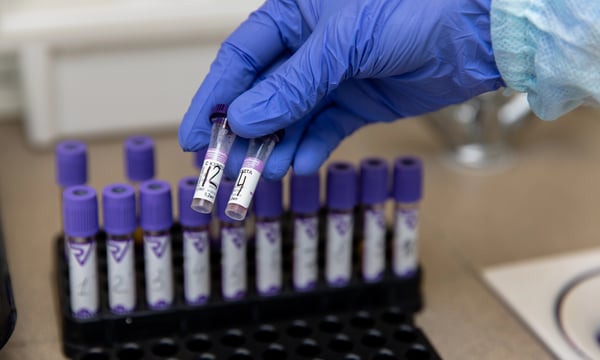
This week, Chinese customs announced they had busted a blood-smuggling ring. The scale of the gang’s activities is shocking – the authorities revealed that they had handled the blood of over 100,000 pregnant women from the majority of the country’s provinces. If we assume one baby per woman, that’s roughly equivalent to 1 percent of all births in the country in 2024.
While the facts of the case reveal the enduring demand for banned medical services, the government’s response highlights the authorities’ heightened concern that foreign entities may be working to undermine China’s biosecurity – and perhaps even develop racially specific bioweapons.
Reportedly, the gang used social media to explicitly advertise “risk-free” genetic screening and fetal sex identification. The latter service is banned in China – begging the question as to why social media sites allowed such ads to proliferate in the first place. After the blood was sent to the gang, the blood-filled test tubes would be taped to the abdomen or inner thighs of couriers, or stuffed into suitcases or boxes of tea. With fees ranging from 2,000 yuan to 3,000 yuan, the gang’s revenue likely exceeded $30 million.
While the authorities didn’t confirm where the blood was eventually sent to, many news bloggers have speculated the destination was Hong Kong, which has long been a destination for fetus sex identification services. The location of the bust – Guangzhou, Foshan, and Shenzhen, all close to Hong Kong – adds some weight to this speculation.
Fetus sex identification emerged during China’s one-child policy, as families limited to just one child wanted to ensure that they’d have a son. Sex selective abortion and female infanticide have famously left China with one of the world’s most imbalanced gender ratios. However, as this case shows, the phenomenon seems to have outlasted the policy that created it. Even though families are now free to have more than one child, few actually want to – so the desire to ensure your only child is a son remains.
Perhaps more striking than the persistence of sexist traditions is how the authorities and media have discussed the case. For instance, an editorial from the official newspaper of China’s top prosecutor, the Procuratorial Daily, emphasizes that the most concerning part of the case is that taking genetic resources abroad “touches the red line of national biosecurity.” The article says that health departments, judicial authorities, and online platforms must do more to build “a solid national biosecurity defensive line.”
China’s 2020 Biosecurity Law makes it clear that the “state enjoys sovereignty over our country’s human genetic resources” and says the government must “strengthen the management and oversight of the collection, storage, use, and external provision” of these resources.
In 2023, the Ministry of State Security was blunt about what it believes the risks are of foreign entities getting their hands on Chinese genes. In an article shared on its social media accounts, it warned that “genetic weapons can be developed to kill targets of a predetermined race, so as to selectively attack targets with specific racial genes.”
Five years earlier, a delegate to the country’s legislature called for a ban on foreign firms participating in China’s blood products industry, again based on the potential threat of racist bioweapons. The fact that the delegate ran a blood product company that would be competing with foreign rivals is probably just a coincidence.
These concerns have long existed. Before the SARS epidemic had even passed, conspiracy theorists were positing that the virus may have been developed by the United States to target ethnically Chinese people. A 2003 book on the topic, which also claimed that foreign entities had developed technology to give Chinese people Alzheimer’s disease, was published by the prestigious China Social Sciences Press.
No evidence has ever emerged that genetic weapons targeting specific ethnic groups exist. The preference for sons, by contrast, is well documented – and, judging by this case, still lucrative.