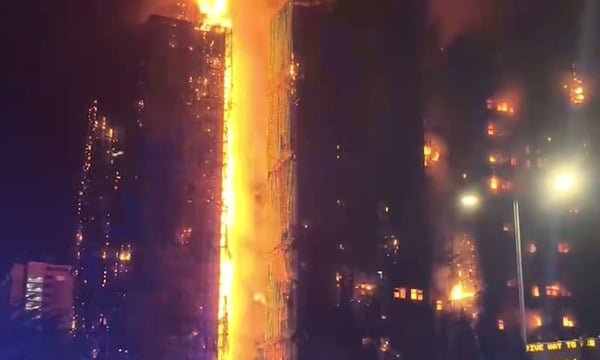
The fire in Tai Po on November 26 was Hong Kong’s deadliest blaze in decades: it killed at least 160 people, with dozens still missing. While the tragedy itself was horrifying, the Hong Kong government’s reaction has been equally alarming. Instead of demonstrating accountability and responsiveness to public concern, authorities have adopted a defensive posture centered on political security.
Many observers see the official handling of the aftermath as another sign that Hong Kong is becoming more like mainland China. In reality, the situation is more troubling. Hong Kong has weakened its own accountability mechanisms without acquiring the governance tools that operate in the mainland. Rather than converging with Beijing’s party-state model, Hong Kong is actually performing worse in moments of crisis.
A Disastrous Response to Disaster
From the outset, the government’s approach to the fire was highly politicized and combative. In the immediate aftermath, Chief Executive John Lee’s public remarks prioritized repeated expressions of gratitude to Chinese President Xi Jinping before supporting local efforts to relieve the incident. Reporters directly questioned why firefighters were acknowledged only as an afterthought.
The government then moved quickly to cast expressions of public concern as a security threat. The National Security Office warned of “hostile forces” using the disaster to disrupt Hong Kong, framing individuals who voiced dissatisfaction as “distorting the efforts of the government.”
As the fire raised concerns over potential corruption issues, a university student who urged a comprehensive investigation and demanded accountability was arrested by national security police for sedition. Volunteers delivering supplies to affected families reported intimidation by the government-led community service corps, and some were even detained. More recently, foreign journalists were summoned by Beijing’s security agency in Hong Kong and warned against publishing information that could “distort” the government’s relief efforts. Meanwhile, local commentators announced they could no longer write about the fire due to “obvious reasons.”
These actions highlighted a governing approach shaped primarily by political risk mitigation rather than public administration. In today’s Hong Kong, public sentiment and civic engagement are treated as potential security concerns. While the situation in Hong Kong is often described as resembling that in the mainland, this comparison overlooks crucial distinctions. Despite the authoritarian system under Beijing’s rule, mainland authorities do possess institutional mechanisms that absorb public pressure and enforce administrative responsibility in ways Hong Kong currently does not.
How Hong Kong Is Worse Than Mainland China
When comparing Hong Kong’s reaction with how various levels of government in the mainland have handled similar crises, the distinctions are clear.
In 2010, following a residential tower fire in Shanghai that killed 58 people, Beijing immediately dispatched a State Council investigation team. Subsequently, 26 people, including government officials, were charged with criminal offenses, and the Communist Party disciplined 28 others. On top of that, Shanghai’s mayor at the time publicly apologized. Acknowledging public sentiment, the authorities handled large-scale mourning cautiously and without violent suppression, even as hundreds of thousands gathered to demand accountability.
Similarly, after the 2021 Henan floods, which caused nearly 400 deaths, the State Council released a detailed report outlining institutional failures. The report resulted in eight criminal prosecutions and disciplinary measures against 89 officials, including several mayors and deputy mayors.
While mainland China is also guilty of suppressing criticism and dissent, it has the structural tools to pursue at least modest accountability, and the confidence to allow a tightly controlled safety valve for the fiercest anger.
In Hong Kong, however, no comparable mechanisms operated after the Tai Po fire. Despite more than a dozen arrests of individuals allegedly responsible for causing the fire, no government official has apologized or faced formal inquiry. The administration has not released preliminary investigative findings, and basic information about victims remains limited.
Meanwhile, calls for a Commission of Inquiry were rejected in favor of a review committee that lacks statutory authority. Instead of demonstrating administrative responsibility, the Hong Kong government’s primary tools were centered on information control and political containment.
Governance Vacuum
These differences are rooted in deeper institutional divergence. Mainland China’s ability to respond to disasters in a structured manner is tied to its system of political promotion. Extensive studies have shown that the Chinese Communist Party relies heavily on performance-based legitimacy, particularly in crisis management. Officials are evaluated on measurable outcomes, and failure can result in rapid disciplinary action. This was evident during the pandemic, when Beijing placed clear priority on the zero-COVID policy – the ability to contain outbreaks and maintain public health was directly tied to the career prospects of local officials. Those who failed to implement containment measures were quickly removed or reprimanded.
Hong Kong’s governance traditions evolved differently. Many of its key accountability mechanisms were designed and institutionalized during the final decades of British rule, when the colonial government sought to develop Hong Kong into a prosperous global city grounded in professionalism, public accountability, and the rule of law. For instance, the Commissions of Inquiry Ordinance, enacted in 1968, was designed precisely to handle major incidents requiring independent scrutiny. The Legislative Council also possessed meaningful powers to investigate official misconduct under the Powers and Privileges Ordinance.
These mechanisms, however, can function effectively only in a political environment that favors checks and balances. Since the political turmoil in 2019, these oversight tools have been politically constrained or rendered symbolic.
Calls for a Commission of Inquiry now evoke associations with the 2019 protest demands, placing them in a politically sensitive category. The Legislative Council, now composed exclusively of pro-Beijing “patriots” after the 2021 electoral reform, no longer acts as an independent oversight body and has shown little inclination to challenge the executive. The impotence of the current law-making body was highlighted by the embarrassing moment when legislative candidates in the recent election were too afraid to express differing views even during the debate session.
Hong Kong has hollowed out the institutional mechanisms that once ensured accountability and effective governance, but it has not developed the structures that support stability in mainland China. The result is a governance vacuum, in which neither democratic nor authoritarian accountability functions effectively.
Limitations Under “One Country, Two Systems”
What is more problematic is that, even under the new political reality shaped by Beijing’s predominant influence, Hong Kong lacks the conditions to replicate the governance model of the mainland under the de jure framework of “One Country, Two Systems.”
In mainland China, a multilayered hierarchy separates local administrations from the central government. This arrangement allows Beijing to discipline local officials without implying failure at the top. The Communist Party’s extensive cadre system, drawing from membership of more than 100 million, also ensures that replacements are readily available. Local officials can be removed with limited political cost.
Hong Kong lacks these institutional buffers. As a Special Administrative Region, senior officials are appointed by and report directly to Beijing. Any admission of administrative error thus risks reflecting poorly on the central government’s oversight. The political cost is even higher today, as Beijing has constructed a narrative of having restored stability and governance effectiveness in Hong Kong following recent crackdowns. Acknowledging serious failures by the city’s government would undermine the rationale for its post-2019 political restructuring.
Moreover, the principle of “Hong Kong people ruling Hong Kong” restricts the ability to draw replacements from the broader mainland bureaucracy. Senior officials must be Hong Kongers personally trusted by Beijing, making rapid substitution practically challenging and politically risky.
This structure traps Hong Kong between two governance models. It has weakened the institutions that once supported its administrative legitimacy, yet it cannot adopt the systems of performance-based accountability that make Chinese authoritarianism sustainable. In this context, political suppression becomes one of the few viable tools available to manage discontent.
Conclusion
The Tai Po fire revealed more than weaknesses in emergency planning. It exposed deeper structural problems in Hong Kong’s current governance model. The city has moved away from the institutional traditions that once made it administratively credible, yet it cannot adapt the mechanisms that enable mainland China to maintain stability through performance and accountability.
As long as Beijing values the appearance of “One Country, Two Systems,” Hong Kong will not be able to replicate the mainland’s approach to crisis governance. But without rebuilding its own institutions of transparency and responsibility, the city risks further erosion of public trust and administrative capacity.
Hong Kong is not becoming more like mainland China. It is becoming something more fragile and less capable of governing itself effectively.