Iran has not attempted to mend the nuclear facilities damaged in U.S.–Israeli airstrikes on the country, the International Atomic Energy Agency (IAEA) stated on Oct. 27.
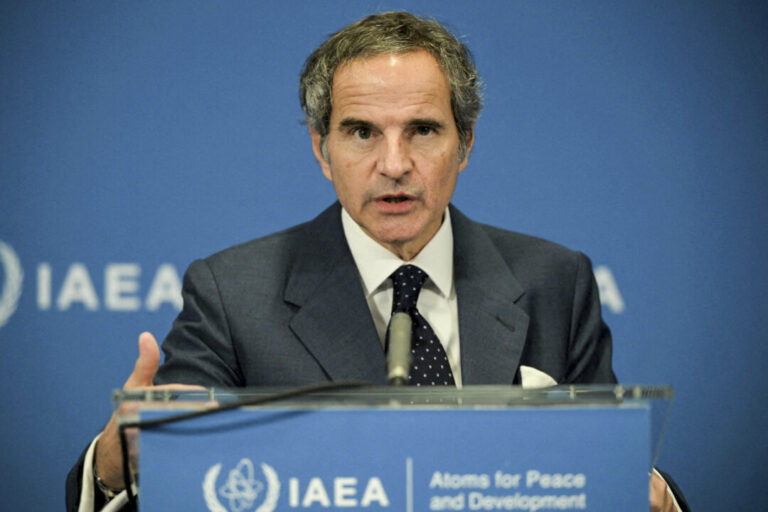
IAEA Director General Rafael Grossi said that “since June 2025, we have not identified any activity to repair or reconstruct any of the facilities damaged in the military attacks of 2025 and 2026,” in a statement to the U.N. Security Council on Oct. 27.
However, Grossi also stressed that “nothing replaces access to the facilities to verify the actual situation,” something the global nuclear watchdog has been unable to do since the attacks conducted by the United States as part of Operation Midnight Hammer in June 2025.
Despite the IAEA’s inability to physically inspect facilities in the Islamic Republic, Grossi stressed that the watchdog had “not been idle.”
“In the context of different mediation efforts, the necessary preparatory technical work has advanced and the foundations on which a diplomatic agreement could be achieved, so that inspectors can return to Iran, are clear,” he said.
“Any path forward with regards to Iran’s nuclear programme must include the IAEA’s indispensable verification role, without which no solution is verifiable, and as a consequence sustainable. Our work with the United States negotiating and technical team has been thorough.”
Grossi went on to say that Iran, in breach of international law, has not provided any requested information or access to the Fordow, Natanz, and Isfahan enrichment plants, nor to the Khondab Heavy Water Research Reactor. The IAEA is supposed to verify that previously declared nuclear material at the facilities is under safeguards.
The one exception, according to Grossi, was the Bushehr Nuclear Power Plant, where inspectors “are currently undertaking verification activities.”
Iran has “engaged constructively” at Bushehr with the IAEA “to arrange for the delivery of safeguards equipment required for the verification of spent fuel prior to its transfer to a new dry storage facility,” he said, noting that the transfer is expected to occur in early 2027.
Iran has not responded directly to Grossi’s statement, but it unequivocally rejected the Oct. 27 Security Council meeting, calling it “illegal,” according to Iranian state-linked news agency Nour News.
Iranian Deputy Permanent Representative to the U.N. Gholamhossein Darzi told the council that since Resolution 2231, the 2015 U.N. resolution that formally endorsed the Joint Comprehensive Plan of Action (JCPOA), which expired in October 2025, the body’s consideration of the nuclear issue under the JCPOA had come to a “definitive end.”
“There is, therefore, no basis whatsoever for convening this meeting under the agenda item ‘Non-proliferation,’” he said.
Darzi also accused the IAEA of “hypocrisy” for raising concerns about Tehran’s nuclear program while not making similar complaints regarding Israel’s alleged atomic arsenal, which he said is made up of “approximately 200 nuclear warheads.”
Israel has never formally admitted to possessing nuclear weapons.
After the council voted 11–2 on Oct. 27, with Pakistan and Somalia abstaining, to adopt the non-proliferation agenda, Darzi thanked permanent council members Russia and China for voting against it.
On the same day that Russia backed Iran at the U.N., Moscow’s state nuclear company Rosatom announced plans for a fivefold increase in its workforce at the Bushehr Nuclear Power Plant in Iran.
Rosatom boss Alexey Likhachev said that the company already has “142 people on construction, 50 people on maintenance, and we will increase (the number of Russian personnel). The planned number is 700 people,” Russian state media outlet RIA reported.