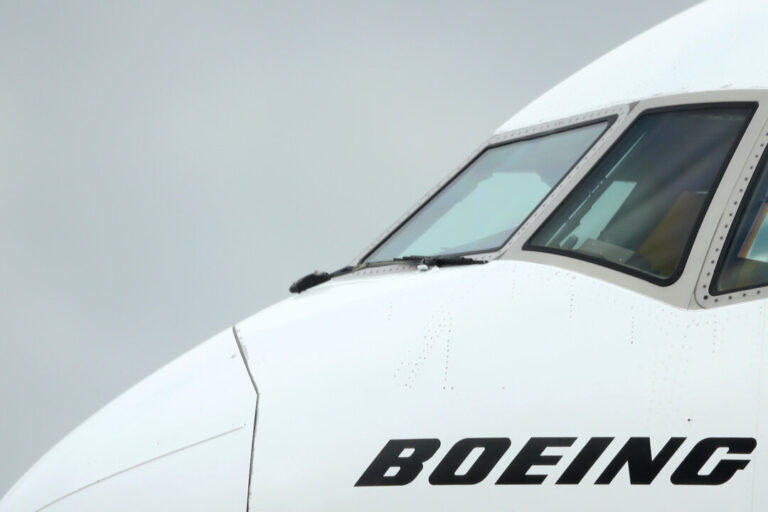

The nose of a Boeing commercial airliner is seen in Sydney, Australia, on March 14, 2019. Cameron Spencer/Getty Images
The Federal Aviation Administration (FAA) has certified Boeing’s 737 MAX 10, allowing the plane manufacturer to begin deliveries of the largest variant of its best-selling narrow-body jet after years of safety reviews and technical setbacks.
The FAA issued a certificate on Tuesday, confirming that the aircraft meets applicable design and safety requirements, along with an updated production authorization.
“The FAA’s decision follows a thorough review of the aircraft’s design and safety requirements,” FAA Administrator Bryan Bedford said. “We will continue to hold Boeing to the highest safety standards as the company begins production of the 737 MAX-10.”
The MAX 10 is the largest member of the 737 MAX family and can carry up to 230 passengers in its maximum seating configuration. Boeing says the aircraft offers the lowest per-seat operating costs of any single-aisle jet currently in service.
Deliveries are expected to begin in the coming months, it said.
Boeing has already built several MAX 10 aircraft awaiting delivery and opened a new 737 production line in its flagship Everett, Washington, factory in July as it works to increase output.
“Completing the certification program clears the path for us to deliver a Boeing airplane that will set a new standard in commercial aviation,” Stephanie Pope, CEO of Boeing’s commercial airplane unit, said in a news release.
More than 30 customers have ordered a total of 1,555 MAX 10s, according to Boeing. The model accounts for more than 30 percent of the company’s current 737 MAX order book.
Major customers of MAX 10 include United Airlines, Delta Air Lines, American Airlines, Alaska Airlines, and Ryanair. Airlines generally need to complete their own operational preparations before putting the aircraft into passenger service.
A Long Way to Approval
Boeing had originally expected to begin delivering the MAX 10 in 2020.
However, its certification process stretched years beyond that schedule as the FAA increased scrutiny of the MAX program following two fatal crashes involving the smaller MAX 8 in 2018 and 2019. The crashes killed a total of 346 people.
The regulator required the MAX 10 to incorporate safety changes stemming from both federal laws and recommendations from the National Transportation Safety Board. Those changes included updates to the flight-control system and an enhanced angle-of-attack sensor, which measures the aircraft’s pitch relative to the surrounding airflow.
Boeing said the certification campaign ultimately involved nearly 1,000 test flights, along with extensive safety assessments and design reviews.
Other technical problems added further delays.
For example, in 2023, Boeing identified an issue involving the engine anti-ice system on MAX aircraft. The problem affected certification work on both the MAX 10 and the smaller MAX 7, which the FAA ultimately certified in August after an eight-year review.
The MAX 10 faced another last-minute obstacle in September after Boeing disclosed a navigation-software problem that could prevent pilots from accessing automated vertical guidance during a specific landing scenario.
The FAA temporarily held up certification while a review board examined the issue. On Oct. 2, the agency determined that the glitch did not pose a flight-safety risk.
The MAX 10 is not Boeing’s only delayed certification program. The company is still working to certify the larger 777-9 wide-body jet, with first deliveries now expected in 2027.