
A British arms research group said Yemen’s Houthi terrorist group is trying to build advanced medium-range ballistic missiles using components shipped from China.
Conflict Armament Research (CAR) stated in an October report that its findings indicate the Iran-backed Houthis are seeking to manufacture parts of the Khaibarshekan-series ballistic missiles inside Yemen.
The report states that the group is also expanding its supply network beyond Iran-linked channels.
Investigators found purpose-built missile components alongside shipping documents listing a Chinese supplier, even though the Houthis are subject to a U.N. arms embargo.
The report comes as fighting between the Houthis, Saudi Arabia, and Saudi-backed Yemeni government forces has intensified in recent months. The Houthis declared a naval blockade in the Bab al-Mandab Strait on July 20 and have since launched missile and drone attacks against Saudi cities, oil infrastructure, and military facilities.
The U.N. Panel of Experts on Yemen stated last year that the Houthis have diversified their international procurement and supply chains, including through Chinese suppliers and regional intermediaries.
U.S. Treasury sanctions records also show that many companies sanctioned for supplying drone components to the Houthis are based in China.
Since 2024, Treasury has sanctioned numerous China-based manufacturers, exporters, and logistics companies for supplying UAV components, missile guidance systems, chemicals, and machining equipment to the Houthis, including companies in Shenzhen, Guangzhou, Ningbo, Dongguan, and Yiwu.
Seized Shipments
CAR stated that its findings are based on four shipping containers seized by Yemeni authorities in July, while they were being transported to the Houthi-controlled port of Hodeidah, Yemen.
According to CAR, shipping records show the containers arrived at the Aden Free Zone in June and October 2025 aboard two vessels carrying cargo from China.
The shipments contained metal parts that appear to be components of the airframe and rocket motor of a Khaibarshekan-series ballistic missile. Investigators identified seven missile components, including fin cores, rocket motor parts, and igniters.
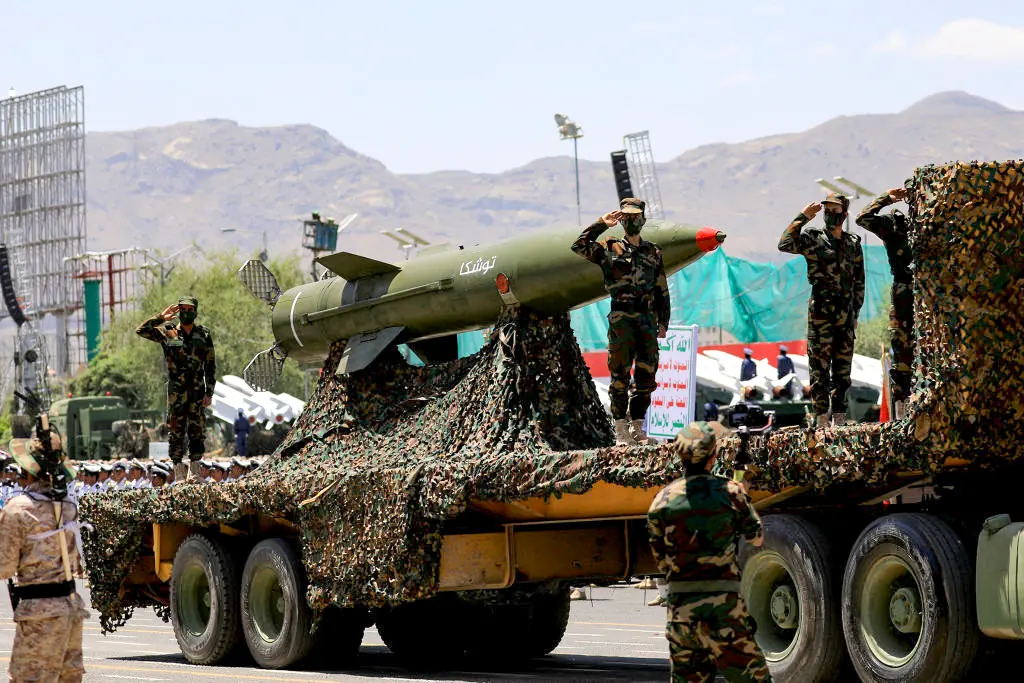
Houthi terrorists stand guard on a missile carrier during a military parade marking the ninth anniversary of the Houthi takeover of Sanaa, Yemen, on Sept. 21, 2023. Mohammed Huwais/AFP via Getty Images
The cargo also contained phenolic resin, a material used to make heat shields that protect ballistic missiles during flight, along with a U.S.-made adhesion tester and other industrial equipment.
CAR stated that much of the equipment also has civilian uses. However, finding it alongside missile components suggests that it was intended to support missile production and testing, the report states.
The Khaibarshekan-1 missile was first unveiled by Iran in 2022 and has a reported range of about 900 miles.
Iran later introduced the Khaibarshekan-2 and the Fattah-1, another variant in the same family. CAR stated that the Houthis appear to operate all three versions under different local names and have used them during the current Middle East conflict.
Chinese Supplier
CAR stated that shipping documents identified a Chinese manufacturer that advertises custom aerospace components. However, the organization said it had not contacted the company and could not independently verify the information in the documents.
According to Yemeni authorities cited in the report, the missile components had been split across several containers to make them harder to detect.
CAR stated that the seizure was similar to one aboard the Al Zahra 1 cargo vessel in November 2024. In that case, investigators identified components for Badr-series guided rockets that were also found alongside products supplied by China-based companies. However, CAR stated that it was unable to identify the manufacturer.
The organization stated that the precise extent of the Houthis’ manufacturing capability remains unclear.
“At a minimum, the evidence points to local airframe and motor assembly, the application of ablative materials, and broader overall system integration and testing,” CAR stated.