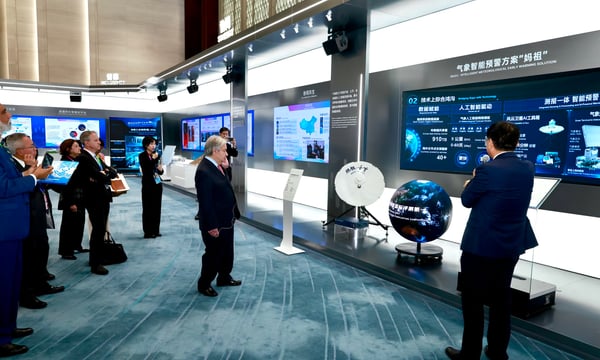
On July 16, a day before the annual World Artificial Intelligence Conference in Shanghai, officials from 29 countries signed an agreement establishing a new body: the World Artificial Intelligence Cooperation Organization (WAICO). The event was attended by United Nations Secretary-General António Guterres and the deputy prime ministers of Kazakhstan, Laos, and Pakistan, among other dignitaries. Foreign Minister Wang Yi represented China at the signing ceremony.
The new organization, first proposed by China at the 2025 World Artificial Intelligence Conference, will be headquartered in Shanghai and is meant to operate as an independent intergovernmental entity. WAICO’s stated aim is to promote international cooperation on AI so that it remains beneficial, safe, and fair for all, in line with the principles of the U.N. Charter and with a people-centered approach.
In his address at the opening of the 2026 WAIC the next day, President Xi Jinping set out China’s view that AI development should be a shared endeavor across nations, rather than something driven by a single nation. He announced plans to provide 5,000 training spots for developing countries over the next five years and to establish cooperation centers with groups like ASEAN, the African Union, and BRICS.
The WAICO agreement stresses open participation without conditions tied to political systems or values. It places strong, or rather pointed, emphasis on narrowing the technology-access gap between richer and poorer nations. The founding members include a somewhat predictable list: Russia, Pakistan, Indonesia, Brazil, Kazakhstan, and other countries from Asia, Africa, and Latin America, with more to be revealed. Given the thinly veiled anti-Western edge, it is hardly surprising that no Western or strongly Western aligned country showed up among the founding nations, nor are they expected to do so in the future.
This composition points quite strongly to an emerging split in AI governance along geopolitical lines. Over time, this may well solidify into parallel ecosystems for standards, data governance, and infrastructure, with limited interoperability between them, further complicating an already fragmented landscape.
Although the emergence of WAICO might strike one as incredibly fast – it took just a single year from the proposal to the actual founding – China has been working toward this step for some time. Last year’s proposal formed part of Beijing’s broader Global AI Governance Initiative, which argues that rules should treat development needs as seriously as safety concerns.
Beijing has criticized international efforts, such as those hosted in the United Kingdom, South Korea, France and India, for they tended to bring together advanced economies and focus heavily on managing high-risk systems and agreeing standards among close partners. Positioning itself as a champion of equitable AI access for developing nations, Beijing has argued that such arrangements exclude too many countries that need help to catch up on skills, data, and computing power.
Indeed, Xi framed the initiative as a direct response to calls from the Global South. In other words, WAICO is not presented as a China-led initiative, but as a practical forum where members can, without entry barriers, work on training programs, joint projects, and basic governance ideas.
In practice, with this step China has gained a significant venue to shape conversations about standards and policy language, the importance and possible long-term effects of which cannot be understated. Yet this is not necessarily the most important angle for Beijing. WAICO allows China to offer structured support to developing countries in the form of access to models, infrastructure assistance, and technical know-how; this is the prize China has been seeking. Such support can help to expand China’s influence and cement Beijing’s role as the leading alternative provider of AI capacity outside Western-led frameworks.
There are many ways in which such influence is likely to manifest itself, including standard-setting, preferred technical architectures, and embedded dependencies in training, cloud infrastructure, and access to models. Each of these channels has a strong potential to shape long-term governance outcomes in ways that are far less visible than formal treaties, yet often prove far more enduring.
Reactions in Western capitals have thus far been muted. Among ASEAN countries, the picture looks generally positive in the short term. Cambodia, Indonesia, Laos, Malaysia, and Myanmar are founding members of WAICO, and China has included ASEAN among the regional blocs for which it will set up AI application cooperation centers focused on practical uses. Predictably, governments in the region have welcomed the Chinese emphasis on capacity building and reducing the technology gap, especially since many face similar challenges around skills and infrastructure.
Whether WAICO grows into something substantial beyond a vehicle of Chinese influence depends on what happens next. Turning a signing ceremony into working groups, shared projects, and actual funding, not only in the immediate future but also for the long term, will take time and sustained effort. It also remains to be seen how many more countries might decide to join WAICO or engage without formal membership. An important early indicator of traction observers will have to watch for is whether WAICO outputs begin to be referenced in national AI strategies or regulatory frameworks.
The broader landscape of AI rules is already quite crowded, with U.N. processes, regional initiatives, and national strategies all running at once. Adding a new standing organization has the potential to radically change the existing dynamics: instead of only debating principles at occasional meetings, countries will now have the option of committing to different institutional tracks.
This may open up Pandora’s institutional box as it introduces competition, where states can “forum shop” for venues that best match their political preferences and development priorities rather than converge on a single global framework. This potential fragmentation would dilute consensus building, but on the other hand it will likely also accelerate experimentation, as different blocs test governance models in parallel.
Announced with great fanfare, WAICO matters less as a headline announcement than for what it represents: a move from talking about cooperation to building structures that can deliver it. Whether it will actually become influential will depend on what follows: funded projects, shared tools, and the extent to which countries begin to rely on it in practice rather than simply endorse it in principle. If that happens, WAICO could become a real node in how AI is governed globally.
Either way, the direction is clear: AI governance is no longer confined to occasional summits but is starting to take shape through competing institutions with their own priorities and constituencies. As a consequence, the global architecture of AI governance has just become more complex – and more contested.