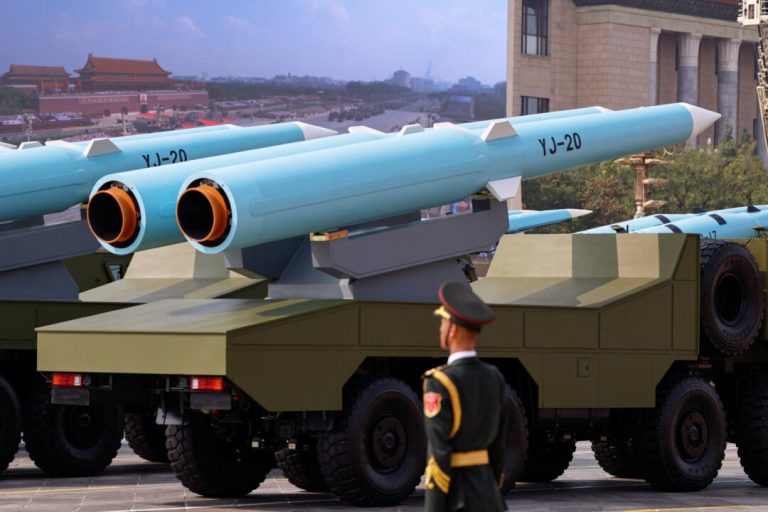
Chinese state media has featured footage of the country’s latest hypersonic anti-ship missile launched from a smaller destroyer, which it has said is “changing the rules in the western Pacific.”
In a trailer aired on July 29 for a military documentary, China’s state-run CCTV’s military Channel showed the launch of its YJ-20 from a Type 052D destroyer for the first time, boosting the Chinese military’s anti-ship capabilities, according to state media Global Times. Previously, this type of missile had only been tested on the larger Type 055 destroyer.
According to the Chinese military, the YJ-20 has a range of 1,500 km (930 miles) and an ability to target moving ships.
However, U.S.-based military tech analyst Mark Cao says the YJ-20 does not possess significant, genuine penetration capability.
“The deployment of YJ-20 hypersonic anti-ship missiles is primarily aimed at the U.S. and Japanese navies,” he said. “Given Japan’s proximity to China, it will definitely be involved in any developments over the Taiwan Strait.”
“The YJ-20 is a hypersonic missile utilizing a biconic warhead, and during the final attack phase, its terminal speed drops to around Mach 3,” he said, noting it’s similarity to Russia’s Kinzhal missile.
“U.S. Patriot missiles are capable of intercepting a target moving at this speed.”
The hypersonic weapon developed by the U.S. military is more advanced and technologically sophisticated, Cao said.
“The U.S. Navy is currently equipped with the Conventional Prompt Strike system,” Cao said. “It belongs to the same family as the U.S. Army’s Long-Range Hypersonic Weapon—known as the Dark Eagle missile—and was developed using the same technology; the only difference is that one version was designed for the Army and the other for the Navy.”
The U.S. military’s Conventional Prompt Strike system boasts speeds exceeding Mach 5 and a greater range—capable of reaching over 1,700 miles, with some estimates suggesting an actual range of up to 2,200 miles, which far surpasses that of the YJ-20.
In addition, “this type of U.S. hypersonic missile employs a glide-body warhead, which offer the advantages of faster lateral movement and higher terminal speeds,” Cao said.
Attempt to Breach Island Chains
Su Tzu-yun, researcher and director of the Division of Defense Strategy and Resources at Taiwan’s Institute for National Defense and Security Research, told The Epoch Times that the Chinese regime is primarily targeting Japan, the Philippines, and the United States.
“This is because Japan, the Philippines, and the U.S. have recently conducted joint military exercises and deployed anti-ship missiles along the island chains,” he said, referring to two strategic chains of islands that stretch south from Japan.

First and second island chains. Courtesy of Department of Defense
The first island chain is a strategic line in the Asia-Pacific that includes Japan, Taiwan, and the Philippines, a strategy conceived by the U.S. military to contain the Chinese regime’s maritime expansion.
The second island chain is located within the middle portion of the Western Pacific and serves as the eastern maritime boundary of the Philippine Sea. It serves as a second strategic defense line for the United States.
Cao noted that the deployment of the YJ-20 is not intended to threaten Taiwan, as the island nation is already well within the range of the Chinese regime’s various land-based missiles.
Recently, the Chinese regime test-fired a
capable of carrying a nuclear warhead from a nuclear submarine into the South Pacific, demonstrating its capability of breaking through the First and Second Island Chains in the western Pacific, according to analysts who spoke with The Epoch Times previously.
Su said that test launches and long-range open-ocean training missions demonstrate the Chinese military’s capability to project power toward the Second Island Chain, but that the actual outcome of a real-world conflict remains uncertain.
Most importantly, Taiwan,
, the United States, and
have deployed significant numbers of anti-ship missiles, effectively blocking the exits China uses to transit the First Island Chain, Su noted.
“A variety of anti-ship missiles, including supersonic variants, have been deployed along both the Miyako Strait to the north and the Bashi Channel to the south,” he said.
While the Chinese military is free to transit any international waters in peacetime, in an actual combat scenario, it would be extremely difficult for the Chinese destroyers, aircraft carrier strike groups, and other naval assets to successfully transit the first island chain, Cao said.
“China lacks a truly viable operational doctrine for wartime conditions. In particular, given the absence of overseas naval bases, any attempt to transit the first island chain during an actual war could well end in disaster.”
China Following USSR Policies
As the Chinese regime has developed more advanced weaponry, the Chinese economy has been slowing down in recent years, with the regime setting its
growth target for this year in decades.

YJ-21 hypersonic anti-ship ballistic missiles are seen during a military parade marking the 80th anniversary of victory over Japan and the end of World War II, in Beijing’s Tiananmen Square on Sept. 3, 2025. Greg Baker/AFP via Getty Images
Su said that while one should not underestimate the Chinese regime’s ability to expand its military capability amid a sluggish economy, neither is there a need to exaggerate its capabilities.
“China is currently the world’s second-largest economy, with an annual economic output of roughly $21 trillion to $22 trillion,” Su said. “Its military hardware tends to be relatively inexpensive; consequently, its total defense spending—combining both declared and hidden figures—likely amounts to around 2 percent of its GDP.”
The Chinese regime certainly retains the capacity to increase investment in this type of new military hardware, he said, but the crucial factor is actual combat capability, especially given past reports of corruption within the Chinese military, as well as “a history of inflating the performance specifications of its weaponry.”
Cao said that one of the Chinese regime’s primary goals is to supplant the United States as the global leader.
“This is very similar to the objectives of the former Soviet Union during the Cold War era,” he said. “The Chinese communist regime risks following the same path as the Soviet Union: pouring vast sums of money into the military—specifically into an arms race—even as the economy deteriorates. Ultimately, such a pursuit will inevitably lead to the regime collapse.”
Luo Ya and Reuters contributed to this report.