Crude oil production by the United Arab Emirates (UAE) surged 122 percent after Abu Dhabi’s withdrawal from the Organization of the Petroleum Exporting Countries (OPEC).
The UAE told OPEC that it produced more than 3.8 million barrels of oil per day in June, up from 1.71 million barrels reported in May.
After almost 60 years as a member of the oil-exporting institution, the UAE announced in April that it would be exiting the group amid frustrations over its production quotas.
Despite its departure, OPEC still includes the UAE’s energy data in its total production figures. The formal change will begin at the start of the next calendar year.
Total OPEC production, meanwhile, has been gradually recovering as Iran and the United States negotiate a peace agreement.
June’s output increased by more than 3 million barrels from the previous month to around 22 million barrels per day.
Kuwait expanded output by 880,000 to 1.45 million barrels a day. Iraq and Iran also raised production levels by 446,000 and 155,000 barrels per day, respectively.
Conversely, Saudi Arabia was the only member to record a sizable 99,000-barrel-a-day drop in output last month.
Last week, Riyadh’s state producer, Saudi Aramco, lowered its official selling price for next month’s regional Arab Light crude oil benchmark by $11 per barrel.
The reduction in its primary crude grade represented the sharpest decrease in more than 20 years.
Higher Oil Prices Ahead
Global energy prices have surged in recent days as Tehran and Washington accuse each other of violating the ceasefire reached last month.
President Donald Trump said in a social media post on July 13 that the United States will impose fees in the Strait of Hormuz “at the rate of 20 percent on all cargo shipped” immediately.
The president added that he will reimpose a blockade on Iranian ports near the Gulf channel.
“All other countries will have fair and open use of the Strait,” Trump said on Truth Social.
“The U.S.A. will be, from this point forward, known as ‘THE GUARDIAN OF THE HORMUZ STRAIT,’ but as such, and as a matter of FAIRNESS, will be reimbursed, at the rate of 20 percent on all cargo shipped, for any and all costs necessary to do the job of providing safety and security to this very volatile section of the World.”
A barrel of West Texas Intermediate—the benchmark for U.S. crude prices—surged more than 8 percent to kick off the trading week, topping $77 on the New York Mercantile Exchange.
Brent, the global benchmark, also climbed nearly 9 percent to almost $83 a barrel in overseas trading.
As a result, U.S. motorists are beginning to see gasoline prices rise after a sharp plunge since early June.
The national average for a gallon of gas sits at $3.87, up about 8 cents from a week ago, according to the American Automobile Association.
Upward movements in oil prices are not entirely surprising, as investors might have priced in a resolution of the U.S.–Iran conflict too prematurely, says Henry Hoffmann, co-portfolio manager at the Catalyst Energy Infrastructure Fund.
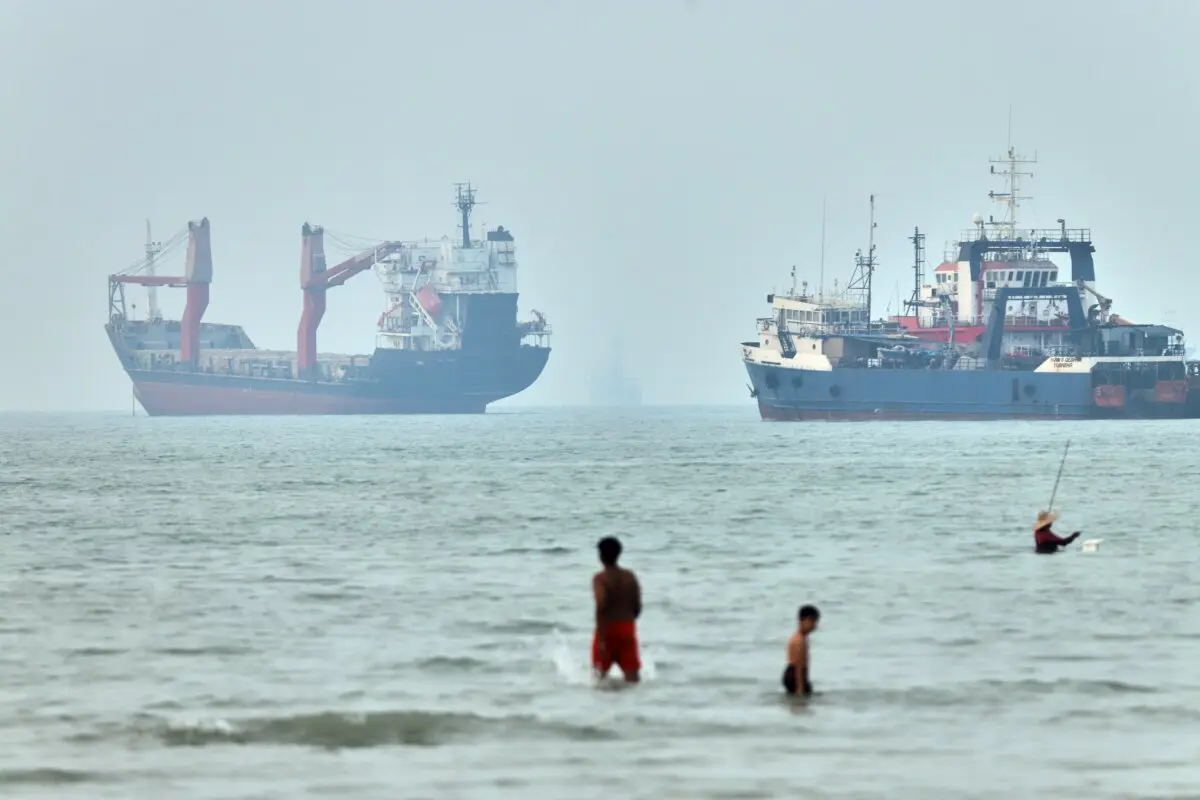
Children wade in the water with cargo ships at anchor in the background and a fisherman nearby, in the Strait of Hormuz off Bandar Abbas, Iran, on June 30, 2026. Amirhosein Khorgooi/ISNA via AP
“The immediate impact is obviously supportive of oil prices, but the more consequential issue is the risk of renewed physical supply losses,” Hoffmann told The Epoch Times in an emailed note.
“Vessel traffic through the Strait has fallen sharply again, and if producers cannot reliably move crude and products out of the Gulf, storage constraints could force additional production shut-ins, even at facilities that have not suffered direct damage.”
Data suggest that tanker and cargo vessel traffic has been sparse in recent days.
Total Gulf oil exports have been recovering, but remain below pre-conflict levels, according to the International Energy Agency (IEA).
June’s shipments totaled 16.1 million barrels per day—including volumes bypassing the global chokepoint—climbing by more than 6 million barrels per day.
Looking ahead, consumption volumes could play a sizable role, especially for China, Hoffmann notes.
“Saudi Arabia recently moved its primary Asian crude grade from an enormous premium to a discount, which should encourage Chinese refiners to increase purchases after imports fell sharply during the initial disruption,” he said.
China’s petroleum imports have been trending downward since October.
The IEA reported that “a recovery in world oil demand is underway,” with contractions easing from 4.8 million barrels in the second quarter to below 2 million barrels a day in the third quarter.
Fourth quarter consumption is expected to rise by 1.2 million barrels.
Jack Phillips contributed to this report.