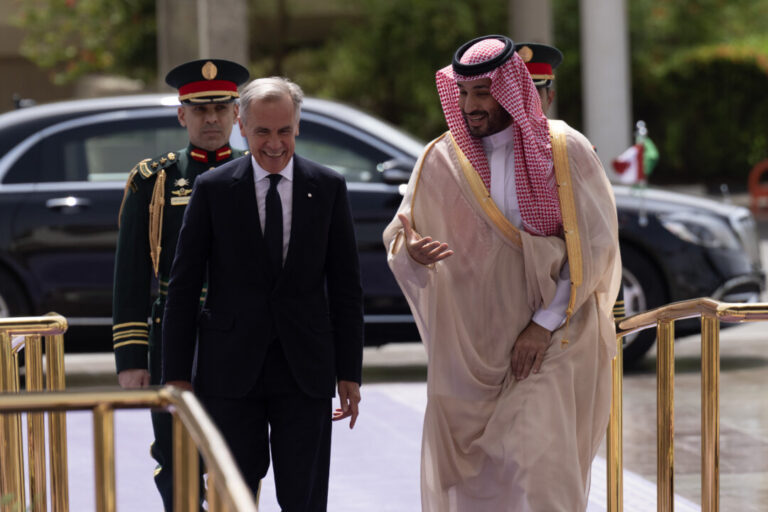

Prime Minister Mark Carney and Crown Prince of Saudi Arabia Mohammed bin Salman speak as they walk to a welcome ceremony at the Royal Palace in Jeddah, Saudi Arabia, on July 9, 2026. The Canadian Press/Adrian Wyld
Prime Minister Mark Carney signed a deal to deepen economic and defence ties with Saudi Arabia’s crown prince during his visit to the Middle Eastern country on July 9.
The Prime Minister’s Office (PMO) said Carney and Saudi Arabian Prime Minister and Crown Prince Mohammed bin Salman signed a memorandum of understanding (MOU) in Jeddah to establish the Canada-Saudi Arabia Coordination Council, aiming to strengthen cooperation on defence, trade and investment, cultural, and scientific priorities.
The two leaders noted that bilateral trade has reached more than US$20 billion since 2020, and they agreed to promote two-way investment, increase trade in products other than oil, and strengthen cooperation between financial institutions. They also agreed to launch negotiations for a Double Taxation Agreement, which would prevent the same income or asset from being taxed by both countries.
The PMO said the two leaders discussed harnessing “Canadian expertise” in the areas of health and medicine, renewable energy, and AI. As such, Canada and Saudi Arabia signed two MOUs on energy and AI.
Carney’s trip to Saudi Arabia, the first by a Canadian prime minister in 26 years, came after he visited Ankara, Turkey, from July 6 to 8 for the annual NATO Summit. Ottawa and Ankara also announced the launch of negotiations toward a free trade agreement.
During a July 9 press conference, Carney was asked about Ottawa’s previous tensions with Saudi Arabia in 2018 over women’s rights issues, and how it contrasted with Canada’s current engagement. Carney said that “lecturing countries from afar is an ineffective strategy.
“It’s satisfying, but it’s ineffective. Engagement can be effective,” Carney said. “It doesn’t mean it’s decisive, but it can be effective.”
Relations between Canada and Saudi Arabia suffered in 2018 after Global Affairs Canada’s Twitter account published a tweet expressing concern over the arrests of civil society and women’s rights activists in Saudi Arabia, while also demanding their “immediate release.”
Saudi Arabian Foreign Minister Adel al-Jubeir responded at the time that while Canada was within its rights to criticize the country’s record on human rights, demanding the women’s release was unacceptable and akin to treating Saudi Arabia like a “banana republic.” He also requested that Canada apologize.
That year, Canada also joined the United States, France, and Germany in imposing sanctions on 17 Saudis linked to the killing of journalist Jamal Khashoggi, which further froze Canada–Saudi relations.
The prime minister also said Canada needed to diversify its partnerships around the world, given that it had become “over reliant on a partner with whom we share many things,” in reference to the United States and its tariffs on Canada.