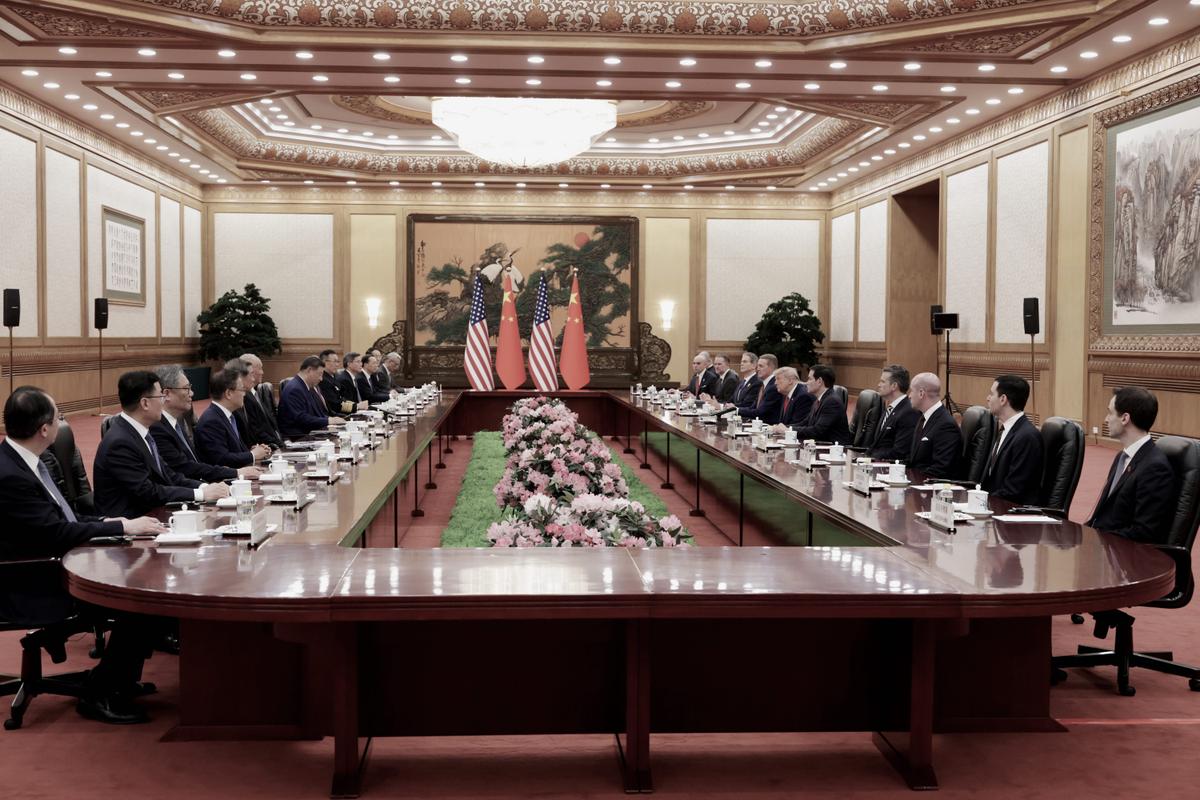
U.S. President Donald Trump and Chinese leader Xi Jinping attend a bilateral meeting in Beijing on May 14, 2026. Alex Wong/Getty Images
Commentary
The lack of major China deals emerging from the summit between U.S. President Donald Trump and Chinese leader Xi Jinping indicates that both sides believe that time is on their side.
The regime in Beijing is likely focused on China’s record $1.2 trillion trade surplus last year and its industrial supply chain strengths. The United States, conversely, is relatively strong technologically and militarily. America’s democratic and free market principles help it gain the trust of the world and a global military footprint that is the envy of the Chinese Communist Party (CCP) and freedom’s other adversaries.
However, the lack of a deal indicates future geopolitical instability between the world’s two military-economic superpowers. Investors dislike instability, and the U.S. stock market started a sell-off on the day Trump left Beijing amid concerns about a lack of agreement. Although the White House issued a fact sheet on May 17 listing agreements that included a Chinese purchase of 200 Boeing jets and agricultural goods, Beijing did not publicly agree to these items in detail.
Trump spearheaded tough-on-China policies, including innovative approaches to tariffs on China that put downward pressure on the country’s exports and were copied by U.S. allies. However, some post-summit U.S. statements on Taiwan, including against independence, could be seen as concessions. The regime took the opportunity of the summit to publicly and pointedly warn the United States over its support of Taiwan, making the U.S. statements that followed appear weak.
In the context of a discussion of Iran’s blockade of the Strait of Hormuz, the fact sheet includes a joint agreement to the notion that “no country or organization can be allowed to charge tolls.” But Beijing issued no similar statement, and the White House statement could impinge on potential U.S. revenue sources in the future, since the United States explicitly agreed to it and China did not. Beijing could use the tactic to collect revenue, for example, in the South China Sea.
The U.S. military’s stance against Iran’s blockade of the Strait of Hormuz benefits China more than the United States, as China imports more energy through the strait than America does, and America is footing the bill to keep it open. Meanwhile, China continues to sell dual-use technologies to Iran. The strait is a regime vulnerability and could be in America’s interest to control, including with America’s own tolls, as Trump has suggested. Giving up this potential leverage with no apparent return could be a strategic error.
The agreement to establish a Board of Trade and a Board of Investment with China, one of the few points confirmed by Beijing, could also play to China’s strengths. China’s global exports are second to none. The agreement to create the boards potentially normalizes China’s continued industrial and technological growth at a technocratic level rather than at the political level of the presidency, which is more visible to U.S. voters. This could decrease U.S. political leverage on the issue and hurt U.S. exports relative to U.S. imports from China. A similar U.S.–Japan board of trade in the 1980s caused inflation and did long-term damage to U.S. industrial competitiveness.